Fernweh: Home
    ExploreTravel GuidesPlan a tripMy tripLast visited
    de|en
    All Places & RegionsAll highlightsAbout FernwehFAQPrivacy PolicyImprint
    ExploreTravel GuidesPlan a tripMy tripLast visited
    • Neighborhoods & highlights
    • Walking tours
    • Eat & drink
    • Food culture
    • Culture
    • Getting around
    • Accommodation
    • Plan trip
    • Nearby
    Siena

    Italy

    Siena

    CityCulture

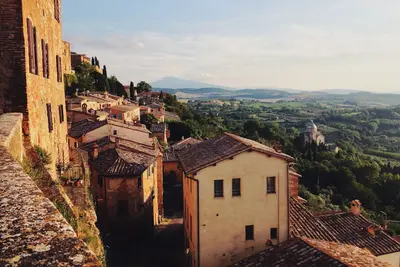
    Siena grew on three hills, its main streets converging in a depression where the Piazza del Campo now lies. A UNESCO World Heritage site since 1995, its Old Town largely retains its 12th to 15th-century Gothic character.

    by Felix Gillen

    1. Home
    2. Destinations
    3. Italy
    4. Tuscany
    5. Siena
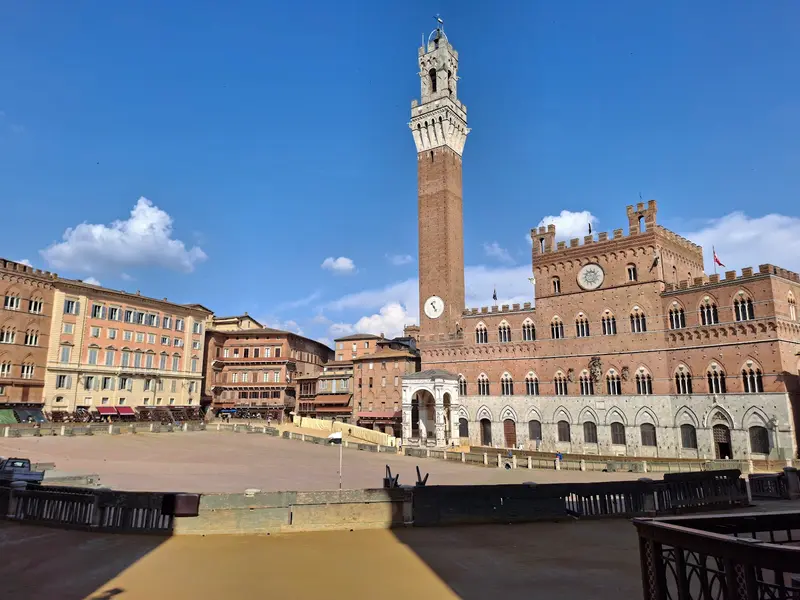
    Siena grew on three hills, its main streets converging in a depression where the Piazza del Campo now lies. A UNESCO World Heritage site since 1995, its Old Town largely retains its 12th to 15th-century Gothic character. On the Campo stand the Palazzo Pubblico and Torre del Mangia; the Cathedral, with its marble floor, is nearby. Twice yearly, on July 2nd and August 16th, the Palio takes place on the Campo.

    Sights in Siena

    Discover the most important sights and attractions

    Piazza del Campo
    Attraction

    1Piazza del Campo

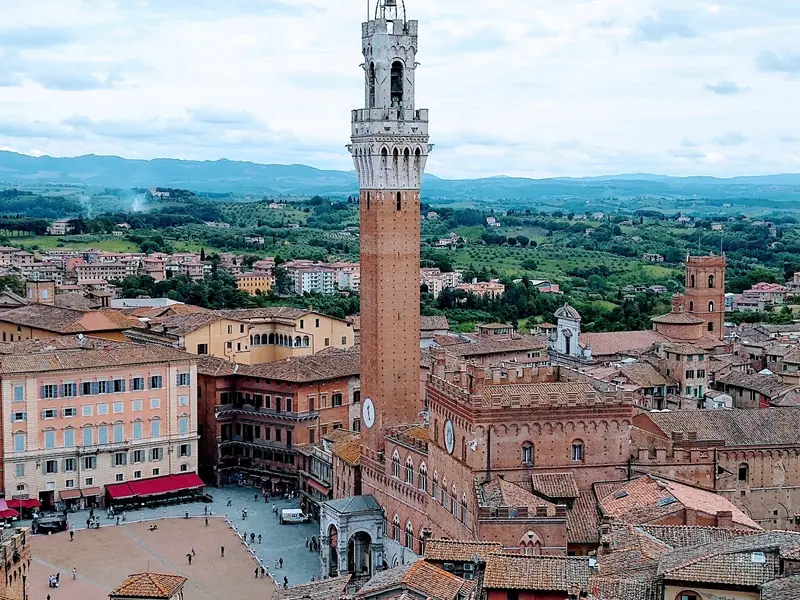
    The shell-shaped square is in front of the Palazzo Pubblico. Since its paving in 1349, eight lines divide it into nine segments, recalling the Government of the Nine, who ruled Siena from 1292 to 1355. At its upper edge stands the Fonte Gaia from 1419; the original reliefs by Jacopo della Quercia are now preserved in the Santa Maria della Scala. On July 2nd and August 16th, the Palio takes place on the edge of the square, a horse race between the Contrade, for which the track is covered with tuff, clay, and sand.
    Open in Google Maps
    Siena Duomo
    Church

    2Siena Duomo

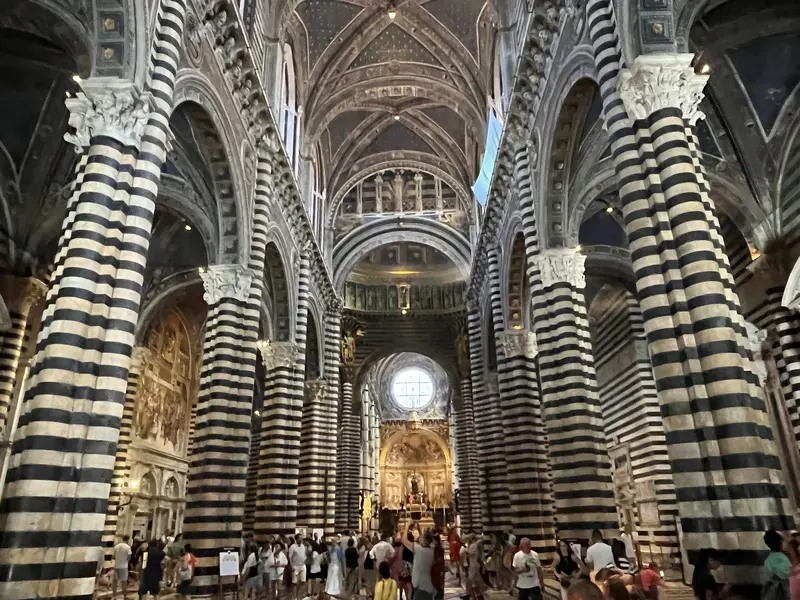
    The Cathedral dates from the 13th century and is clad in black and white marble stripes, the colours of the city's coat of arms. The marble floor with 56 pictorial panels is usually covered and only fully visible for a few weeks a year; in 2026 from June 27 to July 31 and from August 18 to November 15. The Opera della Metropolitana publishes these dates annually. In the Piccolomini Library, Pinturicchio painted frescoes between 1502 and 1507 depicting the life of Pope Pius II. The marble pulpit was created by Nicola Pisano and his workshop between 1265 and 1268.
    Open in Google Maps
    Musei dell’Accademia dei Fisiocritici
    Museum

    3Musei dell’Accademia dei Fisiocritici

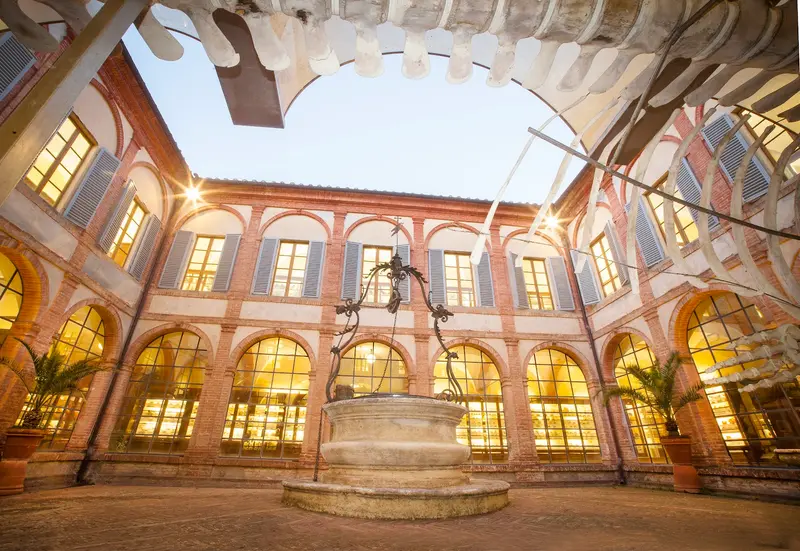
    The Academy of Fisiocritici was founded in 1691. Its natural history museum is in the former Santa Mustiola Monastery, on Piazzetta Silvio Gigli at the start of Via Mattioli. It displays geological, mineralogical, paleontological, and zoological collections. The museum offers a quiet contrast to the city's art museums.
    Open in Google Maps
    Palazzo Pubblico and Torre del Mangia
    Museum

    4Palazzo Pubblico and Torre del Mangia

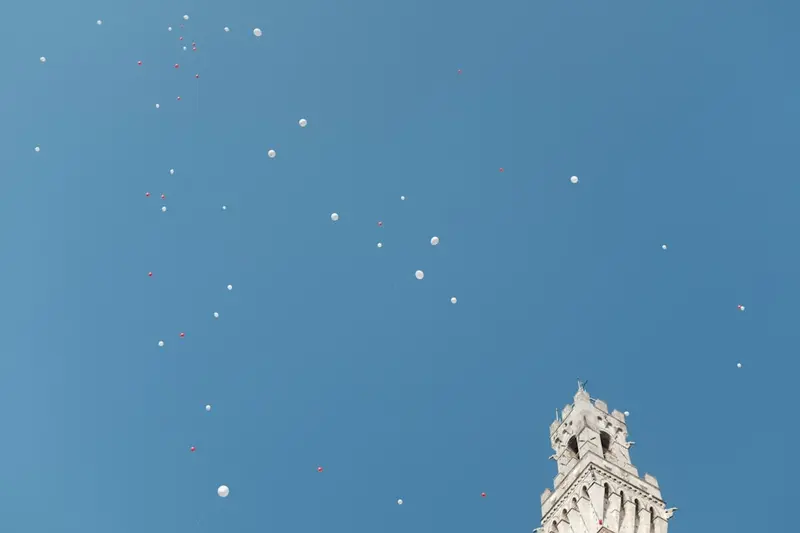
    The Gothic Town Hall on the Campo, built from 1297 as the Republic's seat, now houses the Museo Civico. Ambrogio Lorenzetti painted the Good and Bad Government frescoes in the Sala dei Nove (1338-1339); the Sala del Mappamondo features Simone Martini's Maestà (1312-1315). The Torre del Mangia, built 1325-1344, stands 88 meters to its battlements, with over 400 steps.
    Open in Google Maps
    Museo dell'Opera and Facciatone
    Museum

    5Museo dell'Opera and Facciatone

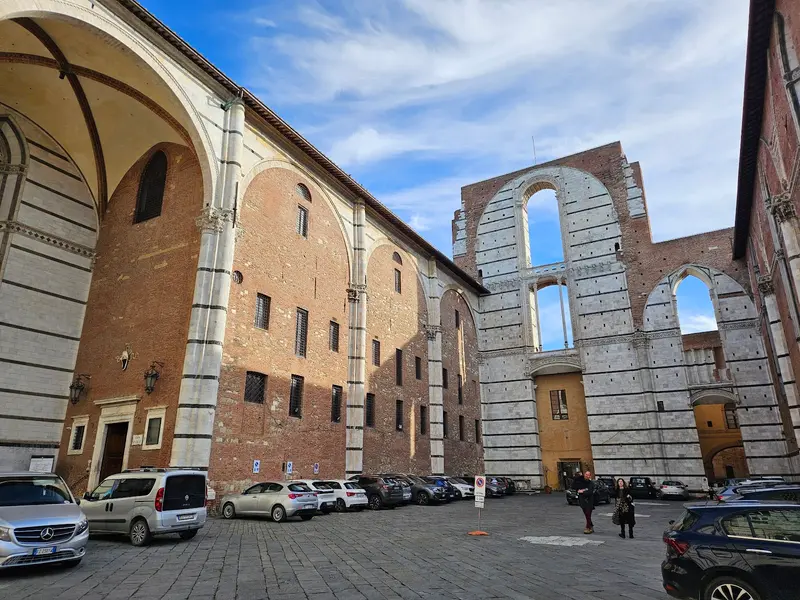
    From 1339, Siena intended to make the existing cathedral part of a much larger church. The plague of 1348 halted construction of the New Cathedral; it was abandoned in 1355. Today, its surviving walls house the Cathedral Museum. There stands Duccio's Maestà, which was brought into the Cathedral in a procession on June 9, 1311. One of the unfinished walls, the Facciatone, can be climbed, offering views over the city.
    Open in Google Maps
    Basilica of San Domenico
    Church

    6Basilica of San Domenico

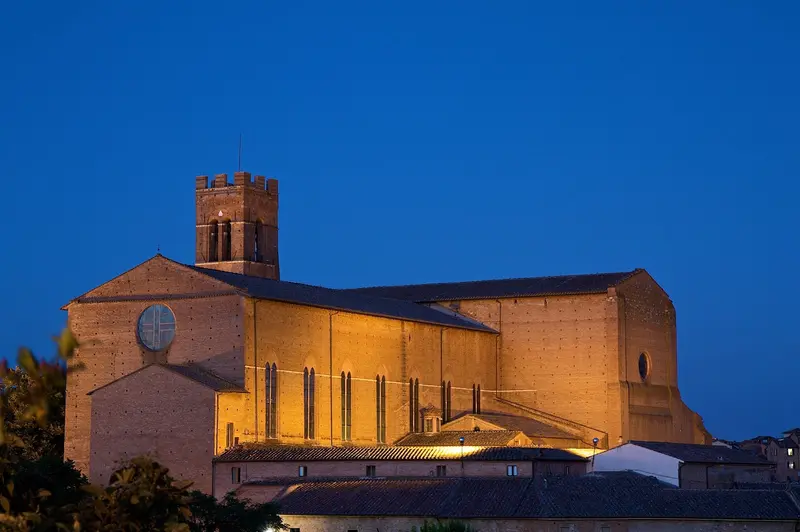
    The large brick Dominican church stands on Camporegio hill, west of the center. In the Chapel of Saint Catherine, her head and thumb are preserved as relics, with frescoes by Sodoma depicting her life on the walls. Catherine of Siena lived nearby and attended Mass here.
    Open in Google Maps

    City walks in Siena

    Curated walking tours through the city's highlights, handpicked by experienced travel journalists.

    Siena's Timeless Beauty: A 2-Hour Walk

    Immerse yourself in Siena's rich history on a two-hour walk through the iconic squares and narrow lanes. From the majestic Piazza del Campo to the magnificent cathedral, experience the authentic heart of this UNESCO World Heritage city. Discover hidden details, breathtaking architecture and the lively atmosphere of the contrade.

    ~2 Std.
    Open in Google Maps
    Stops (6)

    Food and Drinks

    Certosa di Maggiano

    Stilvolle Zimmer und Suiten in einem Kloster aus dem 14. Jahrhundert mit schickem Restaurant und Außenpool.
    Show on Google Maps
    1

    La Taverna di San Giuseppe

    Restaurant in the southern Old Town, in a 12th-century house; Etruscan tomb remains visible in the cellar. Tuscan cuisine offers Pici, wild boar, and autumn truffles. Often booked evenings; reserve ahead.
    Show on Google Maps
    2

    Grotta Santa Caterina da Bagoga

    Traditional restaurant on Via della Galluzza below San Domenico, near the birthplace of Saint Catherine. Serving Sienese dishes such as Pici, Bistecca, and cured meats from Cinta Senese, a Tuscan pig breed. The rooms are rustic with vaulted ceilings.
    Show on Google Maps
    3

    Osteria Nonna Gina

    Small, family-run osteria on Pian dei Mantellini in the southwest of the old town, slightly off the beaten path. The menu features simple Sienese dishes like Pici, Ribollita, and stews at moderate prices.
    Show on Google Maps
    4

    Osteria Le Logge

    The restaurant, a few steps from the Campo, is housed in a former 19th-century pharmacy, with the old wooden shelves preserved. The cuisine combines Sienese dishes with its own ideas, and some wine comes from their own estate in Montalcino. The price level is upscale, reserve in advance.
    Show on Google Maps

    Eating and Drinking

    The Sienese cuisine is simple and hearty, with pasta, game, and pork from the region.

    Pici

    Thick, hand-rolled pasta from Siena, often with breadcrumbs (briciole), ragout or garlic-tomato sauce (all'aglione).

    Cinta Senese

    Pig breed from Siena province, with black coat and white belt. Its meat yields ham, salami, Lardo, and Capocollo.

    Panforte

    Firm cake of nuts, honey, fruits, and spices, known in Siena since the Middle Ages.

    Ricciarelli

    Diamond-shaped almond pastry with a cracked surface and icing sugar, traditional at Christmas, often with Vin Santo.

    Culture and History

    City-Republic and GothicIn the 13th and early 14th centuries, Siena was a wealthy trading and banking city. The Monte dei Paschi di Siena, active since 1472, is considered the world's oldest continuously operating bank. The Plague of 1348 killed about half the population and halted construction of the New Duomo. In 1555, Siena capitulated to Spain; an exile republic held out in Montalcino until 1559.Sienese PaintingDuccio, Simone Martini, and the brothers Pietro and Ambrogio Lorenzetti shaped a distinct school of painting. You can see their works primarily in the Palazzo Pubblico and the Duomo Museum.Contrade and PalioAt the Palio on July 2nd and August 16th, ten of the 17 Contrade compete against each other: seven are set, three are drawn by lot. The racetrack on the edge of the Campo is covered with a mix of tuff, clay, and sand for the event. Six trial races take place beforehand; the city is very crowded on these days.ExcursionsFrom Siena, you can reach Chianti, the Val d'Orcia with Pienza and Montalcino, San Gimignano, and the Abbey San Galgano.

    Discovering Siena

    On FootExplore the old town on foot; due to the inclines, plan to wear comfortable shoes. The train station is below the city: From the shopping center opposite, escalators lead up towards the old town, or city buses run to Piazza Gramsci.Bus and TrainFrom Florence, express buses take about 75 minutes to reach Piazza Gramsci on the edge of the old town. The train takes about 90 minutes. Regional and city transport is operated by Autolinee Toscane.CarThe city center is a Limited Traffic Zone (ZTL). Park outside, for example at the Santa Caterina car park, from which escalators lead into the city, or at the train station.

    Accommodations in Siena

    Find perfect stay in Siena

    Booking.com* (Affiliate link)
    Search Hotels
    Agoda* (Affiliate link)
    Search Hotels
    Airbnb
    Vacation Rentals

    * Affiliate link: if you book through it, we earn a small commission. The price stays the same for you.

    Campgrounds in Siena

    Find perfect campground in Siena

    Search via Google Maps
    Campgrounds nearby (15km)
    Camping.info
    Find Campgrounds
    Park4Night
    RV Parks & Camping

    Plan your trip to Siena

    Save places, build a route and plan your city trip, all in one place.

    1. 1
      Sunrise over alpine peaks and a sea of clouds
      1234

      Round trip

      12 days · 4 stops

      Saved

      Pick a route

      Pick a ready-made one or save places and plan your own.

      Open bookmarks
    2. 2

      Trip to Siena

      Live
      • 1Piazza del Campo3 days
      • 2Siena Duomo4 days
      • 3Musei dell’Accademia dei Fisiocritici5 days
      Budget

      Plan your trip

      The planner sorts stops, days and budget. Plan together in real time.

      Start trip planning
    3. 3
      9:41 No signal
      Siena
      Available offline

      Use it on the road

      Download the guide to your phone and use it on site, even offline.

    Nearby

    Tuscany

    Tuscany

    Tuscany is located in central Italy between the Apennine Mountains and the coast of the Ligurian and Tyrrhenian Seas. The region has almost 3.7 million inhabitants, and its capital is Florence. It is home to eight UNESCO World Heritage Sites: the historic centres of Florence, Siena, San Gimignano and Pienza, the Piazza del Duomo in Pisa, the Val d'Orcia, the Medici Villas and Gardens, and Montecatini Terme as part of the Great Spa Towns of Europe.Besides the art cities, wine regions like Chianti Classico, Montalcino, and Montepulciano shape the area, and in the south, the Maremma with its coast, thermal springs, and tufa towns. For the rural areas, you usually need a car.
    San Gimignano

    San Gimignano

    San Gimignano is situated on a hill in the Valdelsa, Siena province. Of the 72 family towers that once stood, 14 still stand today, shaping its skyline. It has been a UNESCO World Heritage site since 1990. Its heart is formed by Piazza della Cisterna with its fountain, and Piazza del Duomo with the Collegiata and town hall. During the day, the town is very crowded; it's quieter early morning and evening.
    Chianti Classico

    Chianti Classico

    Chianti Classico is the wine region between Florence and Siena, approximately 70,000 hectares of hilly terrain, of which only about a tenth is planted with vines. It fully encompasses the municipalities of Greve, Castellina, Radda and Gaiole in Chianti, and partially also Barberino Tavarnelle, San Casciano Val di Pesa, Castelnuovo Berardenga and Poggibonsi. The distinguishing mark of the wine is the black rooster, the Gallo Nero. Many wineries offer tastings and guided tours, usually by prior appointment.
    Val d'Orcia

    Val d'Orcia

    The Val d'Orcia is a hilly landscape south of Siena, stretching around Montalcino, San Quirico, and Pienza, all the way to Monte Amiata. Since 2004, it has been a UNESCO World Heritage cultural landscape. It acquired its current appearance in the 14th and 15th centuries, when wealthy merchants from Siena invested in agriculture. The World Heritage site includes Montalcino, San Quirico d'Orcia, Castiglione d'Orcia, Rocca d'Orcia, Monticchiello, and Radicofani; Pienza is a separate World Heritage site.
    Montepulciano

    Montepulciano

    Montepulciano sits in the south of Siena province on a roughly 605-meter limestone ridge. Its medieval and Renaissance old town culminates in Piazza Grande, home to the Town Hall and Cathedral. The city is famed for its Vino Nobile di Montepulciano red wine, with many cellars nestled directly beneath the old town's palaces.

    Sources & method

    • Photos: Unsplash, Google Maps. Each photo carries its credit.
    • Place data such as addresses and ratings comes from Google Maps.
    • The content is based on web research from public, traceable sources. How the content is made · The role of AI