Fernweh: Home
    ExploreTravel GuidesPlan a tripMy tripLast visited
    de|en
    All Places & RegionsAll highlightsAbout FernwehFAQPrivacy PolicyImprint
    ExploreTravel GuidesPlan a tripMy tripLast visited
    Lummelundagrottan

    Sweden

    Lummelundagrottan

    Point of InterestCulture

    The Lummelundagrottan is located approximately 11 to 13 km north of Visby on Road 149. With nearly 4.5 km of explored passages, it is one of Sweden's longest caves.

    by Felix Gillen

    1. Home
    2. Destinations
    3. Sweden
    4. Gotland
    5. Lummelundagrottan
    The Lummelundagrottan is located approximately 11 to 13 km north of Visby on Road 149. With nearly 4.5 km of explored passages, it is one of Sweden's longest caves. Linné knew the front part as early as 1741; the inner passages were explored by youths from 1948. In summer, tours lead through the outer part with numerous dripstone formations. Tickets are available online and at the ticket office in the entrance building; online booking is recommended during peak season.

    Sehenswürdigkeiten

    Discover the most important sights and attractions

    Naturschutzgebiet Brucebo

    Park in Väskinde.
    Open in Google Maps

    Jungfrun

    Park in 624 42 Lickershamn.
    Open in Google Maps

    Lummelunds bruk

    Attraction in LUMMELUNDA LUMMELUNDSBRUK 528.
    Open in Google Maps

    Kirche von Lummelunda

    Church in 665.
    Open in Google Maps

    Brucebo

    Museum in Själsö Själsövägen 5.
    Open in Google Maps

    Essen & Trinken

    Hop Shed Brew Pub

    Restaurant in Broväg 119.
    Show on Google Maps

    Familjen Jessens Saluhall & bar

    Bar in Hästgatan 19.
    Show on Google Maps

    Crêperie & Logi

    Restaurant in Wallers Plats 3.
    Show on Google Maps

    History and Geology

    Karst in LimestoneGotland consists predominantly of marine sediments, primarily limestone, in which karst caves can form. This is unusual for Sweden, as most of the country lies on crystalline bedrock. The cave maintains a temperature of about 8 degrees year-round.ExplorationIn 1924, zoologist Torsten Gislén explored the first approximately 40 meters.From 1948 to 1950, teenagers Örjan Håkansson, Percy Nilsson, and Lars Olsson ventured deep into the cave system; another expedition followed in 1955.In 1959, an access tunnel was built, and the cave was opened to visitors.Above the CaveStarting from the entrance building, a geological nature trail leads over the cave system. A forest path follows the water's course from the cave exit to the sea.

    Arrival and Visit

    Getting Here from VisbyA bike path, about 13 kilometers long, runs from Visby to Lummelunda. The ride takes approximately 45 minutes by regular bike and 25 minutes by e-bike. Bike parking is available at the entrance.The Lummelunda bus stop is approximately 400 meters from the cave entrance. Please check the timetable in advance.Guided ToursVisits are only possible with a guided tour. The regular tour lasts about 30 minutes, the Dark Tour around 40 minutes, and the Children's Tour approximately 25 minutes. A short film is shown in the entrance building beforehand.Guided tours are in Swedish and English; audio guides in German.It's best to book tickets online in advance. Bring warm clothing; strollers and pets are not permitted.The cave is closed in January, as it becomes flooded during winter and spring.

    Accommodations in Lummelundagrottan

    Find perfect stay in Lummelundagrottan

    Booking.com* (Affiliate link)
    Search Hotels
    Agoda* (Affiliate link)
    Search Hotels
    Airbnb
    Vacation Rentals

    * Affiliate link: if you book through it, we earn a small commission. The price stays the same for you.

    Campgrounds in Lummelundagrottan

    Find perfect campground in Lummelundagrottan
    Search via Google Maps
    Campgrounds nearby (15km)
    Camping.info
    Find Campgrounds
    Park4Night
    RV Parks & Camping

    Nearby

    Visby

    Visby

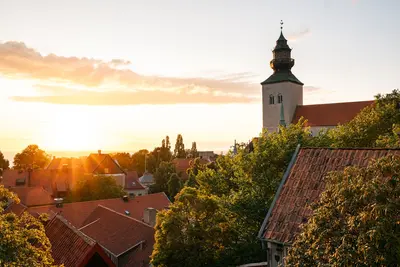
    Visby, Gotland's capital, became a UNESCO World Heritage site in 1995 as a Hanseatic city. Around 3.4 km of its 13th and 14th-century ring wall are preserved, along with 27 large wall towers. Numerous church ruins, like St. Karin and St. Nicolai, stand in the old town's alleys, earning the city the nickname, City of Roses and Ruins. The Botanical Garden (DBW:s botaniska trädgård) offers a green pause among the historic buildings. Roses bloom in summer; off-season, it is considerably quieter.
    Gotland

    Gotland

    Gotland, at around 2,994 km², is Sweden's largest island and lies in the middle of the Baltic Sea. Its capital, Visby, a Hanseatic city and UNESCO World Heritage site since 1995, boasts a ring wall preserved for around 3.4 km. Out on the island, 94 medieval country churches, limestone pillars (Raukar), and long coastal sections shape the scene.
    Fårö

    Fårö

    Fårö lies north of Gotland, separated by the narrow Fårösund, which a free car ferry crosses in about six minutes. The barren island with around 500 inhabitants is known for its raukar, especially at Langhammars and Digerhuvud, and for director Ingmar Bergman, who lived, filmed, and is buried here.
    Nåttarö

    Nåttarö

    Nåttarö, located in the southern Stockholm archipelago, is about 30 boat minutes from Nynäshamn and is protected as a nature reserve. The island is almost entirely covered by pine forest, and on the east side, Stora Sand offers one of the archipelago's longest sandy beaches with large dunes. Additionally, there are bathing rocks, car-free gravel paths, and trails for walks.
    Nynäshamn

    Nynäshamn

    Nynäshamn lies about 60 kilometres south of Stockholm and is one of the mainland ports for ferries to Gotland. Additionally, ships sail from here to Gdańsk in Poland. It also serves as a starting point for the southern archipelago. In summer, the harbour is full of boats, with restaurants and small shops lining the promenade. The surrounding area offers coastal paths and nature reserves inviting visitors for walks. Nynäshamn is an easy day trip from Stockholm by commuter train.

    Sources & method

    • Photos: Unsplash. Each photo carries its credit.
    • The content is based on web research from public, traceable sources. How the content is made · The role of AI