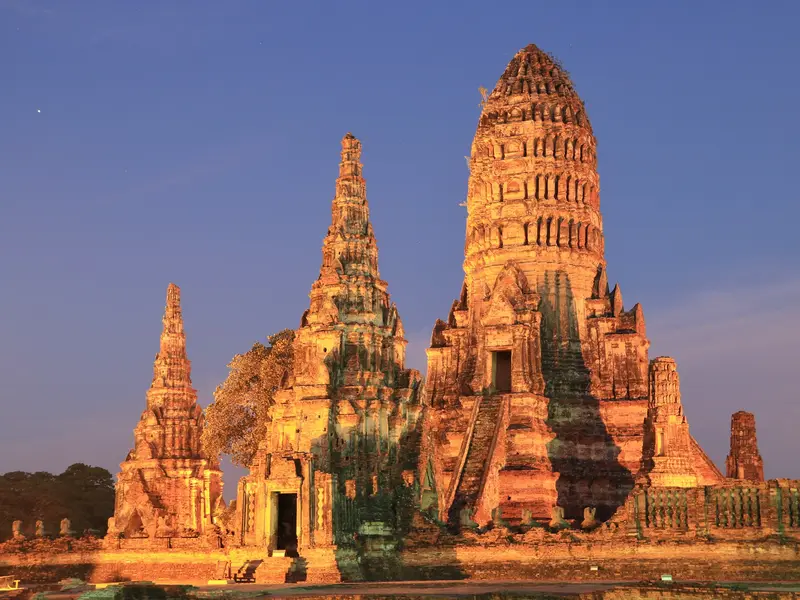
The Ayutthaya Historical Park preserves the remains of the capital of the Kingdom of Siam, founded in 1350 and destroyed in 1767 in a war with Burma. For over four centuries, the city was a trading hub of international standing, home to Portuguese, Dutch, Japanese, and Persian communities. UNESCO lists the site as a World Heritage Site.The core zone lies on an island between the Chao Phraya, Lopburi, and Pa Sak rivers. Among the central structures are Wat Phra Si Sanphet with three adjoining chedis, the royal coronation temple, and Wat Mahathat, where a Buddha head is encased in the roots of a fig tree. On the western riverbank stands Wat Chaiwatthanaram with a central Khmer-style prang, while the nearby Wihan Phra Mongkhon Bophit houses one of the country's great bronze Buddha figures.The sites are widely dispersed; many visitors use bicycles, scooters, or a tuk-tuk for a tour. Mornings and late afternoons are cooler, and the light is more favourable for photos. The same dress code applies in these temple complexes as in active temples: shoulders and knees must be covered. From Bangkok, Ayutthaya is accessible by train, minibus, or boat tour.
Sehenswürdigkeiten
Discover the most important sights and attractions
1Wat Mahathat Ayutthaya
Royal Reliquary Temple in the center of the island, built around 1374 under King Borommaracha I. The original Prang collapsed in 1631, and the approximately 50-meter-high new structure again in 1911; what remains are pedestals, rows of Chedis, and the foundations of the halls. A stone Buddha head is embedded in the roots of a tree at the edge of the site, Ayutthaya's most famous motif. It is an object of veneration: For photos, you crouch in front of it instead of standing above it.
The Wat Phanan Choeng, located east of Ayutthaya's historic island on the Chao Phraya River, is a temple of great historical and cultural significance. It was founded in 1324, 26 years before Ayutthaya's own establishment, making it one of the region's oldest and most important sacred buildings. At the center of the Viharn, you'll find the impressive 19-meter-high seated Buddha statue Luang Pho Tho, also known as Phra Phuttha Trai Rattana Nayok. This golden statue is highly revered by both Thai and Chinese devotees, considered a bringer of luck and prosperity. You'll find the temple often lively, especially on weekends and holidays, with many pilgrims offering prayers and tributes. Our Tip: To experience the spiritual atmosphere peacefully and avoid crowds, an early morning visit is recommended. Observe the details of offerings and devotees' devotion for an authentic cultural experience.
The temple was located on the grounds of the old Royal Palace and was reserved for the royal family. The three bell-shaped Chedis in a row were built in 1492 and 1529 for Kings Borommatrailokkanat, Borommaracha III., and Ramathibodi II., and are the complex's most famous image. In 1767, Burmese troops destroyed the temple and melted down its gold; only the Chedis survived and were restored in 1956. The grounds offer little shade.
Next to Wat Phra Si Sanphet stands the hall featuring Phra Mongkhon Bophit, one of Thailand's most significant bronze figures, approximately 12.5 meters high. It was cast in 1538; during the city's fall in 1767, the hall's roof burned, and the figure's head and right arm broke off. The current hall was completed in 1957, supported by a donation from the Burmese Prime Minister. Inside, it is an active place of worship: remove shoes, cover shoulders and knees.
The Wat Khruttharam in Ayutthaya Historical Park is a lesser-known but historically significant temple complex, often associated with the early Ayutthaya period. Its name, referring to Garuda, Vishnu's royal mount, suggests a strong connection to the monarchy, possibly even to King Uthong, the founder of the kingdom. Here you will find the remains of a large principal chedi, once surrounded by smaller stupas and viharns. The ruins reflect the architectural style of the early Ayutthaya era and offer insight into the religious practices of that period. Unlike the park's busier temples, you'll experience a quieter atmosphere here, ideal for a contemplative exploration. Our Tip: It's best to visit Wat Khruttharam in the early morning or late afternoon. The light for photos is then particularly soft, and you can enjoy the tranquility of this place undisturbed, away from the tourist crowds. It is an excellent place to experience the vastness and history of Ayutthaya off the beaten path.
King Prasat Thong had the complex built in 1630 as the first temple of his reign on the west bank of the Chao Phraya, southwest of the island. Surrounding the approximately 35-meter-high central Prang are four smaller Prangs, plus eight chapel-like Chedis, all connected by a rectangular gallery. In this gallery once sat around 120 Buddha figures; mainly column foundations and the outer wall remain. In the late afternoon, the sun is favorable for the view over the river.
Isaan cuisine in Ayutthaya: Papaya salad, laab, and grilled chicken with sticky rice, as advertised. Simple tables, quick service; spice level can be adjusted when ordering. Busiest at lunch and early evening.
Cafe at the edge of the park with coffee, cold drinks, and light snacks, with air conditioning. Useful as a break on the bike route when the heat on the open ruin sites gets too much.
The city's cuisine is central Thai, with its own signature dish: river prawns from the Chao Phraya, served grilled. Noodle soups, Isaan grilled dishes, and the markets are also present. The park itself has stalls at its larger sites; the most concentrated selection is at the night market and in the island's northeast guesthouse zone.
Kung Mae Nam
Large river prawns, halved lengthwise and grilled over charcoal, served with a spicy dipping sauce. The city's most famous specialty, usually priced by weight and therefore more expensive than the rest of the menu.
Kuay Teow Ruea
The dark, robust noodle soup, originally sold from boats. Portions are small; you eat several bowls. Available at dedicated eateries in Ayutthaya and neighboring provinces.
Roti Sai Mai
Ayutthaya's Sweet: Filaments of spun sugar that are wrapped into a thin pancake. It is sold at street stalls and in front of the hospital, and is the usual souvenir from the city.
Night Market and Fresh Market
In the evening, a market with food stalls sets up in the northeast of the island; during the day, the fresh market operates in the same area. Very affordable food, plus fruit and drinks for your bike tour.
Isaan Cuisine
Papaya salad, Laab, and grilled chicken are also widespread here, as many new residents hail from the Northeast. Simple eateries, often with only a Thai menu.
Ayutthaya: Capital 1350 to 1767
Four Centuries as a CenterFounded in 1350, Ayutthaya served for over four centuries as the capital of one of Southeast Asia’s greatest empires. The city, situated on an island at the confluence of the Chao Phraya, Lopburi, and Pa Sak rivers, was crisscrossed by canals. Portuguese, Dutch, Japanese, Chinese, and Persian communities had their own quarters beyond the rivers.1767In April 1767, Burmese troops captured and destroyed the city after a long siege. Temples were plundered, gold melted down, and archives lost. The new capital emerged further south, first in Thonburi, then in Bangkok. Many headless Buddha figures in the park are a result of this looting.What to See in the ParkThe ruins have been a UNESCO World Heritage site since 1991. They are characterized by two architectural forms: the Prang, a corn-cob shaped tower of Khmer origin, and the bell-shaped Chedi in Sinhalese tradition. What remains are mainly bricks and laterite; the wood and stucco of the halls have disappeared.EtiquetteDo not climb or sit on ruins, Chedis, or Buddha figures.When photographing, do not pose above a Buddha figure. In front of the Buddha head within the tree roots at Wat Mahathat, you should crouch down.In active temples like Wat Phanan Choeng and Wat Yai Chai Mongkhon, cover your shoulders and knees, and remove your shoes.
Exploring locally
Getting ThereThe park is not an enclosed area but is spread across the island among residential streets, schools, and markets. Entry is charged per site, with a combi-ticket for the main ones.Train: From Bangkok Krung Thep Aphiwat, express trains take about 50 to 65 minutes; slower trains from Hua Lamphong take 80 to 90 minutes. From the station east of the island, walk to the pier opposite and cross the Pa Sak in two minutes by longtail boat.In the ParkBicycle: the most practical way to see the park. The island is flat, and paths between core sites are short. Ride in the morning; it gets hot in open areas from noon onwards.Scooter: useful for sites outside the island, such as Wat Chaiwatthanaram or Wat Yai Chai Mongkhon.Tuk-Tuk: can be rented hourly; agree on price and route beforehand.Boat: River cruises stop at temples along the banks, such as Wat Phanan Choeng and Wat Chaiwatthanaram.Half a day is sufficient for the core sites, a full day with the temples beyond the rivers. It's doable as a day trip from Bangkok, but more relaxed with an overnight stay.