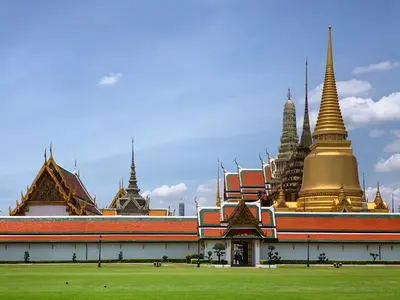
Rattanakosin is the historical heart of Bangkok: an artificial island encircled by the Chao Phraya River and a ring of canals. King Rama I founded it in 1782 as the new capital after Ayutthaya's destruction, arranging the palace, temples, and administrative buildings at its center.Here stands the **Grand Palace** with the Temple of the Emerald Buddha (Wat Phra Kaeo) and, a few minutes south, **Wat Pho** with the Reclining Buddha and a Thai massage school. Across the river, **Wat Arun** rises, which ferries from Tha Tien Pier access. Also here are the National Museum at Sanam Luang, Museum Siam, and Wat Suthat with the Giant Swing.A dress code applies to the palace and temples, strictly enforced at the palace: shoulders covered, long trousers or long skirts, no sleeveless tops. The Sanam Chai MRT station is right by Wat Pho; otherwise, you can easily get around by express boat. To the north, the district around Khao San Road connects. Locally offered 'special tours,' claiming the palace is supposedly closed, are a well-known scam.
Sights in Rattanakosin (Old City)
Discover the most important sights and attractions
1Sanam Luang
The Royal Ceremonial Ground north of the Palace, a large lawn in the planned city's layout. Here, state ceremonies, Royal Family cremation ceremonies, and the annual Ploughing Ceremony are held. Closed during ceremonies. No shade; can be uncomfortable around midday.
Directly south of the Palace, with its 46-meter long reclining Buddha figure, whose soles are adorned with mother-of-pearl inlays in 108 panels. The temple is regarded as the country's first public educational institution: murals and stone tablets preserve knowledge of religion, medicine, and literature. The school for traditional medicine and Thai massage still operates here today. The MRT-Station Sanam Chai is just a few minutes away.
The palace complex, built from 1782, with the Temple of the Emerald Buddha, Thailand's most important sanctuary. Wat Phra Kaeo has no monastic community and serves royal ceremonies; the jade figure's robes are changed three times a year. The dress code is strictly checked at the entrance: covered shoulders, long trousers or long skirts. Access only via the official entrance on Na Phra Lan Road. If anyone tells you on the way that the palace is closed, they want to sell you a tuk-tuk tour.
On the northwest edge of Sanam Luang, on the grounds of the former Wang Na, the Palace of the Vice-King. The collection traces the country's art history from Dvaravati and Srivijaya through Sukhothai and Ayutthaya up to the Rattanakosin period; royal funeral carriages are displayed in a separate hall. Spacious and noticeably emptier than the Palace and Wat Pho.
South of Wat Pho, in the former Ministry of Commerce building, a few minutes from Sanam Chai MRT Station. The museum explores what makes Thailand unique, using interactive rooms and media stations instead of display cases. Air-conditioned and a good complement when palaces and temples become overwhelming.
About fifteen minutes east of the Palace stands a royal temple, begun by Rama I and completed under Rama III., featuring a tall Vihara, murals, and cloisters full of Buddha figures. In front of it is the red-lacquered Giant Swing, Sao Ching Cha, a remnant of a Brahmin ceremony that was discontinued in 1935 after fatal accidents. In the adjacent streets, shops sell temple supplies.
Das Viertel isst altstadttypisch: kleine, alte Lokale in Shophouses, Garküchen an den Kanälen, Marktstraßen für Beamte, Mönche und Studenten. Rund um den Platz Phraeng Phuthon und in den Gassen der Tha Tien liegen Betriebe, die seit Generationen in Familienhand sind. Am Abend wird es im Palastumfeld schnell leer; die Universitätsgegend um Thammasat und die Khao San Road bleiben länger auf.
Old Shophouse Kitchens
In the alleys around Phraeng Phuthon, Phraeng Nara, and Tha Tien, family-run eateries often serve only a few dishes. Menus are short, sometimes only in Thai, and some establishments close when the pots are empty.
Food stalls along Maha Rat and Tha Chang
Between palace wall and river, stalls sell fried rice, noodle soups, curries over rice, and fruit. Fast and cheap, limited seating. Good for a break between Palace and Wat Pho.
Market Tha Wang Lang
Across on the Thonburi side, a few minutes by ferry: a bustling market lane with street food, sweets, and fruit near Siriraj Hospital. Noticeably fewer travelers than on the Palace side.
Khanom Thai
Traditional sweets: rice flour, coconut milk, palm sugar, egg yolk; sold in portions at stalls & small shops.
Cafes in old houses
Between Tha Tien and Museum Siam, cafes have opened in shophouses, some with rooftop terraces and views of Wat Arun. Air-conditioned and a good break from the midday heat.
The State's Constructed Heart
Rattanakosin is not an Old Town in the European sense, but a planned complex. After Ayutthaya was destroyed in 1767, Rama I moved the capital from the west bank to the east bank of the Chao Phraya in 1782 and had a canal dug, turning the new city center into an artificial island. The layout deliberately mirrors Ayutthaya: a palace by the river, temples next to it, and an open ceremonial field in front.What You'll Find HereThe Grand Palace and Wat Phra Kaeo with the Emerald Buddha form the core. The Emerald Buddha is a small jade figure, ceremonially re-dressed three times a year, and considered the protective palladium of the state. Immediately to the south lies Wat Pho with the Reclining Buddha and the Thai massage school. To the east are Wat Suthat with the Giant Swing, the National Museum, and the ministerial districts.Dress CodeAt the Grand Palace and Wat Phra Kaeo, the dress code is strictly enforced. Covered shoulders and long trousers or skirts are required. Sleeveless tops, shorts, tight or transparent clothing will be turned away. You can rent or buy suitable clothing nearby, but it is safer to arrive appropriately dressed.What You Should KnowThe palace is only accessible via the official entrance on Na Phra Lan Road. If someone tells you on the way that it's closed today and offers you a tuk-tuk tour instead, they are trying to sell you something.Criticism of the monarchy is punishable by law in Thailand, and penalties are severe. For current advisories, refer to the German Federal Foreign Office.During ceremonies at Sanam Luang, the field will be closed. Please stay along the perimeter.Buddha figures are not decorations. Do not step on pedestals, do not pose with your back to a figure, and do not stretch your feet towards a figure.
Local explorations
Rattanakosin is a district best explored on foot and has no Skytrain (BTS) station. The walking times between the Palace, Wat Pho, Sanam Luang, and the National Museum are each under twenty minutes, but with little shade.MRT: The Sanam Chai station (Blue Line) is located at the southern edge, just a few minutes from Wat Pho. It offers the best connection. The neighbouring station, Itsaraphap, is across the river on the Thonburi side.BTS: If you're coming by Skytrain, take it to Saphan Taksin and change there at Sathorn Pier to the express boat.Express Boat: The Chao Phraya boats stop at Tha Chang (Palace), Tha Tien (Wat Pho, ferry to Wat Arun), and Tha Phra Chan (Amulet Market, Thammasat). Pay attention to the flag colour: the orange-flagged boat is the standard service, while the blue-flagged one is a more expensive tourist boat.Ferry to Wat Arun: From Tha Tien Pier, you can cross in just a few minutes.On Foot: Start early. From late morning onwards, the Palace gets crowded, and open areas are shadeless. Bring water.Tuk-Tuk and Taxi: Around the Palace, fixed prices and sightseeing tours are common. A metered taxi or an app-based service is usually cheaper. Decline any ride offers that end at a gem shop or a tailor.Traffic: For commutes between Rattanakosin and Silom or Sukhumvit, the boat and MRT are often faster than a taxi.