Fernweh: Home
    ExploreTravel GuidesPlan a tripMy tripLast visited
    de|en
    All Places & RegionsAll highlightsAbout FernwehFAQPrivacy PolicyImprint
    ExploreTravel GuidesPlan a tripMy tripLast visited
    El Djem
    Skander zarrad / Wikimedia Commons / CC BY-SA 4.0

    Tunisia

    El Djem

    Point of Interest

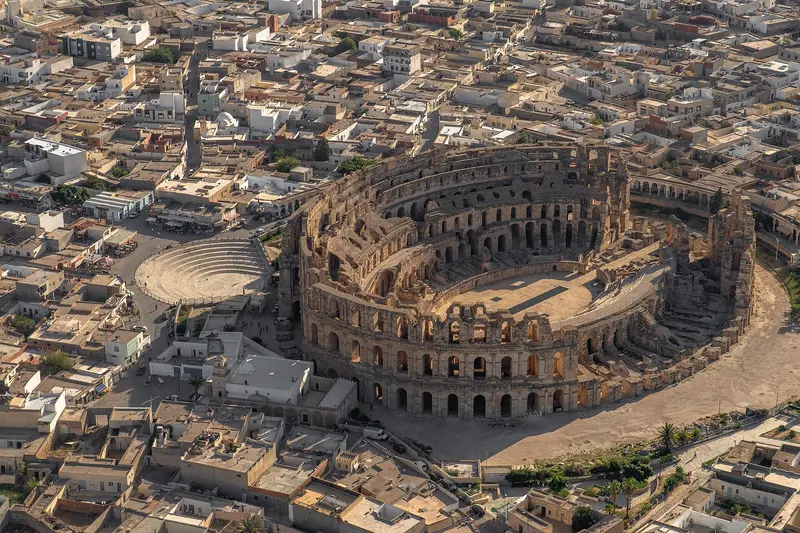
    The Amphitheatre of El Djem is one of the largest in the Roman world, situated in a small town in the Sahel, about an hour by train south of Sousse.

    by Felix Gillen

    1. Home
    2. Destinations
    3. Tunisia
    4. Sahel & Kairouan
    5. El Djem
    The Amphitheatre of El Djem is one of the largest in the Roman world, situated in a small town in the Sahel, about an hour by train south of Sousse. It was built in the first half of the 3rd century in ancient Thysdrus and has been a UNESCO World Heritage site since 1979. With the same ticket, you can visit the Archaeological Museum with its mosaics and a reconstructed Roman villa.

    Sights in El Djem

    Discover the most important sights and attractions

    Amphitheater of El Djem
    Historic Landmark

    1Amphitheater of El Djem

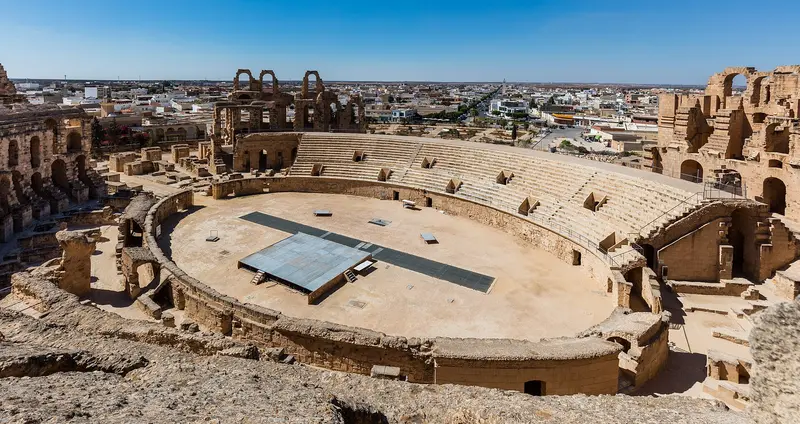
    The amphitheatre, measuring 148 by 122 metres externally, was built in the first half of the 3rd century and has been a UNESCO World Heritage Site since 1979. Below the arena you can walk through the passages of the hypogeum, whose cells held the animals for the games. Early morning and late afternoon are best for photos.
    Open in Google Maps
    El Djem Archaeological Museum
    Museum

    2El Djem Archaeological Museum

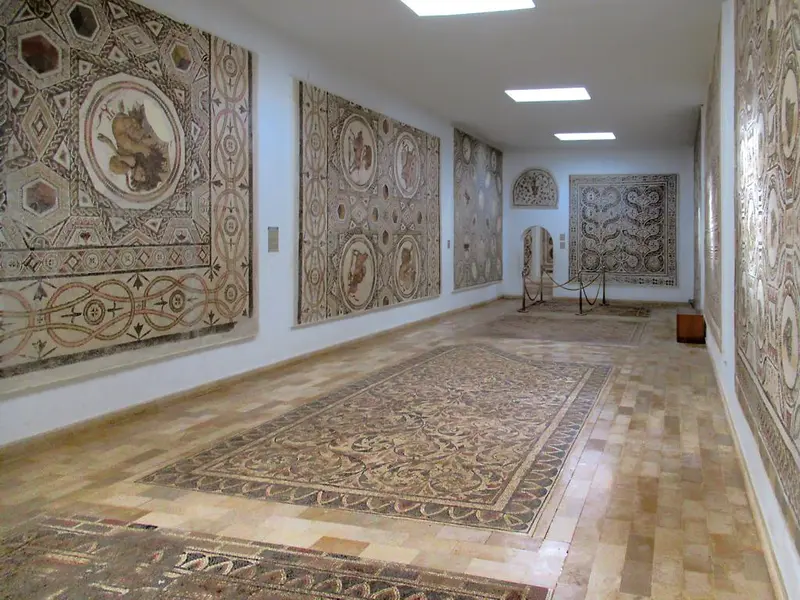
    Opened in 1970, the museum on the street southwest of the train station displays Roman mosaics from the 2nd to 5th centuries, many from ancient Thysdrus. Alongside, the Villa Africa, dating to around 170, has been rebuilt with its mosaics, including the goddess Africa with the Four Seasons. Admission is included in the Amphitheater ticket.
    Open in Google Maps

    Restaurants in El Djem

    1

    El Hana Café & Restaurant

    Cozy café-restaurant directly opposite the amphitheater, convenient for a break before or after your visit.
    Show on Google Maps
    2

    Le Bonheur 2

    Simple restaurant opposite the Amphitheater, serving Tunisian and Mediterranean cuisine, open for lunch and dinner.
    Show on Google Maps

    History and Culture

    The AmphitheaterDimensions: 148 x 122 meters (external dimensions), Arena 65 x 39 meters, approximately 36 meters highCapacity: Estimates range from 27,000 to 45,000 spectatorsConstruction Period: first half of the 3rd century, the year 238 is frequently citedPredecessors: It is the city's third amphitheater; the two older ones held approximately 6,000 and 7,000 spectatorsLater UseDuring the Middle Ages, the structure served as a fortress. In 1695, Mohamed Bey had a breach made in one of the walls; by 1850, it had been extended to approximately 30 meters. Later, its interior was used for a saltpeter factory, shops, dwellings, and as a grain store.Festival in the AmphitheaterSince 1985, summer concerts of the Festival international de musique symphonique d'El Jem have taken place. The 39th edition ran from July 11 to August 15, 2026; the program appears each June.

    Arrival

    By TrainFrom Sousse: approx. 1 hour 15 minutesFrom Tunis: approx. 3 hours 40 minutesFrom Sfax: approx. 50 minutesTrain Station: approx. 300 meters from the Amphitheater, the upper tiers are visible from the platformBy Louage and CarLouage: shared taxis from Sousse in about an hour, stop located a few minutes' walk west of the train stationFrom Kairouan: no direct connection, transfer in Sousse

    Accommodations in El Djem

    Find perfect stay in El Djem

    Booking.com* (Affiliate link)
    Search Hotels
    Agoda* (Affiliate link)
    Search Hotels
    Airbnb
    Vacation Rentals

    * Affiliate link: if you book through it, we earn a small commission. The price stays the same for you.

    Nearby

    Mahdia

    Mahdia

    Mahdia lies on a narrow peninsula on the east coast and is the southern terminus of the Metro du Sahel from Sousse and Monastir. The Fatimids founded the city as their capital in 916; the fortified gate Skifa el Kahla and the Great Mosque date from that time. North of the old town stretch white sandy beaches with hotels; the port is among Tunisia's largest fishing ports.
    Sahel & Kairouan

    Sahel & Kairouan

    The Sahel is the coastal plain in eastern Tunisia, home to Sousse, Monastir, and Mahdia, a good two hours by train south of Tunis. Inland lie two of the country's most famous World Heritage Sites: the Medina of Kairouan with its Great Mosque and the Roman Amphitheatre of El Djem. Behind the beaches, olive groves stretch over flat hills.
    Monastir

    Monastir

    Monastir, located on the east coast between Sousse and Mahdia, has an international airport offering connections to many Western European countries. The city is the birthplace of Tunisia's first president, Habib Bourguiba; his golden-domed mausoleum and the Ribat, dating from 796, define its cityscape. The Medina, Ribat, and Marina are close together and easily reachable on foot, while Sousse is about 20 minutes away by louage.
    Sousse

    Sousse

    Sousse, with around 240,000 inhabitants (2024 census), is the largest city in the Sahel, on the east coast, a good two-hour train ride south of Tunis. Its walled Medina, with its Ribat and Great Mosque, has been a UNESCO World Heritage site since 1988; the Archaeological Museum in the Kasbah displays mosaics from Roman villas. To its north are the hotel zone and Port El Kantaoui marina. Medina, museum, and port are reachable by foot; the Metro du Sahel runs from Bab Jedid to Monastir and Mahdia.
    Sfax

    Sfax

    Sfax, with approximately 274,000 inhabitants (2024 Census), is Tunisia's second-largest city, located about 270 kilometers southeast of Tunis on the Gulf of Gabès. Its Medina is still completely enclosed by a roughly 2.75-kilometer-long city wall with 69 towers and is largely untouched by tourism.Sfax is a commercial and port city: Its port is one of the country's most important fishing ports, and about 40 percent of Tunisian olive oil originates from the surrounding area. You can explore the Old City with its Great Mosque, Kasbah, and Dar Jellouli on foot, and ferries depart from the port to the Kerkennah Islands.

    Sources & method

    • Photos: Wikimedia Commons, Google Maps. Each photo carries its credit.
    • Place data such as addresses and ratings comes from Google Maps.
    • The content is based on web research from public, traceable sources. How the content is made · The role of AI