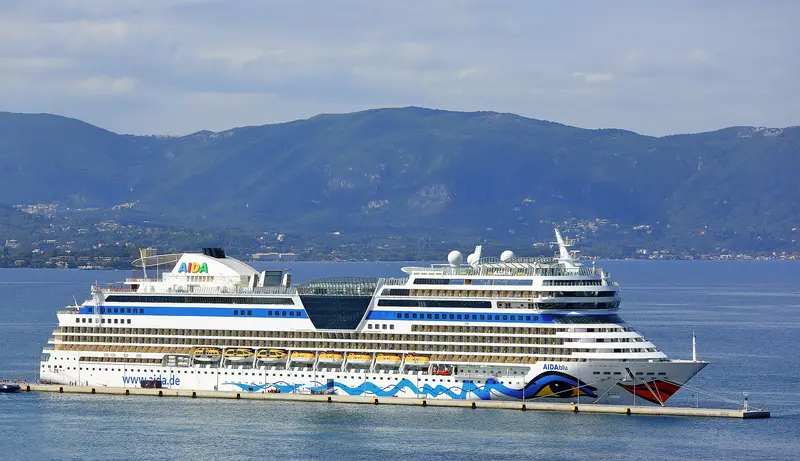
Martin Falbisoner / Wikimedia Commons / CC BY-SA 4.0, mod.
Cruise · AIDA Cruises · AIDAblu
AIDAblu – Greek Islands from Corfu
by Felix Gillen
- 8 Days / 7 Nights
- Corfu Town → Corfu Town
- Sails May 1, 2027
A week with the AIDAblu from Corfu across the Ionian Sea and Aegean: Zakynthos, after a sea day Rhodes, Bodrum on the Turkish coast, Heraklion on Crete and Katakolon, the port for ancient Olympia. On port days, you have 8 to 10 hours. In Zakynthos, Rhodes, and Heraklion, you walk from the port to the old town; for Olympia and Knossos, you need a train, bus, or taxi.
A cruise by AIDA Cruises
- You book the trip with AIDA Cruises. Fernweh does not sell trips.
- “Plan Trip” adds the ports, times in port and sea days to your trip planner, with the way there and back.
- For every port you find tips for going ashore on your own.
At a glance
- Duration
- 8 Days / 7 Nights
- Stops
- 7 · Corfu Town → Corfu Town
- Countries on the route
- Greece, Turkey
- Arrival
- Flight · Korfu (CFU)
- Ship
- AIDAblu (AIDA Cruises)
- Sailings
- May 1, 2027, Jun 19, 2027, Jul 31, 2027, Oct 16, 2027
- Best Time to Go
- May, June, and October
More on when to go
In July and August it gets hot, expect over 30°C and little shade in Olympia and Knossos.
7 stops
Why This Route?
The route connects five very distinct places of Greek history: the Venetian Old Town of Corfu, the Knights' City of Rhodes, the Crusader castle of Bodrum, the Palace of Knossos, and the Sanctuary of Olympia. With most ports located near city centers, you can skip the excursion bus and enjoy lunch in the old towns' tavernas. Bodrum also adds a day on the Turkish coast.
Hidden Gems
- Liston in Corfu Town: the arcades on Spianada Square, where people drink coffee in the evening
- Koules in Heraklion: the Venetian harbor fortress, reachable on foot from the cruise port
- Train from Katakolon to Olympia: a short branch line through fields and olive groves, if it runs on your day
Getting there and back
Round trip, returning to where you started
- Arrival
- Flight · Korfu (CFU)The airport is on the southern outskirts of Corfu Town; a taxi gets you to the New Port where the ship is. Departure is at 10 PM; with a few hours to spare, the Old Town is worth visiting first. The ship docks at 6 AM, with return flights on the same day.
- Departure
- Flight · Korfu (CFU)
Itinerary
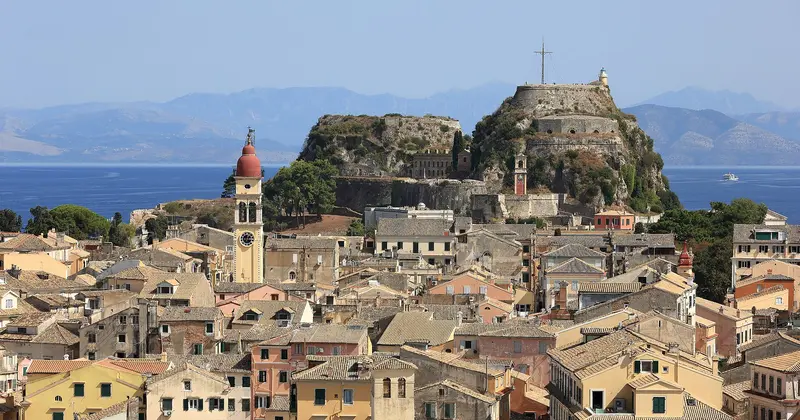
Corfu Town
Corfu Town, located on the east coast, is the island's capital and its historical center. The Old Town, situated between the Old and New Fortresses, has been a UNESCO World Heritage site since 2007, as a Venetian-influenced port city, later further developed by the French and British, has been almost entirely preserved here.You'll walk through narrow, cobbled alleys with tall houses and shutters, drink coffee under the Liston's arcades, and gaze across the Spianada, where cricket is still played today. The Church of Agios Spyridon preserves the relics of the island's patron saint, while St. Michael and St. George Palace recalls the British era. One to two days are sufficient for exploring the city, and it also serves as the best starting point for excursions across the entire island.
The ship docks at the New Port, about two kilometers west of the Old Town, 20 to 30 minutes on foot, or faster by city bus or taxi. The Old Town, with its Venetian houses, is a UNESCO World Heritage site; Spianada Square features the Liston's arcades and, opposite, the Old Fortress.
6 Sights
4 Restaurants
Culture and Traditions
The Island's Patron SaintAgios Spyridon is Corfu's patron saint; his relics have been in the city since the 15th century. Several times a year, devotees carry them in processions through the Old Town; the longest on Palm Sunday commemorates the end of a plague epidemic in 1629.Easter in CorfuThe Orthodox Easter celebration is the year's highlight. All 17 island philharmonic orchestras join the Palm Sunday procession. On Holy Saturday at 11 am, as the bells ring for the First Resurrection, residents throw clay pots (Botides) from windows and balconies onto the streets. You should book Easter accommodation early.Legacies of Foreign RuleVenetians, French, and British have shaped the cityscape: Venetian fortresses, the French arcades of the Liston from 1807, and the British Palace of St. Michael and St. George. Cricket on the Spianada is a legacy of the British era.
Departs 22:00
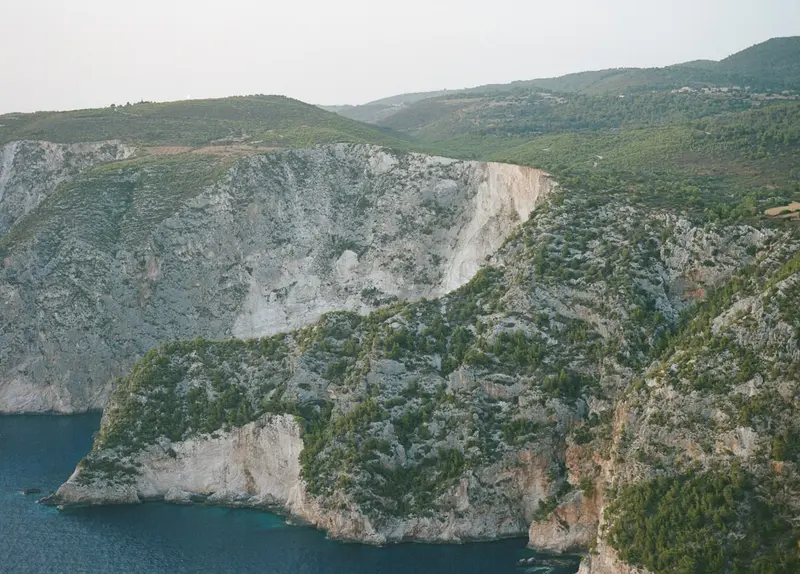
Zakynthos
Zakynthos is the southernmost of the larger Ionian Islands and presents two faces: in the north and west, a rugged coastline with caves and Shipwreck Bay Navagio; in the south, flat sandy beaches where loggerhead sea turtles lay their eggs. In between lies a fertile plain with vineyards and olive groves. The Venetians named the island Fior di Levante.
Usually the ship anchors offshore, and tender boats bring you directly to the harbor promenade. From the pier, it’s five to ten minutes to Solomos Square with the Church of Agios Nikolaos. From there, you walk through the arcaded streets of the city rebuilt after the 1953 earthquake. Afterwards, a sea day towards Rhodes.
8 Sights
3 Restaurants
Culture and History of Zakynthos
Fior di LevanteFrom 1485 to 1797, Zakynthos belonged to Venice, which named the island “Fior di Levante,” Flower of the Levant. The Venetian era shaped its architecture, art, and language: arcades, vaults, and freestanding bell towers modeled after Italian campanili. After the 1953 earthquake, which almost completely destroyed the city, it was rebuilt in this style.Music and LiteratureThe musical tradition includes the polyphonic Kantades and Arekies, accompanied by mandolin and guitar. Born on Zakynthos were the poets Dionysios Solomos, who wrote the lyrics of the Greek national anthem, and Andreas Kalvos, as well as the Italian poet Ugo Foscolo.Heptanese School of PaintingFrom the 17th century onwards, painters of the Ionian Islands combined Byzantine iconography with Western painting. Many works of this Heptanese School, rescued from the destroyed churches, are now displayed at the Byzantine Museum in Solomos Square.
In port 08:00–18:00 · 1 day at sea after
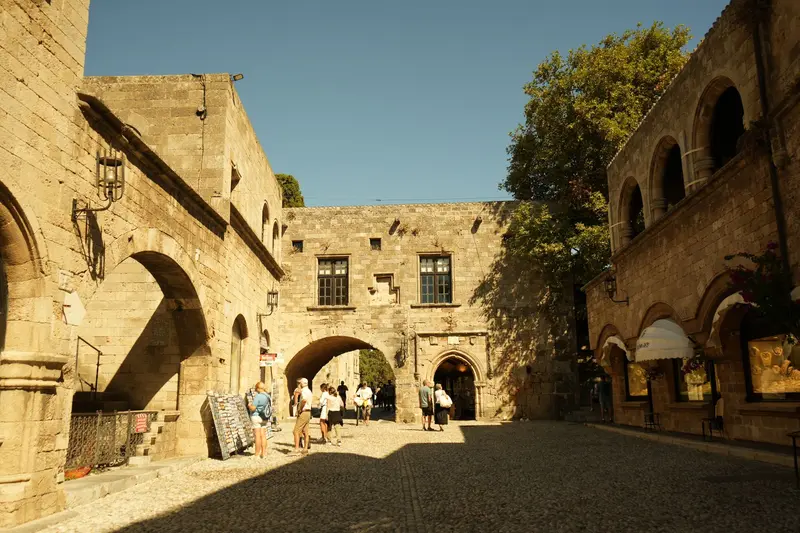
Rhodes Town
The Old Town of Rhodes City is one of Europe's most completely preserved medieval cityscapes and has been a UNESCO World Heritage site since 1988. It was shaped by the Knights Hospitaller, who ruled the island from 1309 to 1522, with mosques and baths later added by the Ottomans. Behind a roughly four-kilometer-long ring wall lie the Grand Master's Palace, the Street of the Knights, and a maze of alleys. Outside the walls are the New Town with Italian buildings from the 1920s and 1930s and Mandraki Harbor. Walk through the Old Town in the early morning or late afternoon; at midday, it's crowded with day-trippers.
From the cruise dock, you walk in about ten minutes to the nearest Old Town gate; it's 15 to 20 minutes to the Palace of the Grand Master. Walk early through the Street of the Knights before it gets crowded and hot, and at midday, find a tavern off Sokratous Street.
7 Sights
5 Restaurants
History of the city
The city of Rhodes was jointly founded in 408 BC by the island's three ancient cities: Lindos, Ialysos, and Kamiros. During the Hellenistic period, it was a significant maritime and commercial power. Around 280 BC, the Colossus of Rhodes, a bronze statue of the sun god Helios, was built, only to collapse about 50 years later in an earthquake.Knights and OttomansFrom 1309 to 1522, the Order of Saint John ruled Rhodes. The knights fortified the city with a wall, the Grand Master's Palace, and the Street of the Knights. In 1522, Sultan Süleiman the Magnificent conquered the city after a months-long siege, and the knights moved to Malta. During the Ottoman era, mosques, baths, and fountains were added.Italy and GreeceIn 1912, Italy occupied the Dodecanese. The Italians restored the Old Town and largely rebuilt the Grand Master's Palace from 1937, while administrative buildings were erected outside the walls. In 1944, almost the entire Jewish community of the city was deported. Rhodes finally became part of Greece in 1947.
In port 08:00–18:00
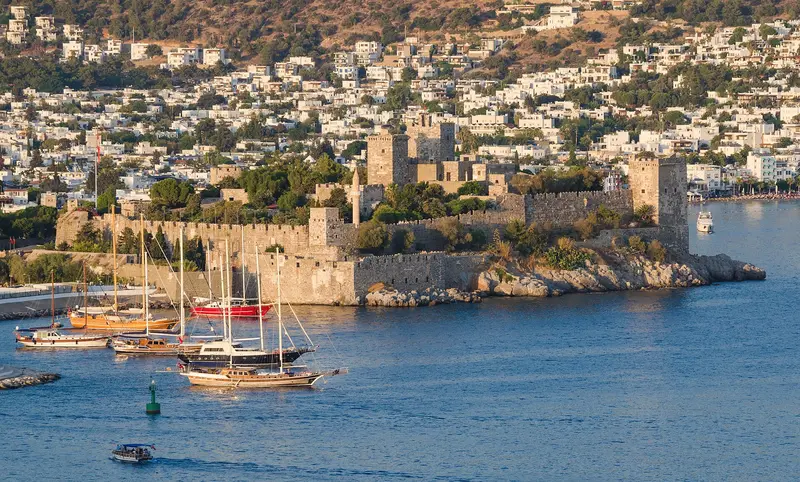
Bodrum
Bodrum is located at the southern tip of the Turkish Aegean on the peninsula of the same name, at the site of ancient Halikarnassos. You come for the Castle of St. Peter with its Museum of Underwater Archaeology, the remains of the Mausoleum, and the evenings in the harbor and bar street. The Old Town with its castle, harbor, and bazaar is the focal point; on the peninsula are towns like Bitez, Gümüşlük, and Yalıkavak.
The cruise port is 1.5-2 km from St. Peter's Castle, a 20-30 min promenade walk; allow more time in peak summer. Taxis, Dolmuş minibuses, and water taxis are available. St. John's Castle houses the Museum of Underwater Archaeology. Bring passport or ID ashore; pay in Lira or by card.
4 Sights
3 Restaurants
Culture and History
HalicarnassusIn the 4th century BC, the Carian satrap Maussolus ruled here. For him and Artemisia II, the Mausoleum was built from 353 to 351 BC, which was considered one of the Seven Wonders of the World. Alexander the Great besieged the city in 334 BC.The Knights HospitallerFrom 1404, the Knights Hospitaller built St. Peter's Castle; its towers are named after the nations that erected them. In 1494, the knights used stones from the ruined Mausoleum for its fortifications. Since the 1960s, the castle has housed the Museum of Underwater Archaeology.Underwater ArchaeologyThe museum displays finds from shipwrecks off the Turkish coast. The most famous piece is the Uluburun shipwreck, dating from the 14th century BC, with copper ingots from Cyprus, glass, and Egyptian jewelry.
In port 07:30–18:00
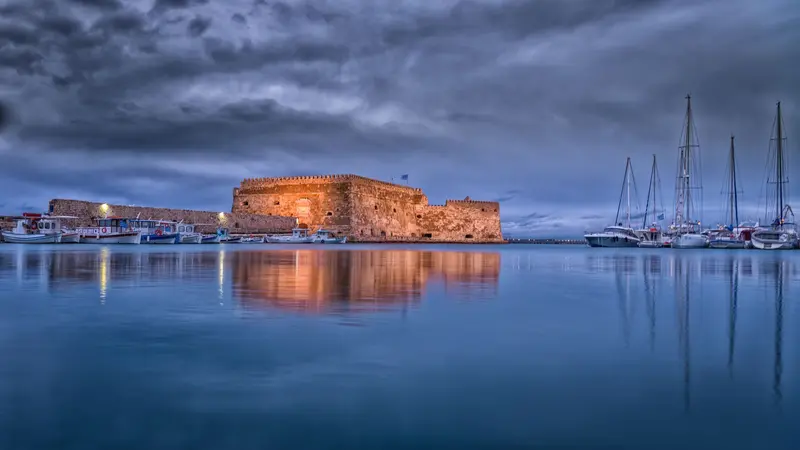
Heraklion
Heraklion is Crete's largest city and capital, and for most travelers, it's the island's arrival point. Behind the Venetian city walls lies a bustling city center, the harbor with Koules Fortress, and the Archaeological Museum, home to the most important collection of Minoan art.You come for the museum and the Palace of Knossos, a UNESCO World Heritage site for Minoan Palace Centres from 2025. The city itself is more for work than leisure, but a day is well spent on the old town, market, and city walls.
From the cruise pier, walk 15-20 minutes along the harbor to the Venetian fortress Koules and on to the Old Town with the Archaeological Museum. City bus line 2 goes to Knossos, taking about 20 minutes. For the palace, you should plan three to four hours; it's exposed to the sun. With eight hours of port time, you can manage Knossos or the Museum and Old Town; doing both will be tight.
7 Sights
3 Restaurants
Cultural Heritage of Heraklion
Minoan RootsA few kilometers south of the city lay Knossos, the largest center of the Bronze Age Minoan culture. Since 2025, Knossos, along with Phaistos, Malia, Zakros, Zominthos, and Kydonia, has been part of the UNESCO World Heritage site “Minoan Palace Centers.” The finds from the excavations, led by Arthur Evans starting in 1900, are now housed in the Archaeological Museum of Heraklion.Venetians and OttomansVenice acquired Crete after the Fourth Crusade and held the city, then known as Candia, until 1669. Dating from this period are the city walls with seven bastions, the Koules Fortress, the Loggia (1626-1628), and the Morosini Fountain (1628). From 1648 to 1669, the Ottomans besieged the city for 21 years, one of the longest sieges in history. Under Ottoman rule, churches were converted into mosques, including Agios Titos.Kazantzakis and Cretan MusicHeraklion is the hometown of Nikos Kazantzakis, author of “Zorba the Greek” (Alexis Sorbas). His tomb is located on the Martinengo Bastion. You can hear Cretan music, featuring the lyra and lute, in some of the city's tavernas and at festivals in the surrounding villages.
In port 08:30–16:30
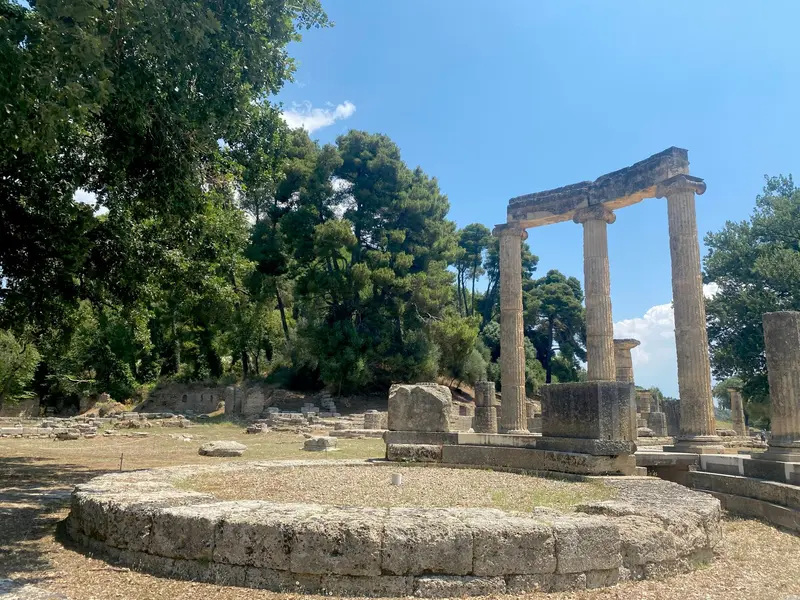
Katakolon (Olympia)
Ancient Olympia is located in the region of Elis in the west of the Peloponnese, where the Kladeos flows into the Alpheios. From 776 BC to 393 AD, the Olympic Games were held here every four years in honor of Zeus, for almost twelve centuries. Of the sanctuary, foundations, toppled column drums, and the stadium are preserved; the sculptures are in the museum opposite.
Katakolon is a small port town; ancient Olympia lies 30 km inland. The local train to Olympia takes ~45 minutes but isn't daily; check the schedule. Port taxis offer rides with waiting time; a ~4-hour round trip costs ~80 Euro per car. At Olympia, walk through the sanctuary to the stadium and museum.
7 Sights
3 Restaurants
Olympia: Holy Ground, Competition, and Truce
A Thousand Years of GamesOlympia was not a residential area, but a sanctuary that became a competition venue every four years. The preserved list of victors begins in 776 BC; initially, there was only a race the length of the stadium, with wrestling, boxing, pentathlon, and chariot racing added later. Free Greeks were eligible to participate, with a wreath from the wild olive tree as the prize, while the fame in their hometown was all the greater. During the Ekecheiria, the sacred truce, the path to Olympia was protected for participants. Towards the end of the 4th century AD, the games ended with the prohibition of pagan cults under Emperor Theodosius I. The sanctuary fell into disrepair and was sealed by earthquakes and alluvium.Art and RediscoveryThe sculptor Phidias created here the approximately twelve-meter-high statue of Zeus, made of gold and ivory, one of the Seven Wonders of the World. The gables and metopes of the Temple of Zeus are considered masterpieces of the Severe Style. Olympia was excavated starting in 1875 by German archaeologists under Ernst Curtius; the finds remained in Greece after a specially concluded agreement. Pierre de Coubertin, the founder of the International Olympic Committee, is honored in Olympia with a monument where his heart is interred.
In port 09:00–18:00
Corfu Town
Corfu Town, located on the east coast, is the island's capital and its historical center. The Old Town, situated between the Old and New Fortresses, has been a UNESCO World Heritage site since 2007, as a Venetian-influenced port city, later further developed by the French and British, has been almost entirely preserved here.You'll walk through narrow, cobbled alleys with tall houses and shutters, drink coffee under the Liston's arcades, and gaze across the Spianada, where cricket is still played today. The Church of Agios Spyridon preserves the relics of the island's patron saint, while St. Michael and St. George Palace recalls the British era. One to two days are sufficient for exploring the city, and it also serves as the best starting point for excursions across the entire island.
Arrival at 6 AM, disembarking in the morning. A taxi will get you quickly to the airport. If flying later, breakfast under the Liston arcades.
6 Sights
4 Restaurants
Culture and Traditions
The Island's Patron SaintAgios Spyridon is Corfu's patron saint; his relics have been in the city since the 15th century. Several times a year, devotees carry them in processions through the Old Town; the longest on Palm Sunday commemorates the end of a plague epidemic in 1629.Easter in CorfuThe Orthodox Easter celebration is the year's highlight. All 17 island philharmonic orchestras join the Palm Sunday procession. On Holy Saturday at 11 am, as the bells ring for the First Resurrection, residents throw clay pots (Botides) from windows and balconies onto the streets. You should book Easter accommodation early.Legacies of Foreign RuleVenetians, French, and British have shaped the cityscape: Venetian fortresses, the French arcades of the Liston from 1807, and the British Palace of St. Michael and St. George. Cricket on the Spianada is a legacy of the British era.
Arrives 06:00
Plan this route as your trip
All stops, trains and nights go into your trip planner. You adjust dates and places to stay afterwards.
This route is a suggestion from our research. Please check timetables, times in port, opening hours and prices before you book – what your tour operator or carrier says is what counts.
Fernweh is a free travel guide and trip planner: routes researched by people, taken over in one click, used day by day on the road. More about Fernweh
7 stops
Route Summary
Duration8 Days
Stops7 Places
TypeCulture