From Athens, you drive across the Corinth Canal to Nafplion, from where Mycenae and Epidaurus are a short drive away. To conclude, head southeast to Monemvasia; the drive from Nafplion takes around two and a half hours.
9 Days / 8 Nights
April–June & September–October
RV Friendly
4 stops
Why This Route?
For travelers who want to combine antiquity, old towns, and coast without ferry connections.
Hidden Gems
Palamidi Fortress in Nafplio late afternoon, with views over the Old Town
Arvanitia Beach below the Akronauplia in Nafplio
Agia Sofia Church in Monemvasia's Upper Town
Itinerary
Stop 1 • 2 Nights
Athen
City
Rich in culture and history. Perfect for an exciting city trip and Culinary highlights.
Athens is a city that doesn't keep its 3,400 years in a museum, but lives them daily: Beneath the Acropolis lie districts full of tavernas, record shops, and rooftop bars. If you only seek antiquity, stay two days. If you want to get to know the city, you need four.
12 Sights
6 Restaurants
Culture and History
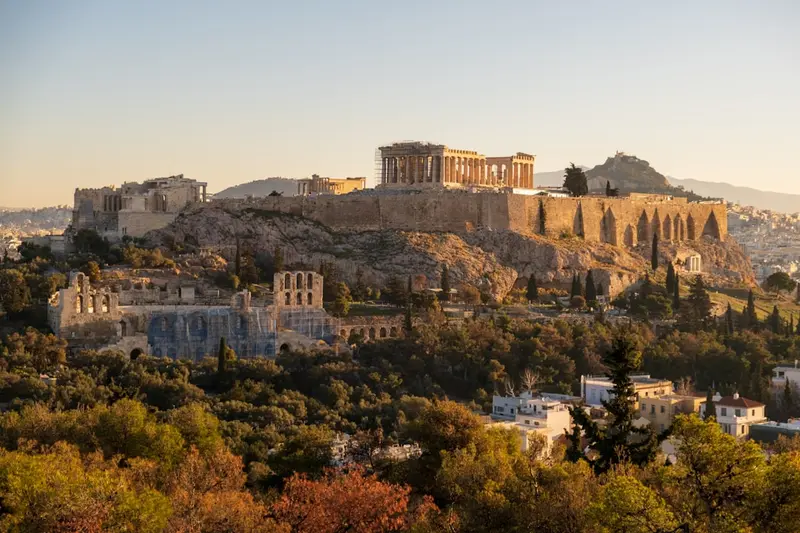
Athens has been inhabited for over 3,000 years. In the 5th century BC, under Pericles, it gave rise to Attic democracy, tragedy as a theatrical form, and the buildings of the Acropolis. Philosophers like Socrates, Plato, and Aristotle taught in the city.Antiquity and ByzantiumThe Acropolis, with the Parthenon, Propylaea, and Erechtheion, combines Doric and Ionic architectural styles. From the Byzantine era come small domed cruciform churches like Kapnikarea and Panagia Gorgoepikoos, which today stand amidst commercial buildings.Capital since 1834When Athens became the capital of the new state in 1834, it was a small town. Under King Otto, Neoclassical buildings such as the University, Academy, and National Library emerged, designed among others by the Hansen brothers. Today, the Acropolis Museum and the National Archaeological Museum display the ancient finds.
Corinth is situated on the Isthmus, the narrowest point between the Peloponnese and the Greek mainland, and thus controlled traffic between two seas for centuries. The ancient city was destroyed by Rome in 146 BC and re-established as a colony a century later; it was here that the Apostle Paul preached. The Temple of Apollo, the Acrocorinth fortress, and the canal opened in 1893 represent three very different eras in one place.
8 Sights
3 Restaurants
Corinth: Trading Power Between Two Seas
From City-State to Roman ColonyCorinth, with its two harbours, Lechaion on the Gulf of Corinth and Kenchreai on the Saronic Gulf, controlled the trade routes between West and East. This strategic location brought the city great wealth in archaic and classical times; it founded colonies like Syracuse and Korkyra and hosted the Isthmian Games. In 146 BC, the Roman general Lucius Mummius completely destroyed the city, and its population was enslaved. It wasn't until 44 BC that Caesar founded a colony on the same site, which became the capital of the province of Achaea. Most of the structures visible today date from this Roman period; only the Doric Temple of Apollo, from the 6th century BC, is older.Paul and the Layers of AcrocorinthAround 50 AD, the Apostle Paul lived in Corinth for a year and a half, founding one of Europe's first Christian communities, later sending his two letters to the Corinthians. The Bema on the Forum is believed to be where he faced proconsul Gallio. On the citadel hill above lie the layered fortifications of all successive rulers: Byzantine walls, Frankish towers, Venetian bastions, and Ottoman alterations with a mosque.
Nafplio lies on Argolis' east coast, on the Argolian Gulf, some 140 kilometers southwest of Athens. From 1823 to 1834, it served as the first capital of independent Greece, having previously seen Venetians and Ottomans alternately rule its port. The city retains three fortresses, a compact old town of Venetian and neoclassical houses, and a scenic rock path encircling the peninsula.
8 Sights
4 Restaurants
History of the City
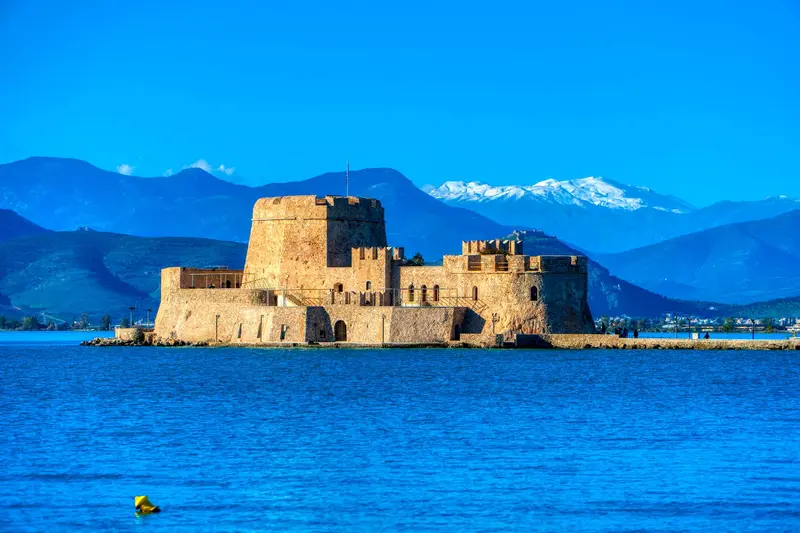
In the vicinity of Nafplio lie Mycenae and Tiryns, two of the most important cities of the Mycenaean Bronze Age. The city itself was mainly shaped in modern times: Venetians and Ottomans alternated as masters of the port between the 14th and 18th centuries.Venice and OttomansFrom 1473, the Venetians built the water castle Bourtzi in front of the harbor and, from 1711 to 1714, the Palamidi fortress on the hill above the city. The Ottomans recaptured Nafplio in 1715. Mosques on Syntagma Square date from their time; one later served as Greece's first parliament.First CapitalAfter its capture by Greek rebels in 1822, Nafplio became the seat of government, officially capital from 1829. In 1831, Ioannis Kapodistrias, the country's first head of government, was assassinated in front of Agios Spyridon Church; the bullet hole is still visible. King Otto landed here in 1833, and in 1834, the capital moved to Athens. Many neoclassical houses in the old town date from this era.
Rich in culture and history. Perfect for an exciting city trip.
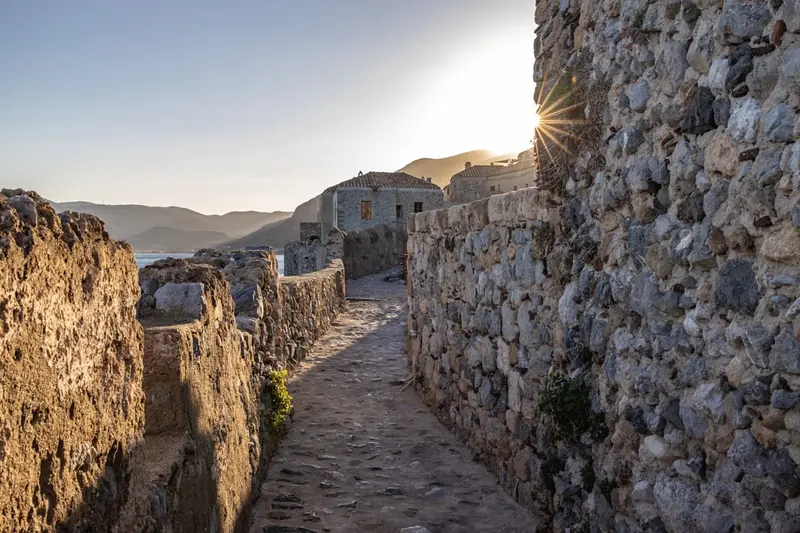
Monemvasia is perched on a steep limestone rock off the Laconian east coast, linked to the mainland solely by a causeway. Its name, meaning 'single entrance', accurately describes this location, which made the settlement difficult to attack since its 6th-century founding.Behind the walls, Byzantine churches and stone houses stand closely together; above on the plateau lies the deserted Upper Town with the Church of Agia Sofia. The town is car-free and ideal for one or two peaceful days.
8 Sights
4 Restaurants
Culture and History of Monemvasia
Byzantine FortressThe first settlement emerged in the late 6th century, when inhabitants of the Peloponnese sought refuge on the rock from Slavic and Avar invasions. Monemvasia developed into an important Byzantine trading and naval base, later alternating between Byzantine, Frankish, Venetian, and Ottoman rule. During its heyday, an estimated several thousand to over ten thousand people lived here.Churches and TownscapeIn the lower town stand stone houses, narrow alleys, and churches like Christos Elkomenos. On the plateau is the Agia Sofia from the 12th century, which served as a mosque under Ottoman rule. By 1971, only a few dozen people lived in the Kastro; many houses were then restored and used as guesthouses and holiday apartments.MalvasierThe Italian name of the town, Malvasia, gave the sweet wine Malvasier its name. Monemvasia primarily served as an export harbor; the grapes originated from various regions of the Peloponnese and the Aegean. Today, vintners in Laconia once again cultivate wines under the name Monemvasia-Malvasia.