From Bozen, the route leads to the Seiser Alm, via the Pustertal to the Pragser Wildsee, then to Cortina d'Ampezzo and the Drei Zinnen. The Seiser Alm is closed to private cars during the day; take the cable car up from Seis. For parking at Pragser Wildsee and the Drei Zinnen toll road, online reservation is recommended in summer.
12 Days / 11 Nights
July–September
5 stops
Why This Route?
For hikers wanting to explore the Dolomites' high plateaus, mountain lakes and famous peaks from fixed bases, with short drives.
Hidden Gems
Lago di Sorapis near Cortina, a turquoise mountain lake about two hours' walk from Passo Tre Croci
Plätzwiese above the Prags Valley, a high-alpine pasture with views of the Hohe Gaisl
Earth pyramids on the Ritten above Bozen
Itinerary
Stop 1 • 3 Nights
Bozen
City
Rich in culture and history. Culinary highlights and Breathtaking mountain views.
Nestled in a valley basin at the confluence of the Talfer and Eisack, Bolzano is the capital of South Tyrol. The city is bilingual; unlike the rest of South Tyrol, the Italian language group is in the majority here: In the 2024 language census, about three-quarters of the inhabitants declared themselves part of the Italian language group and about one-quarter part of the German language group.Old TownThe heart of the Old Town features the over 300-meter-long Lauben (arcades) with their merchant houses, the Obstplatz (Fruit Square) with its market, and the Waltherplatz with the Gothic cathedral. Gothic frescoes are preserved in the Dominican Church, while the Franciscan Church boasts a winged altar and a cloister.MuseumsThe South Tyrol Museum of Archaeology exhibits the glacier mummy Ötzi. Additionally, there is the Museion for modern and contemporary art and the Messner Mountain Museum Firmian at Sigmundskron Castle.SurroundingsCable cars lead up to Ritten and Kohlern.
8 Sights
6 Restaurants
Culture
Bolzano originated in the Middle Ages as a market settlement with a lane lined with arcades. Since its founding, several annual markets took place here, and at the behest of Claudia de’ Medici, the city received the Mercantile Magistracy, its own commercial court, in the 17th century. The Mercantile Museum tells this trading history.After its annexation to Italy, South Tyrol was systematically Italianized during the Fascist era. The coexistence of language groups continues to shape politics and daily life to this day.Autumn is Törggele time: then you taste the new wine directly at the winery, accompanied by roasted chestnuts.
Breathtaking mountain views. Stunning nature and outdoors and For adventure seekers.
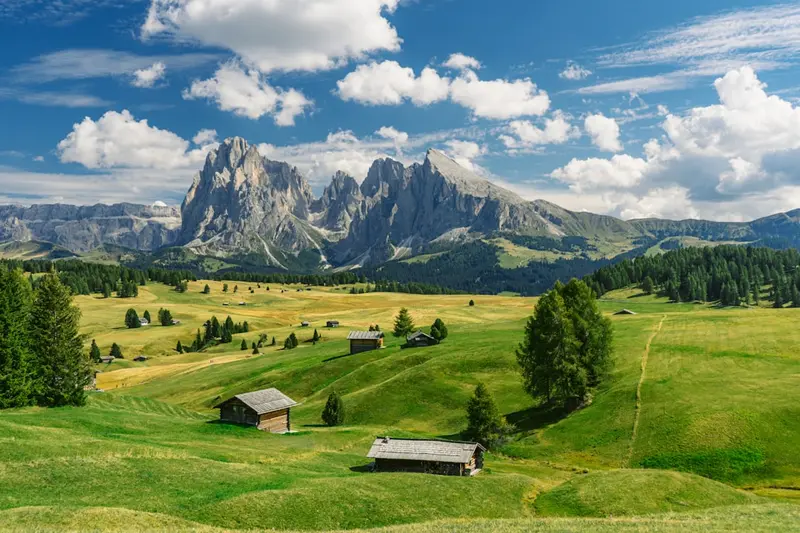
The Seiser Alm (Alpe di Siusi) is a wide high plateau at roughly 1,680 to 2,350 meters with an area of about 56 square kilometers, and is considered the largest high alpine meadow in Europe. Administratively it is a fraction of the municipality of Kastelruth. Its southern parts belong to the Schlern-Rosengarten Nature Park.SummerA dense network of trails, alpine pastures and huts makes the Alm a destination for families and leisurely hikers. The tours up the Schlern are more demanding.WinterIn winter the Seiser Alm is a ski area with about 60 kilometers of slopes, part of Dolomiti Superski and connected to St. Ulrich in Gröden by a gondola lift.AccessThe road from Seis to Compatsch is closed to private traffic uphill between 9 a.m. and 5 p.m., while you may drive downhill at any time. Since the end of June 2026, an online reservation is mandatory for the parking lots P1 Spitzbühl and P2 Compatsch. The easiest way is to take the cable car from Seis to Compatsch. Guests of accommodations on the Alm receive an access permit from their host. You can find the current rules at Seiser Alm Marketing.
3 Sights
4 Restaurants
Culture
The alpine pasture has been farmed for a long time: As early as 1600, Marx Sittich von Wolkenstein described livestock, haymaking, and cheesemaking on the Seiser Alm.Legends of witches surround the Schlern. At the Hexenbänken on the Puflatsch, the Schlern witches are said to have danced until the Middle Ages.
Pragser Wildsee is situated at 1494 meters in the Pragser Tal, a few kilometers south of the Pustertal between Bruneck and Toblach. It belongs to the Fanes-Sennes-Prags Nature Park and is overlooked by the 2810-meter-high Seekofel. It also became known as a filming location for the TV series “Die Bergpolizei”.VisitA circular path of just under four kilometers leads around the lake in just over an hour. In summer, you can rent rowing boats at the boathouse. The Dolomite High Path No. 1 starts at the lake.Access in High SeasonIn 2026, a traffic regulation was in effect from July 1st to September 15th, between 9 AM and 4 PM: You could only enter the Pragser Tal with a parking space booked online in advance, with a scheduled bus service (also to be booked in advance), on foot, or by bike. The regulation is expected to return in summer 2027; details will be published in spring. Check them on the official website prags.bz before your arrival.
Breathtaking mountain views. Stunning nature and outdoors and Luxury accommodations and experiences.
Cortina d'Ampezzo is situated at around 1,200 meters in a wide valley basin of the Ampezzo Dolomites, surrounded by Tofane, Pomagagnon, Cristallo, Faloria, and Sorapiss.Winter and OlympicsThe Olympic Winter Games were held here in 1956, and in 2026, Cortina, together with Milan, will again host the Olympic and Paralympic Winter Games. The ski area is part of the Dolomiti Superski network.Summer in the MountainsCable cars ascend Faloria and Tofana, and from Passo Falzarego, to Lagazuoi. Popular destinations in the vicinity include the Cinque Torri, Lake Misurina, and the Drei Zinnen. During World War I, the front line ran along Lagazuoi, and tunnels and emplacements are preserved to this day.Mountain SafetyWeather and trail conditions in the high mountains change rapidly. Before tours, inquire with local sources; current safety and health advice for Italy can be found via the link to the Auswärtiges Amt on the country page.
5 Sights
4 Restaurants
Culture
Ampezzo was under Habsburg rule from 1508 and belonged to Tyrol until after the First World War; in 1920 it became part of Italy, and in 1923 it joined the province of Belluno. Many locals, in addition to Italian, speak Ampezzano, a Ladin variety.A unique feature is the Regole d'Ampezzo, an ancient institution that manages the communal heritage of the valley, including forests and pastures. The Regole operate three museums in the town: the Mario Rimoldi Museum of Modern Art, the Rinaldo Zardini Palaeontological Museum, and an ethnographic museum.Since 2009, the Dolomites have been a UNESCO World Heritage site.
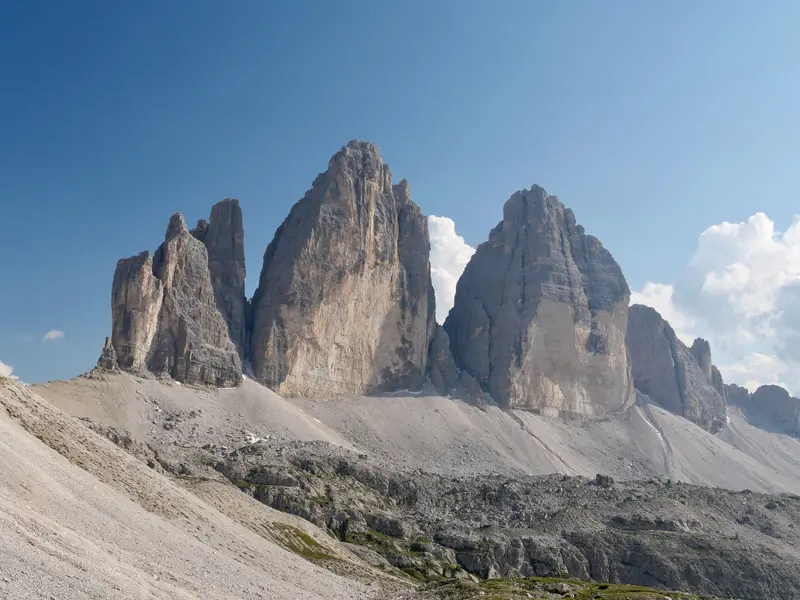
The Drei Zinnen are three freestanding rock towers in the Sesto Dolomites, on the border between South Tyrol and the Province of Belluno. The Große Zinne reaches 2,999 meters. Their north faces are among the most famous climbing destinations in the Alps; for hikers, the circular trail around the towers is the main objective.HistoryDuring the First World War, the front line between Austria-Hungary and Italy ran through here. Remains of fortifications, tunnels, and paths can be found on Paternkofel and Monte Piana.VisitingMost visitors start at the Auronzo Hut, which is accessible via a toll road from Misurina; an online reservation is required for car access. The huts along the circular trail are generally open from June to September; outside this period, snow may be present on the paths. Check the weather and trail conditions before your tour; current safety and health advisories for Italy can be found via the link to the Federal Foreign Office on the country page.
3 Sights
4 Restaurants
The History
The first ascent of the Große Zinne was achieved on August 21, 1869, by mountain guides Franz Innerkofler and Peter Salcher with Paul Grohmann. Emilio Comici, along with Giovanni and Angelo Dimai, first climbed the North Face of the Große Zinne in August 1933; this ascent is considered a milestone in alpinism.From 1915, the area was a front in the Mountain War. The Sexten mountain guide Sepp Innerkofler was killed on July 5, 1915, on the Paternkofel. Today, remnants of positions and an open-air museum on Monte Piana commemorate this period.