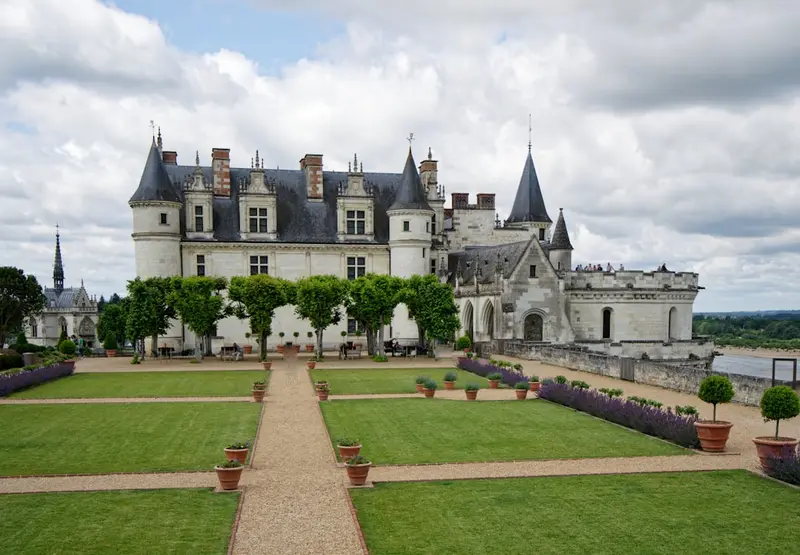
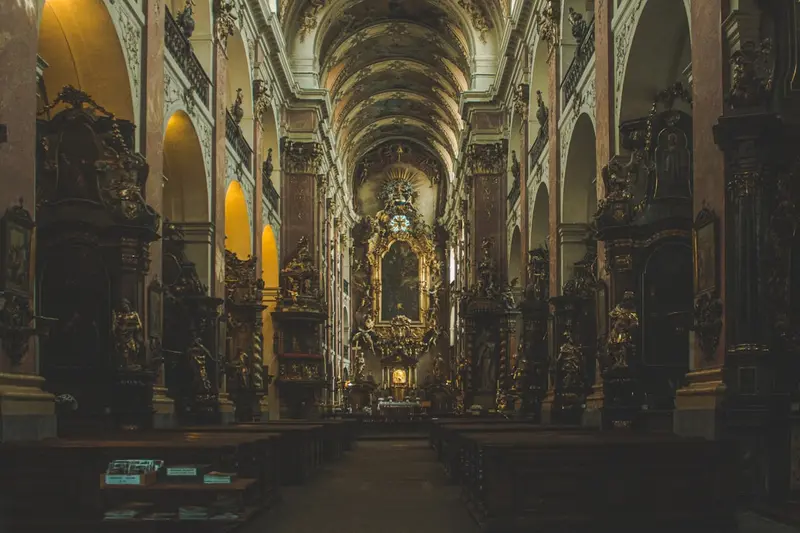
Welcome to the **Loire Valley**, where a fairytale landscape of majestic castles, gentle rivers, and lush gardens awaits you. As a UNESCO World Heritage site, this region is known for its impressive architecture, excellent wines, and a relaxed way of life that uniquely reflects the heart of France. Discover here the history and beauty of one of France's most fascinating regions, often affectionately referred to as the “Garden of France.”
The Loire Valley, a UNESCO World Heritage site and the 'Garden of France', impresses with gentle river landscapes, vast vineyards, and historic towns. Here you'll discover an impressive density of over 300 castles, such as the monumental Château de Chambord and the elegant Château de Chenonceau, picturesquely built over the Cher. This region once served French kings as a residence and is an outstanding testament to the French Renaissance. Along the Loire, one of Europe's last wild rivers, excellent cycling tours through the wine regions are also available. For a relaxed exploration, a visit in spring or autumn is recommended, combined with a wine tasting directly from the winemaker.
Places in Loire Valley
Chenonceau
Welcome to Chenonceau, a true jewel in the heart of the Loire Valley! Here you'll discover a fairytale castle that elegantly floats over the River Cher and whose history is closely intertwined with France's most powerful women. Immerse yourself in a world full of beauty, intrigue, and royal splendor that will captivate you with its unique architecture and magnificent gardens.
Sights in Loire Valley
Discover the most important sights and attractions
Château de Chambord
The Château de Chambord is the largest and perhaps most impressive château of the Loire Valley, a masterpiece of the French Renaissance. Its unique double-helix staircase, attributed to Leonardo da Vinci, and its countless towers and chimneys make it an unforgettable sight. Explore the vast interiors and stroll through the extensive park, which was once royal hunting grounds.
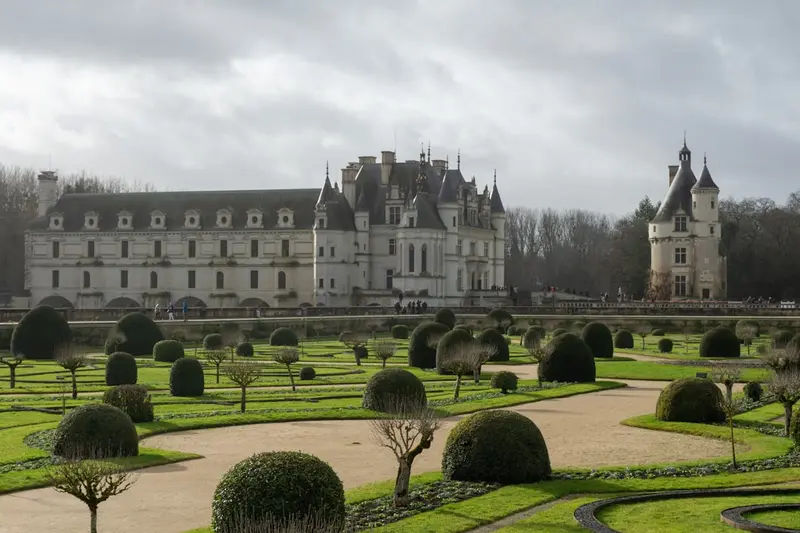
The elegant Château de Chenonceau, also known as the 'Ladies' Château', picturesquely spans the River Cher and is famous for its fascinating history shaped by strong women. You'll love the ornate gardens, the luxuriously furnished rooms, and the unique gallery spanning the river, which makes it one of the most beautiful châteaux in France.
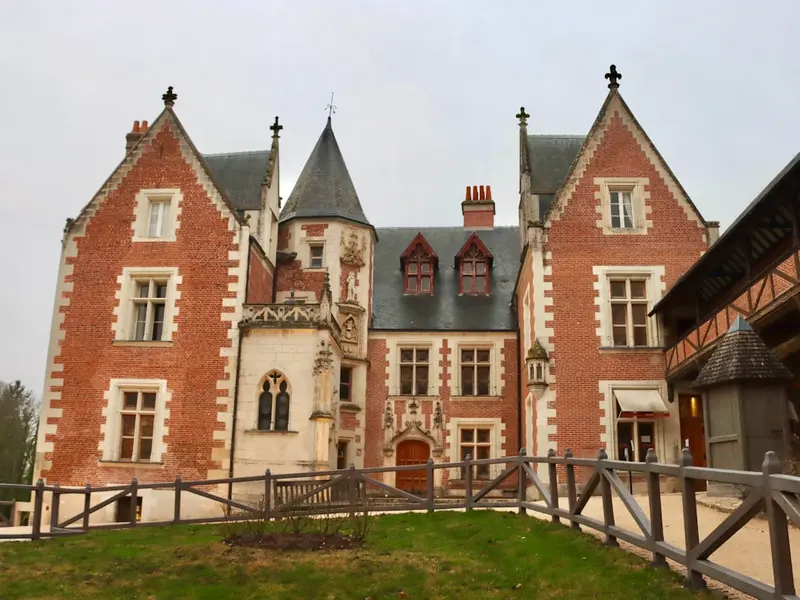
The charming town of Amboise and its royal château majestically overlook the Loire, offering you deep insight into French history. Here Leonardo da Vinci lived and worked in his final years, and his former home, the Clos Lucé, is just a short walk away. Enjoy the panoramic view over the river and the picturesque streets of the town.
In Chinon, you'll discover a medieval fortress dramatically rising above the Vienne, holding a rich history from Joan of Arc to the Plantagenets. Stroll through the charming town's narrow streets, sample the region's excellent red wines, and let yourself be enchanted by the historical atmosphere.
Diese Monate bieten milde bis warme Temperaturen, moderate Niederschläge und angenehm viel Sonnenschein, ideal für Besichtigungen der Schlösser, Radtouren und Spaziergänge in den Gärten. Die Touristenmassen sind außerhalb der französischen Sommerferienzeit geringer.
Das Loire-Tal, bekannt als 'Garten Frankreichs', liegt in einer Region mit gemäßigtem ozeanischem Klima. Dies bedeutet milde Winter, warme Sommer und ganzjährig verteilte Niederschläge.Temperaturen: Die Sommer (Juni bis August) sind angenehm warm, können aber gelegentlich Hitzeperioden aufweisen. Die Winter sind mild, mit seltenem, leichtem Schneefall und Frösten.Niederschlag: Der Niederschlag verteilt sich relativ gleichmäßig über das Jahr, wobei die regenreichsten Monate typischerweise im Herbst und Frühwinter liegen können. Es gibt keine ausgeprägte Trocken- oder Regenzeit.Sonnenschein: Die Sommermonate bieten die längsten Sonnenstunden, während die Wintertage kürzer und oft bedeckt sind.Besonderheiten: Nebel, insbesondere in den Morgenstunden, kann im Herbst und Winter in den Flusstälern auftreten. Extreme Wetterphänomene wie Monsune oder Hurrikane sind in dieser Region nicht zu erwarten.Regionale Unterschiede: Innerhalb des langen Loire-Tals sind die klimatischen Unterschiede gering. Tendenziell kann es im Osten, abseits des direkten Atlantikeinflusses, im Sommer etwas wärmer und im Winter etwas kälter sein, aber diese Abweichungen sind marginal.Für Reisende, die die Weinregionen erkunden oder Radfahren möchten, sind die Übergangszeiten besonders reizvoll, da die Landschaft in voller Blüte steht oder sich in herbstlichen Farben präsentiert und die Temperaturen ideal für Outdoor-Aktivitäten sind.
Seasons
Jan
Feb
Mär
Apr
Mai
Jun
Jul
Aug
Sep
Okt
Nov
Dez
Hauptsaison
Übergangssaison
Nebensaison
Best Time to Visit
▶Show detailed monthly data
Month
Temp (°C)
Rain (mm)
Sun (h)
January
3.5
65
2.5
February
4.5
55
3.5
March
7.5
55
4.5
April
10.5
60
6.5
May
14.0
70
7.5
June
17.5
55
8.5
July
19.5
50
9.0
August
19.0
55
8.0
September
16.0
60
6.5
October
12.0
75
4.0
November
7.0
80
2.5
December
4.5
70
2.0
Loire Valley: Heritage of Kings and Arts
The Loire Valley, often called the Garden of France, is deeply rooted in the country's history. It experienced its golden age during the Renaissance, when French kings and their court chose the region as their preferred residence.This era shaped the valley with an unparalleled density of castles, which served as expressions of power, wealth, and cultural sophistication. The architecture of these Châteaux, such as Chambord, Chenonceau, or Azay-le-Rideau, demonstrates a unique blend of medieval defensiveness and the elegant, symmetrical forms of the Italian Renaissance. Beyond these impressive structures, the culture of the Loire Valley is also shaped by its rich winemaking tradition and the meticulous care of magnificent garden estates, which have defined the landscape for centuries. The valley is thus a living testament to royal history and artistic development.
Locations nearby
These places are nearby — perfect for additional days or a day trip.
Amboise
The royal city of Amboise, dominated by the majestic Château d'Amboise and known as Leonardo da Vinci's final resting place, exudes historical grandeur and offers a picturesque riverside setting.
Loire Valley (Vallée de la Loire)
The Loire Valley, a UNESCO World Heritage site, is a fairytale region of France, famous for its over 300 magnificent châteaux, elegant gardens, and picturesque river landscape.This royal garden of France entices with a unique blend of history, culture, and excellent gastronomy, particularly its world-renowned wines.
Chenonceau
Welcome to Chenonceau, a true jewel in the heart of the Loire Valley! Here you'll discover a fairytale castle that elegantly floats over the River Cher and whose history is closely intertwined with France's most powerful women. Immerse yourself in a world full of beauty, intrigue, and royal splendor that will captivate you with its unique architecture and magnificent gardens.
Centre-Val de Loire
Welcome to Centre-Val de Loire, a region that will captivate you with its unrivaled beauty and history. Here, where the majestic Loire gently flows through verdant landscapes, you'll discover a collection of magnificent châteaux and gardens, witnesses to a glorious past, which will transport you back in time. Let yourself be enchanted by the gentle way of life, the rich culture, and the culinary delights of this UNESCO World Heritage site.
Tours
Tours, a vibrant university city in the heart of the Loire Valley, serves as an ideal base for exploring the Châteaux region. You can experience its rich history in the Old Town, especially around Place Plumereau with its characteristic half-timbered houses and lively terraces. The Gothic Saint-Gatien Cathedral impresses with its ornate stained-glass windows. The Musée des Beaux-Arts offers cultural insights. In the evenings, Place Plumereau transforms into a hub of regional gastronomy. The best time to visit is spring or autumn, to explore the historic alleys at a relaxed pace and avoid the largest crowds.