ExploreTravel GuidesPlan a trip
    de|en
    All Places & RegionsAbout FernwehFAQPrivacy PolicyImprint
    ExploreTravel GuidesPlan a trip
    • Places in the region
    • Round trips
    • Nearby
    Franken

    Germany

    Franken

    RegionCultureUNESCO

    Nuremberg is Bavaria's second-largest city. Perched on a sandstone ridge above the Old Town is the Kaiserburg (Imperial Castle), where all emperors and kings of the Holy Roman Empire temporarily resided between 1105 and 1571.

    1. Home
    2. Destinations
    3. Germany
    4. Franken
    Nuremberg is Bavaria's second-largest city. Perched on a sandstone ridge above the Old Town is the Kaiserburg (Imperial Castle), where all emperors and kings of the Holy Roman Empire temporarily resided between 1105 and 1571. The Germanisches Nationalmuseum (German National Museum) is considered the largest cultural history museum in the German-speaking world.In Bamberg, the Old Town has been a UNESCO World Heritage site since 1993, and in Würzburg, Balthasar Neumann's Residenz (Residence) with its Court Garden since 1981. The Romantic Road, founded in 1950 as Germany's first scenic route, leads from Würzburg via Rothenburg ob der Tauber, with its 3,360-meter-long city wall, all the way to Füssen.
    Rothenburg ob der Tauber

    Place 1 of 4

    Rothenburg ob der Tauber

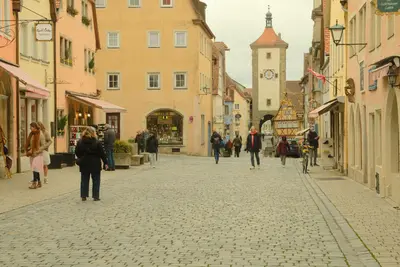
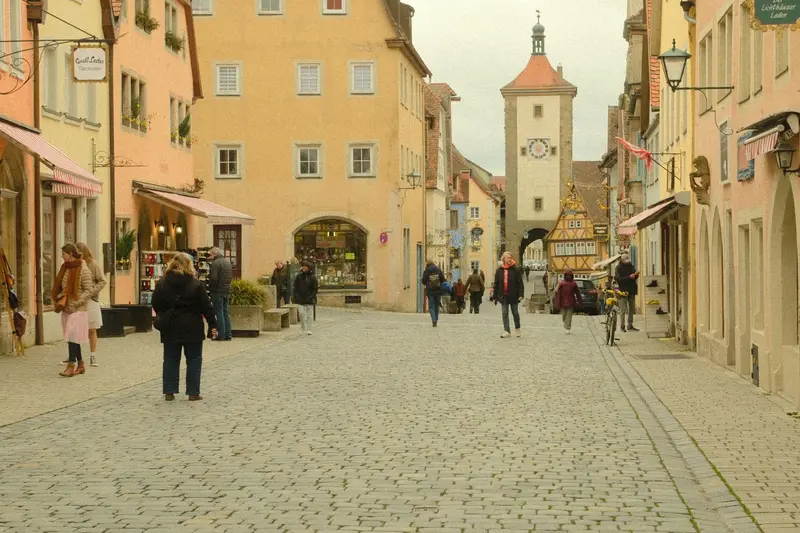
    Rothenburg ob der Tauber owes its distinguishing name to its location above the Tauber. The city, with its approximately 11,000 inhabitants, is still surrounded by a 3360-meter-long town wall, whose course dates back to the early 14th century.

    Discover
    Würzburg

    Place 2 of 4

    Würzburg

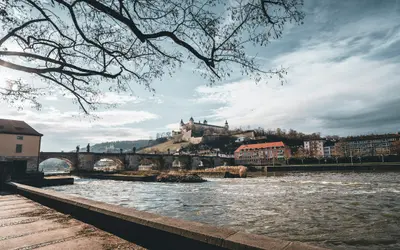
    Würzburg lies in the Maindreieck region and has a population of around 128,000.

    Discover
    Bamberg

    Place 3 of 4

    Bamberg

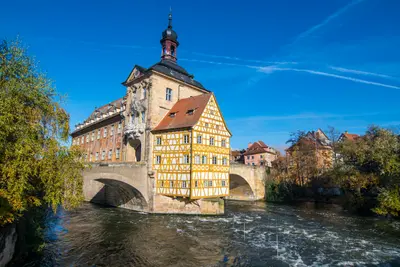
    Bamberg an der Regnitz hat rund 80.000 Einwohner, seine Altstadt ist seit 1993 UNESCO-Welterbe. Weil sie sich über sieben Hügel verteilt, nennt man Bamberg auch das „Fränkische Rom“.

    Discover
    Nuremberg

    Place 4 of 4

    Nuremberg

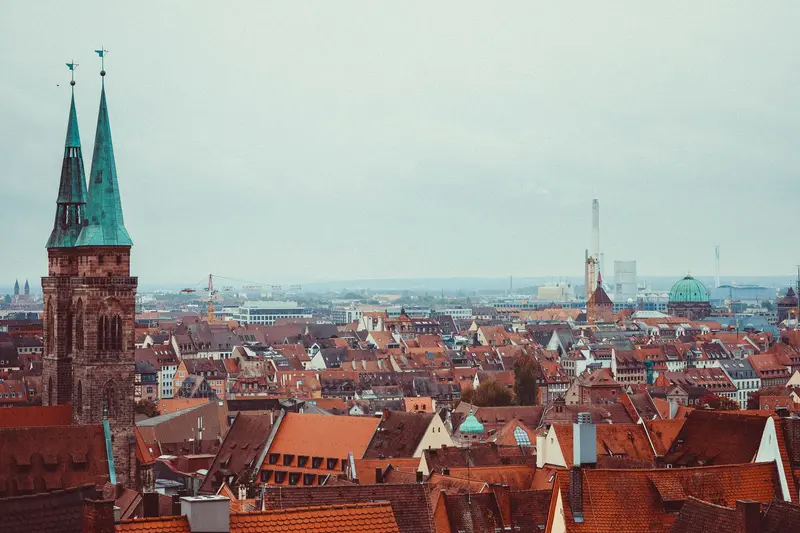
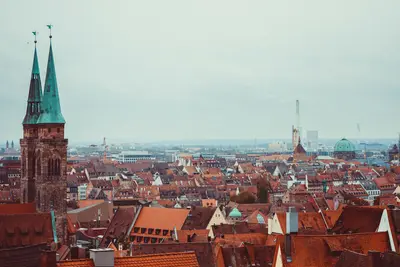
    Nuremberg is Bavaria's second-largest city, with over 520,000 inhabitants. The Pegnitz divides the almost entirely walled Old Town into the Sebalder and Lorenzer sides.

    Nuremberg has over half a million residents, yet most attractions lie within its almost fully preserved city walls and are easily reached on foot.

    Discover

    Round trips through this region

    Classics in 14 Days

    This 14-day journey combines Germany's great cities and landscapes from Berlin to Cologne. From the capital, via Dresden to Franconia, whose Bamberg Old Town is a UNESCO World Heritage site since 1993, and further via Nuremberg to Munich. Near Füssen, you visit Schloss Neuschwanstein; the route then leads via Heidelberg to Koblenz at the Moselle estuary, the north end of the Upper Middle Rhine Valley World Heritage site. The journey ends in Cologne; from the main station, you can reach Köln/Bonn Airport in 11 minutes by Regional-Express.

    14 Days
    10 stops
    Open jaw

    Nearby

    Rothenburg ob der Tauber

    Rothenburg ob der Tauber

    Rothenburg ob der Tauber owes its distinguishing name to its location above the Tauber. The city, with its approximately 11,000 inhabitants, is still surrounded by a 3360-meter-long town wall, whose course dates back to the early 14th century. At Plönlein, a fork in the road lined with half-timbered houses, you look upon Sieberstor and Kobolzellertor.In the market square, the historic clock of the Ratstrinkstube from 1466 displays the scene of the legendary Meistertrunk; from the Town Hall Tower, the view extends 60 meters high over the rooftops. In the Gothic Church of St. Jakob stands Tilman Riemenschneider's Holy Blood Altar. Rothenburg is located on the Romantic Road between Würzburg and Füssen.
    Nuremberg

    Nuremberg

    Nuremberg is Bavaria's second-largest city, with over 520,000 inhabitants. The Pegnitz divides the almost entirely walled Old Town into the Sebalder and Lorenzer sides. On the northern edge, the Imperial Castle stands, where all emperors and kings of the Holy Roman Empire temporarily resided between 1105 and 1571. Albrecht Dürer lived from 1509 until his death in 1528 in his house at the Tiergärtnertor.The city also confronts its dark history: a Documentation Center is located on the former Nazi Party Rally Grounds, and the Nuremberg Trials began in the Palace of Justice in November 1945. The Germanisches Nationalmuseum is considered the largest cultural history museum in the German-speaking world, and during Advent, the Christkindlesmarkt draws visitors.
    Bamberg

    Bamberg

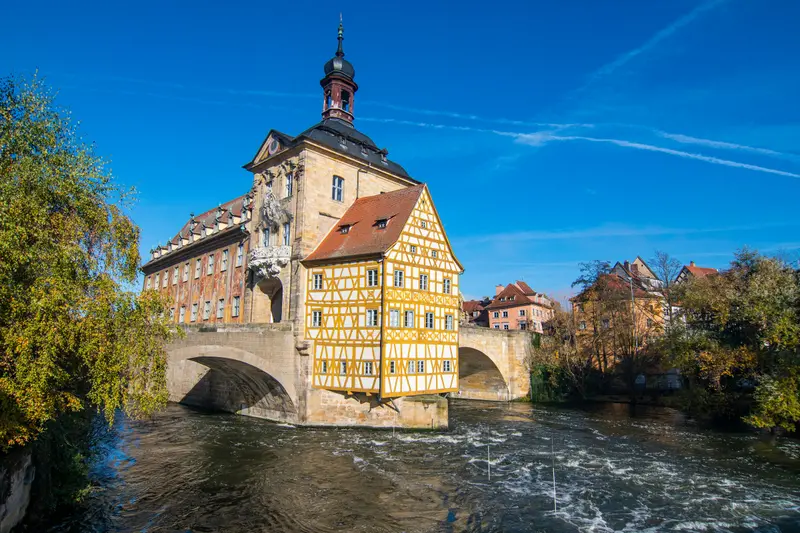
    Bamberg an der Regnitz hat rund 80.000 Einwohner, seine Altstadt ist seit 1993 UNESCO-Welterbe. Weil sie sich über sieben Hügel verteilt, nennt man Bamberg auch das „Fränkische Rom“. Auf dem Domberg steht der viertürmige Kaiserdom, der 1237 geweiht wurde und das einzige Papstgrab Deutschlands birgt.Mitten im linken Regnitzarm sitzt das Alte Rathaus mit seinen bemalten Fassaden, auf der Regnitzinsel reihen sich in Klein-Venedig Fischerhäuser aus dem 17. Jahrhundert mit langen Holzbalkonen. Berühmt ist Bamberg für sein Rauchbier, etwa das Aecht Schlenkerla, dessen Malz über Buchenholz gedarrt wird.
    Würzburg

    Würzburg

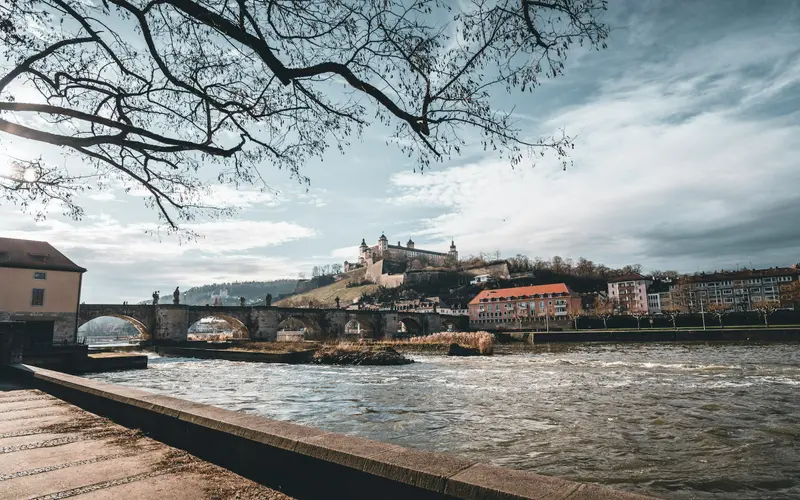
    Würzburg lies in the Maindreieck region and has a population of around 128,000. The Residence of the Prince-Bishops, built from 1720 according to plans by Balthasar Neumann, has been a UNESCO World Heritage site since 1981, including its Court Garden and Residence Square. The approximately 580-square-meter ceiling fresco by Giovanni Battista Tiepolo stretches above its staircase.The Old Main Bridge, with its twelve statues of saints, has been closed to cars since 1990 and leads over to Marienberg Fortress, which towers approximately 100 meters above the Main river. The city is the center of a renowned wine region; three of Germany's fifteen largest wineries are located here.
    Heidelberg & Neckar

    Heidelberg & Neckar

    The Neckar links two distinct cities in Baden-Württemberg: Stuttgart, the state capital in its valley location, with the river flowing through its northeast, and Heidelberg, where it exits the Odenwald into the Upper Rhine Plain. Heidelberg's castle ruin above the old town attracts, according to its administration, around a million guests annually.Here, experience the romance of Germany's oldest university city, alongside car city Stuttgart with its Mercedes-Benz and Porsche museums. Stuttgart's vineyards reach right into the city centre, and Wilhelma in Bad Cannstatt ranks among Germany's most visited zoos.