Fernweh: Home
    ExploreTravel GuidesPlan a tripMy tripLast visited
    de|en
    All Places & RegionsAll highlightsAbout FernwehFAQPrivacy PolicyImprint
    ExploreTravel GuidesPlan a tripMy tripLast visited
    • Neighborhoods & highlights
    • Walking tours
    • Eat & drink
    • Food culture
    • Culture
    • Getting around
    • Accommodation
    • Plan trip
    • Nearby
    Pompeii

    Italy

    Pompeii

    CityCultureFor Families

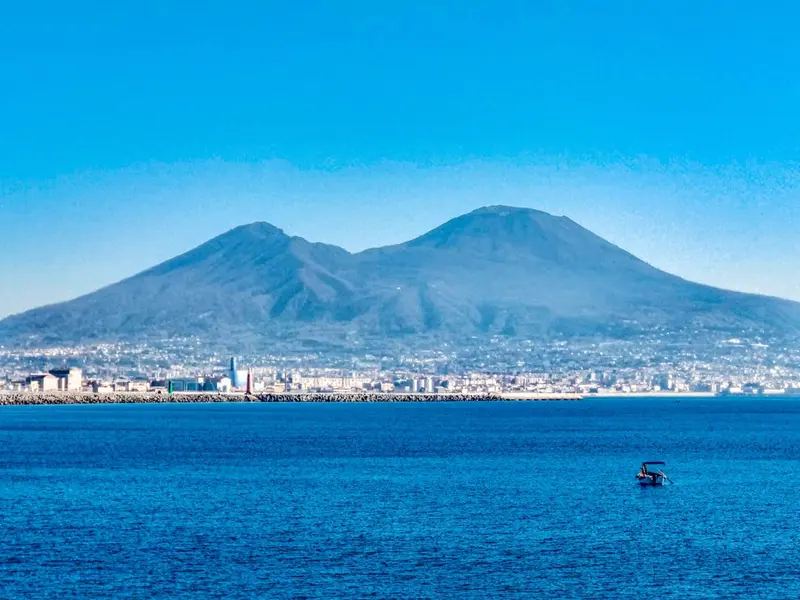
    Pompeii was a Roman town at the foot of Mount Vesuvius, which disappeared under four to six meters of pumice and ash during the eruption in 79 AD.

    by Felix Gillen

    1. Home
    2. Destinations
    3. Italy
    4. Campania
    5. Pompeii
    Pompeii was a Roman town at the foot of Mount Vesuvius, which disappeared under four to six meters of pumice and ash during the eruption in 79 AD. It has been excavated since 1748, revealing streets, houses, workshops, temples, theaters, and baths.The archaeological site, a UNESCO World Heritage site since 1997, lies on the outskirts of the modern town of Pompei, southeast of Naples, about 35 to 40 minutes away via the Circumvesuviana.

    Sights in Pompeii

    Discover the most important sights and attractions

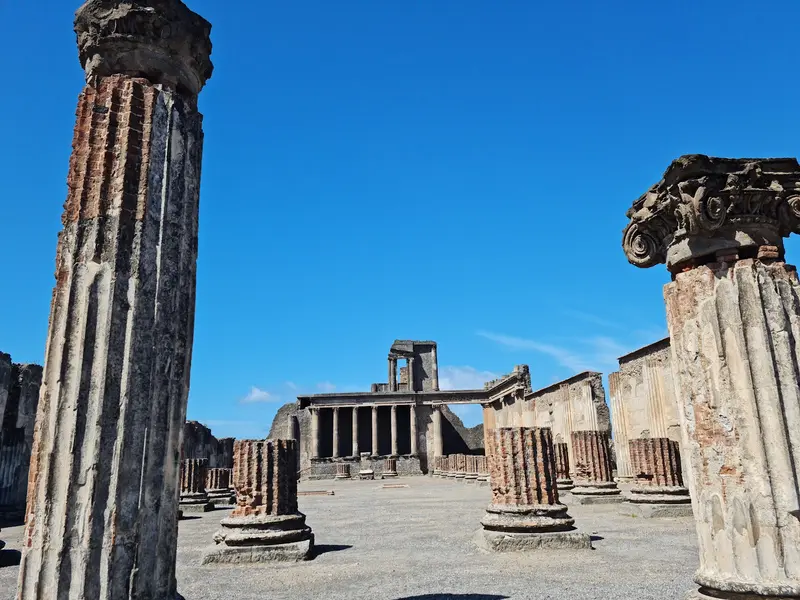
    Forum
    Historic Landmark

    1Forum

    Rectangular main square in the center of the ancient city, lined by the remains of significant public buildings such as the Capitol (Temple of Jupiter), the Basilica, a court and market hall, and several temples.
    Open in Google Maps
    Villa dei Misteri
    Historic Landmark

    2Villa dei Misteri

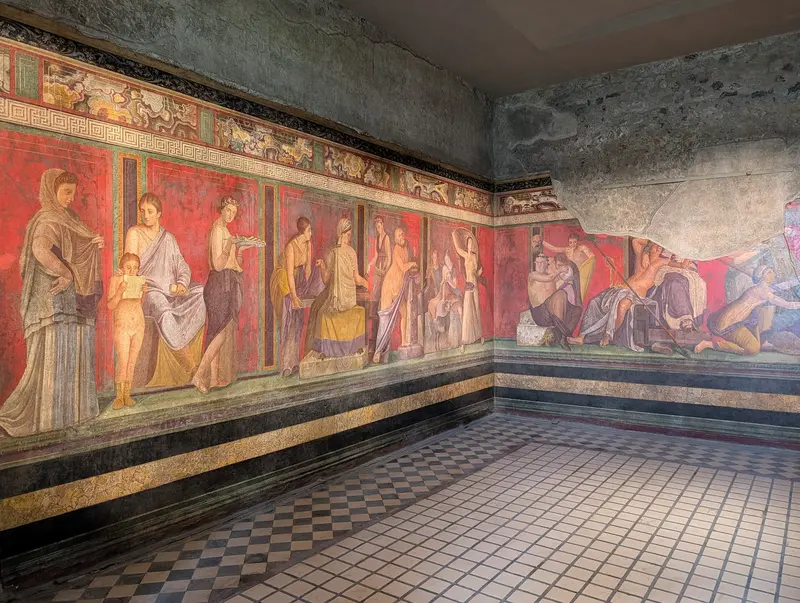
    Villa approximately 400 meters northwest of the city walls, along the Tomb Roads outside Porta Ercolano. One hall is painted all around with a fresco cycle on a red ground, its scenes mostly interpreted as the initiation of a woman into the cult of Dionysus; some scholars see other meanings in them.
    Open in Google Maps
    Amphitheater
    Historic Landmark

    3Amphitheater

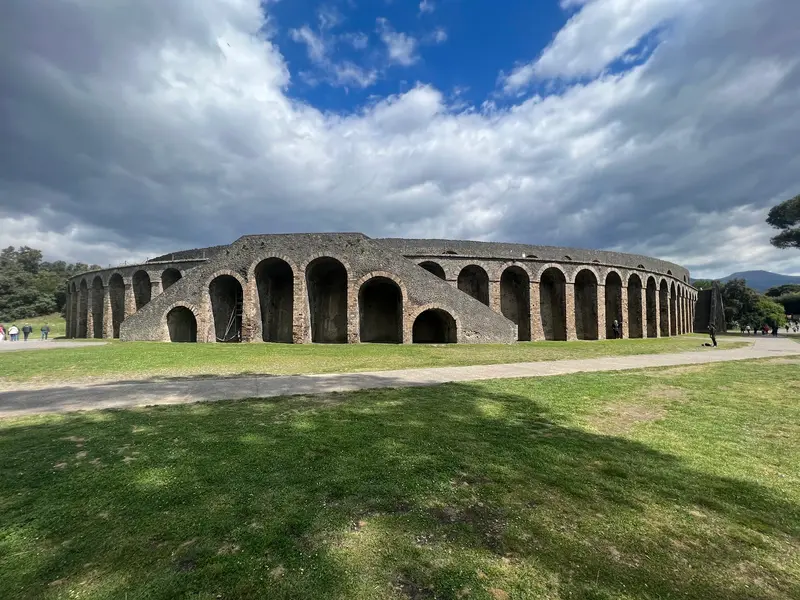
    Dating to 70 BC, the amphitheater in the city's east is among the oldest surviving Roman amphitheaters and one of the first made of stone instead of wood. It seated around 20,000 spectators. Nearby is the entrance Piazza Anfiteatro.
    Open in Google Maps
    Stabian Thermae

    4Stabian Thermae

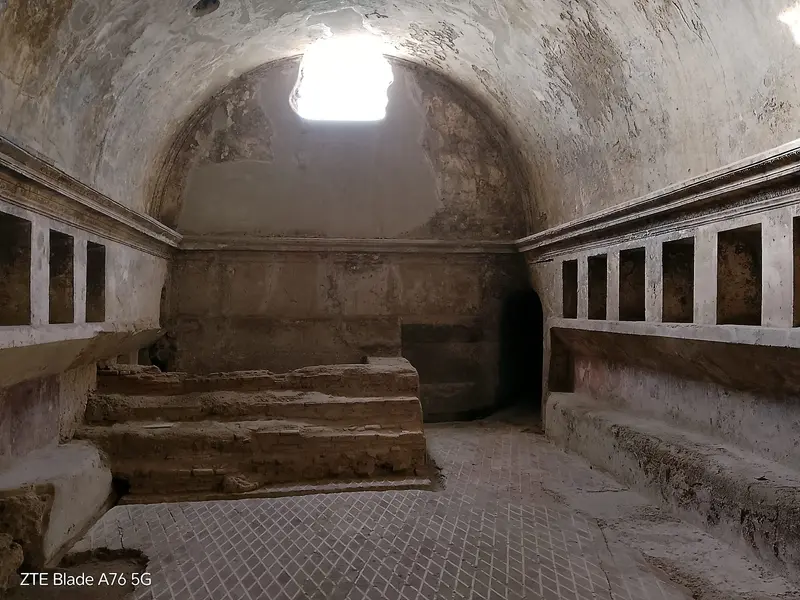
    The oldest and largest of Pompeii's five public baths, at the intersection of Via dell'Abbondanza and Via Stabiana, begun circa 125 B.C. It includes separate areas for men and women with changing rooms, cold, lukewarm, and hot baths, plus a colonnaded courtyard for physical exercise with a swimming pool.
    Open in Google Maps
    Casa del Fauno
    Historic Landmark

    5Casa del Fauno

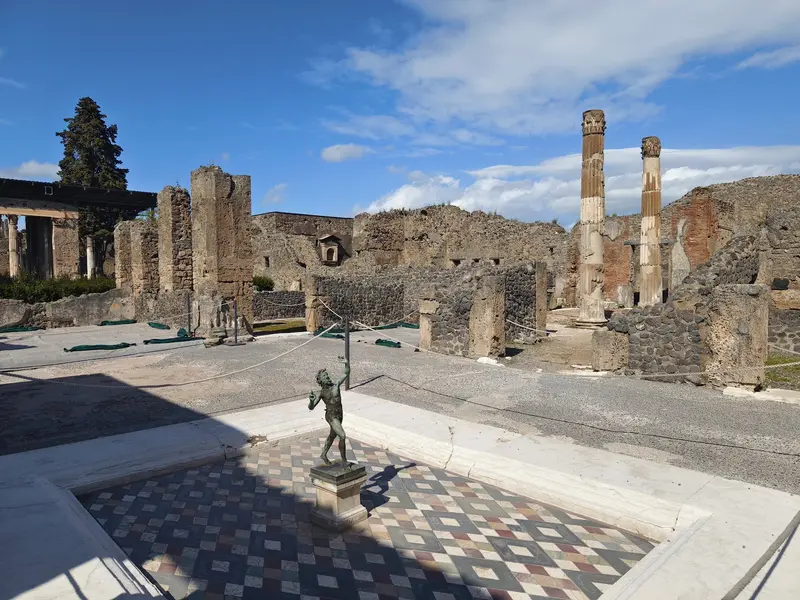
    One of Pompeii's largest and most splendid houses, built around 180 BC, with approximately 3,000 square meters and two peristyle courtyards. It is named after the bronze statue of a dancing Faun in the atrium, which stands here as a copy. The famous Alexander Mosaic from this house is now housed in the National Archaeological Museum in Naples, with a replica on display here.
    Open in Google Maps

    City walks in Pompeii

    Curated walking tours through the city's highlights, handpicked by experienced travel journalists.

    Echoes of Pompeii: A Journey Through Time in Ancient Streets

    Discover Pompeii on a fascinating 2-hour tour that leads you to the most impressive sites of the ancient city. From bustling squares to silent houses and poignant testimonies of the catastrophe, experience Roman life up close. An unforgettable walk through history.

    ~2 Std.
    Open in Google Maps
    Stops (7)

    Restaurants & Cafes

    1

    Pizzeria I Matti

    Restaurant and Pizzeria on Via Plinio in modern Pompei, a short walk from the Piazza Anfiteatro entrance.
    Show on Google Maps
    2

    Caupona

    Restaurant south of the excavation site, whose rooms are designed with frescoes in the style of a Roman inn. The menu offers modern cuisine and dishes based on ancient recipes.
    Show on Google Maps
    3

    Bosco de' Medici Winery

    Winery on the northern outskirts of Pompeii with vineyards at the foot of Vesuvius. Besides tastings of its own wines, it offers food.
    Show on Google Maps

    Dining & Drinks

    Pompeii lies in the wine region at Vesuvius, with a Neapolitan-influenced cuisine.

    Lacryma Christi of Vesuvius

    Red and white wine from the volcanic slopes of Vesuvius, part of DOC Vesuvio, made mostly from local varieties Piedirosso and Caprettone.

    Pomodorino del piennolo

    Small tomatoes from Vesuvius, whose trusses are tied into a large bunch after harvest and hung for storage, traditionally as stores for the cold months. They bear a Protected Designation of Origin (DOP).

    The Story

    From the 8th century BC, settlements of the Osci lay in the area of Pompeii; later, Greek influences arrived, and the Samnites ruled the city. After Sulla's siege in 89 BC, Pompeii became a Roman colony. An earthquake severely damaged the city in 62 AD, and many buildings were still being rebuilt when Vesuvius erupted in 79 AD. Estimates for the population at that time range from 10,000 to 20,000.Excavations began in 1748 under Roque Joaquín de Alcubierre, and in 1763, the city was definitively identified as Pompeii. Giuseppe Fiorelli, director of excavations from 1863, developed the method of casting plaster into the cavities left by victims' bodies in the ash. Excavations continue to this day, in recent years, notably in Regio V.Wall paintings, mosaics, and inscriptions make Pompeii one of the most important sources for daily life in Roman antiquity. Many originals are housed in the National Archaeological Museum in Naples.

    Arrival and On the Go

    The regional train Circumvesuviana connects Naples (Piazza Garibaldi) and Sorrento with the Pompei Scavi-Villa dei Misteri station, located opposite the Porta Marina entrance. From Naples, the journey takes about 35 to 40 minutes, with trains running approximately every 20 to 30 minutes during the day. Additionally, the Trenitalia regional train stops in Pompeii, about a 15-minute walk from the Piazza Anfiteatro entrance.Within the archaeological site, you explore on foot. If you come by car, you can park in paid parking lots near the entrances. A shuttle bus runs from Pompeii to Vesuvius. Current information on the region can be found in the travel and security advisories of the Federal Foreign Office.

    Accommodations in Pompeii

    Find perfect stay in Pompeii

    Booking.com* (Affiliate link)
    Search Hotels
    Agoda* (Affiliate link)
    Search Hotels
    Airbnb
    Vacation Rentals

    * Affiliate link: if you book through it, we earn a small commission. The price stays the same for you.

    Campgrounds in Pompeii

    Find perfect campground in Pompeii

    Search via Google Maps
    Campgrounds nearby (15km)
    Camping.info
    Find Campgrounds
    Park4Night
    RV Parks & Camping

    Plan your trip to Pompeii

    Save places, build a route and plan your city trip, all in one place.

    1. 1
      Sunrise over alpine peaks and a sea of clouds
      1234

      Round trip

      12 days · 4 stops

      Saved

      Pick a route

      Pick a ready-made one or save places and plan your own.

      Open bookmarks
    2. 2

      Trip to Pompeii

      Live
      • 1Forum3 days
      • 2Villa dei Misteri4 days
      • 3Amphitheater5 days
      Budget

      Plan your trip

      The planner sorts stops, days and budget. Plan together in real time.

      Start trip planning
    3. 3
      9:41 No signal
      Pompeii
      Available offline

      Use it on the road

      Download the guide to your phone and use it on site, even offline.

    Nearby

    Positano

    Positano

    Positano lies on the western Amalfi Coast, its houses climbing from the sea far up the hillside. The colorful facades, Santa Maria Assunta's majolica dome, and the main beach below define the town's image.The town has about 3,700 residents. Most routes within the town are stairs and steep alleys.
    Ravello

    Ravello

    Ravello is situated on a rocky plateau about 350 meters above the Amalfi Coast, above Atrani. This small town of around 2,300 residents is known for its villas, gardens, and panoramic terraces.In the Middle Ages, Ravello belonged to the Duchy of Amalfi; merchant families like the Rufolo built their palaces here. Today, Villa Rufolo, Villa Cimbrone, and the summer Ravello Festival define the town.
    Amalfi Coast

    Amalfi Coast

    The Amalfi Coast is the southern edge of the Sorrentine Peninsula on the Gulf of Salerno, with approximately 40 kilometers of coastal road stretching between Positano and Vietri sul Mare. The mountains here drop steeply into the sea; lemon groves cling to the slopes, and densely built towns perch in the bays and on rocky promontories.The most famous are Positano, Amalfi, Atrani, and Ravello. Since 1997, the coast has been a UNESCO World Heritage site.
    Sorrento

    Sorrento

    Sorrent is situated on a high tuff terrace, descending steeply towards the Gulf of Naples, overlooking Mount Vesuvius. This town of about 15,000 residents is the main hub of its namesake peninsula; travelers have been drawn here since the era of the Grand Tour.The Old Town's street network still adheres to the ancient city's grid layout. Citrus groves flourish all around. From Marina Piccola port, ships sail to Capri, Naples, and the Amalfi Coast.
    Campania

    Campania

    Campania is located in southwest Italy on the Tyrrhenian Sea, with Naples as its capital. Around the Gulf of Naples, the most famous destinations cluster: Mount Vesuvius, the archaeological sites of Pompeii and Herculaneum, the Sorrento Peninsula, and the islands of Capri, Ischia, and Procida.South of this, the Amalfi Coast stretches along with its towns built into the cliffs; further south are the Greek temples of Paestum and the Cilento National Park. Inland lie the Royal Palace of Caserta and the hills of Irpinia, known for producing the region's famous wines.

    Sources & method

    • Photos: Google Maps. Each photo carries its credit.
    • Place data such as addresses and ratings comes from Google Maps.
    • The content is based on web research from public, traceable sources. How the content is made · The role of AI