ExploreTravel GuidesPlan a trip
    de|en
    All Places & RegionsAbout FernwehFAQPrivacy PolicyImprint
    ExploreTravel GuidesPlan a trip
    • Overview
    • Places in the region
    • Food culture
    • Culture
    • Getting around
    • Round trips
    • Nearby
    Valais

    Switzerland

    Valais

    Region

    Valais in southwestern Switzerland follows the Rhone Valley and is home to most of the country's four-thousand-meter peaks, including the Matterhorn and Dufourspitze, Switzerland's highest peak.

    1. Home
    2. Destinations
    3. Switzerland
    4. Valais
    Valais in southwestern Switzerland follows the Rhone Valley and is home to most of the country's four-thousand-meter peaks, including the Matterhorn and Dufourspitze, Switzerland's highest peak. The canton is bilingual: German is spoken in Upper Valais, French in Lower Valais.Valais is also Switzerland's largest wine-growing canton and home to Raclette. Its most famous place is car-free Zermatt.
    Valais follows the Rhone Valley from Gletsch to Lake Geneva. At Siders, the language border: German upstream, French downstream. 41 of the 48 Swiss 4000m peaks lie in the Valais Alps, including Matterhorn and Dufourspitze. In the Rhone Valley is Switzerland's largest wine region, home to Fendant and Raclette. Car-free Zermatt is its most famous resort, reached by train via Visp.
    Zermatt

    Place 1 of 2

    Zermatt

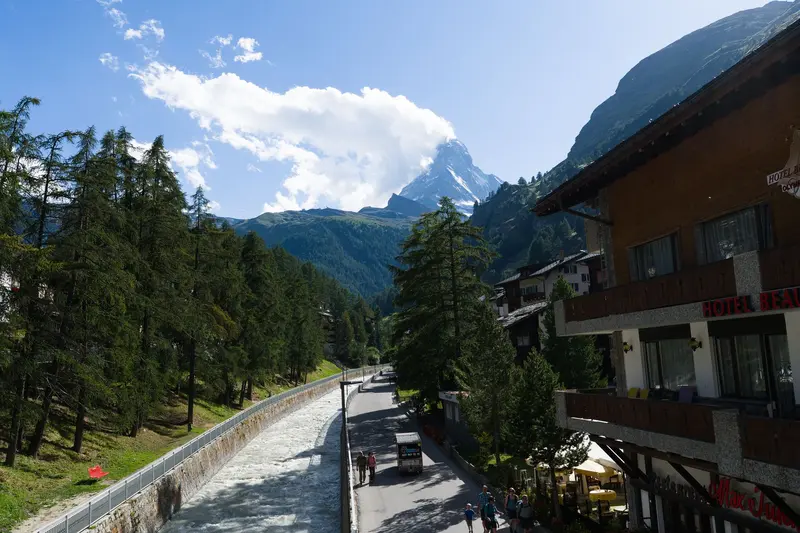
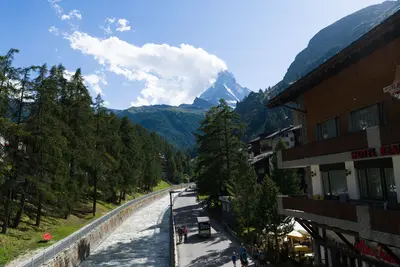
    Zermatt is located in Valais at the end of the Matter Valley, directly beneath the 4478-meter-high Matterhorn.

    Zermatt ist ein autofreies Bergdorf am Ende des Mattertals im Wallis. Autos parkst du im Terminal in Täsch, von dort fährt ein Pendelzug ins Dorf, im Ort selbst sind Elektrobusse, Elektrotaxis und Pferdekutschen unterwegs.

    Discover
    Aletsch Glacier

    Place 2 of 2

    Aletsch Glacier

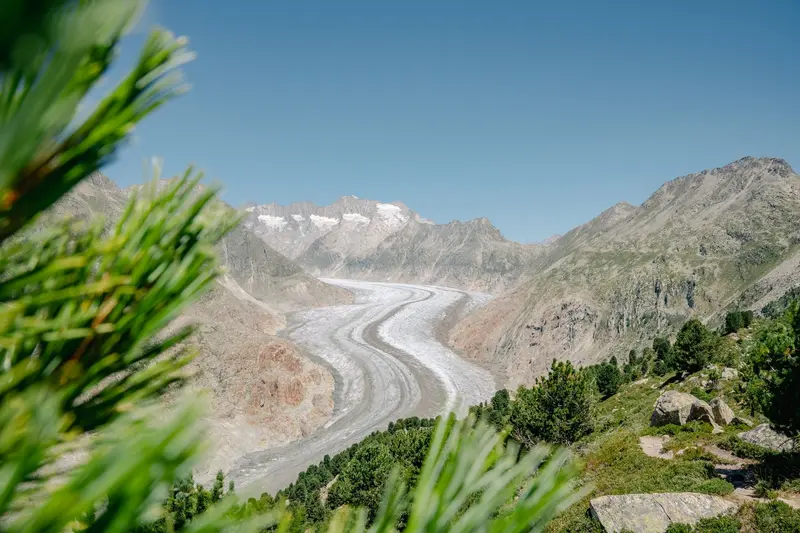
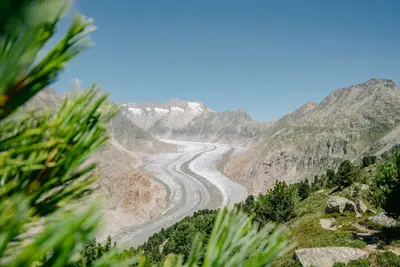
    At 23 kilometres, the Great Aletsch Glacier in Oberwallis is the longest glacier in the Alps and has been part of the UNESCO World Heritage Swiss Alps Jungfrau-Aletsch since 2001.

    The Aletschgletscher isn't on a road, but above the car-free mountain villages of the Aletsch Arena. Riederalp, Bettmeralp, and Fiescheralp are only accessible by cable car from the Rhonetal; cars stay at the valley stations.

    Discover

    Sights in Valais

    Discover the most important sights and attractions

    Basilica of Valère
    Church

    Basilica of Valère

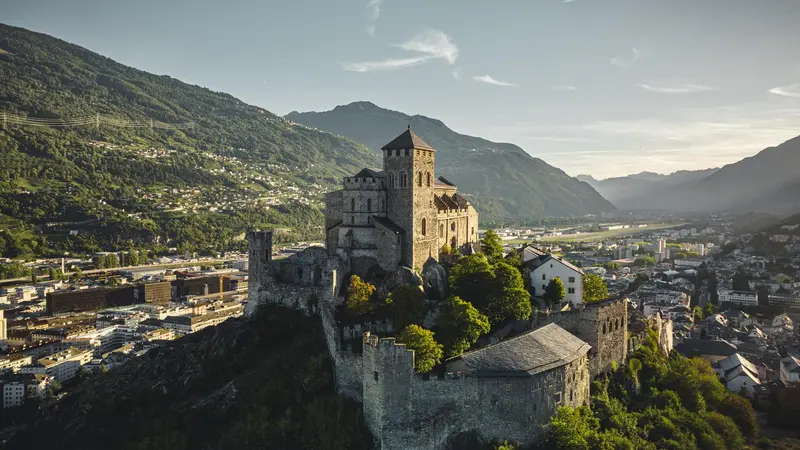
    The fortified church from the 12th and 13th centuries is perched on one of the two castle hills above Sion. High on the west wall hangs a swallow's nest organ from around 1435, which is considered the world's oldest playable organ. You can visit the church itself for free.
    Open in Google Maps

    Food & Drink in Valais

    Raclette

    Melted Valais Raclette cheese, scraped directly from the wheel and served with potatoes, gherkins, and pearl onions.

    Cholera

    A covered pie from Goms with potatoes, leeks, apples, and cheese.

    Valais Wine

    Valais is Switzerland's largest wine region; typical varieties include Fendant, Petite Arvine, and Cornalin.

    Culture in Valais

    The Valais is bilingual: German is spoken in Upper Valais, French in Lower Valais, the border runs near Sierre. In the side valleys, old wooden granaries still stand on stone slabs, designed to protect against mice.Cow FightsIn spring and autumn, the black Hérens cows compete in cow fights; the queen is celebrated throughout the valley. The highlight is the cantonal final in Aproz.AlpinismZermatt became famous with the first ascent of the Matterhorn in 1865. In the Matterhorn Museum, you can learn more about this period.

    Travelling in Valais

    The train goes through the Rhone Valley from Lausanne, Martigny, Sion to Brig; via the Lötschberg Base Tunnel, you're quickly in Visp from Bern. The Matterhorn Gotthard Bahn then travels to car-free Zermatt. You reach the side valleys by Postauto. The Glacier Express connects Zermatt with St. Moritz.

    Round trips through this region

    Grand Rail Tour: Lakes, Passes, and Glaciers

    This round trip connects Switzerland's most famous destinations almost exclusively by train, bus, and boat. From Zurich, it's to Lake Lucerne and Lucerne, and through the Gotthard to Italian-speaking Lugano. With the Bernina Express Bus, you travel over Lake Como to Tirano, and from there on the Bernina Express over the Berninapass to Upper Engadine and St. Moritz. The Glacier Express takes you in approximately eight hours over 291 bridges and through 91 tunnels to Zermatt, beneath the Matterhorn. Via Valais, you reach the Bernese Oberland with Jungfraujoch and Lauterbrunnen Valley, before the journey ends in the federal city of Bern.

    14 Days
    7 stops

    Nearby

    Zermatt

    Zermatt

    Zermatt is located in Valais at the end of the Matter Valley, directly beneath the 4478-meter-high Matterhorn. This car-free mountain resort is the starting point for scenic railways, hikes, and high-alpine tours around the four-thousander peaks on the Italian border.By car, you can only get as far as Täsch; from there, a train shuttles to Zermatt. Within the village, electric buses and taxis operate. The Gornergrat Bahn, a cogwheel railway, has been operating since 1898, taking 33 minutes from the village to the 3089-meter-high Gornergrat, offering views of the Matterhorn and the Monte Rosa massif. Even higher, you can ascend to the Matterhorn Glacier Paradise at 3883 meters. For both railways, the Swiss Travel Pass only offers a discount. Zermatt is also the terminus of the Glacier Express to St. Moritz.
    Aletsch Glacier

    Aletsch Glacier

    At 23 kilometres, the Great Aletsch Glacier in Oberwallis is the longest glacier in the Alps and has been part of the UNESCO World Heritage Swiss Alps Jungfrau-Aletsch since 2001. From the panoramic peaks above the car-free villages of the Aletsch Arena, you can look down on the mighty ice stream, which sweeps in a wide arc from the Jungfrau region into the valley.The three most important viewpoints are the Eggishorn at 2869 metres, accessible by cable cars from Fiesch via Fiescheralp, the Bettmerhorn at 2872 metres above Bettmeralp, and the Moosfluh at 2333 metres above Riederalp. To reach Bettmeralp and Riederalp, you travel by train to Betten or Mörel and from there ascend by cable car. At Konkordiaplatz, where several ice streams converge, the ice is up to 900 metres thick.
    Jungfrau Region

    Jungfrau Region

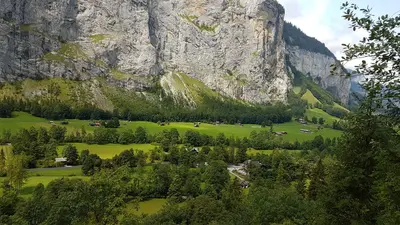
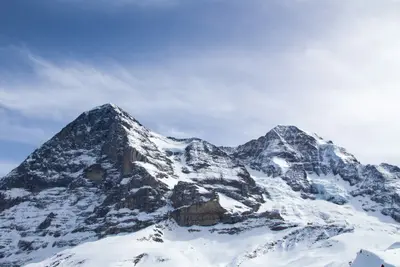
    The Jungfrau Region in the Bernese Oberland lies at the foot of Eiger, Mönch, and Jungfrau, south of Interlaken. Here, the Jungfraubahn has been traveling since 1912 through Eiger and Mönch to the Jungfraujoch, which, at 3,454 meters, is Europe's highest-altitude railway station.From Grindelwald Terminal, the Eiger Express takes you to Eigergletscher station in 15 minutes, from there you continue by cogwheel train; from Interlaken Ost, the journey takes about an hour and a half. At the top, you look out onto the Aletsch Glacier, at 23 kilometers the longest glacier in the Alps and part of the UNESCO World Heritage Site Swiss Alps Jungfrau-Aletsch. In the Lauterbrunnen Valley, also known as the Valley of 72 Waterfalls, and in Grindelwald and Wengen, many hiking trails begin. The Swiss Travel Pass only grants a discount on the journey to the Jungfraujoch.
    Bern Region

    Bern Region

    The Bern region stretches from the federal city on the Aare to the high mountains of the Bernese Oberland. To the north lies Bern with its Old Town, a UNESCO World Heritage site since 1983, while to the south stand Eiger, Mönch, and Jungfrau.Between them lie Lake Thun and Lake Brienz, along with Interlaken, the starting point for Grindelwald, Lauterbrunnen, and the Jungfraujoch.
    Chamonix-Mont-Blanc

    Chamonix-Mont-Blanc

    Chamonix-Mont-Blanc liegt am Fuß des Mont Blanc in Hochsavoyen und gilt als Wiege des Alpinismus. Der Ort ist ein internationales Zentrum für Bergsteiger, Wanderer und Wintersportler. Die Seilbahn auf die Aiguille du Midi (3842 Meter) bringt dich mitten ins Mont-Blanc-Massiv, die Zahnradbahn zum Montenvers zur Mer de Glace, dem größten Gletscher Frankreichs, mit ihrer jährlich neu gehauenen Eisgrotte. Im Ortszentrum mischen sich savoyische Architektur, Belle-Époque-Hotels, Ausrüstungsläden und Restaurants. Die Geschichte der Alpenerschließung zeigt das Musée Alpin. Am vollsten ist es im Juli und August sowie in den Winterferien im Februar; ruhiger sind Juni, September und der Frühwinter. Tickets für die Aiguille du Midi buchst du am besten frühzeitig online, idealerweise für eine der ersten Fahrten am Morgen.