Fernweh: Home
    ExploreTravel GuidesPlan a tripMy tripLast visited
    de|en
    All Places & RegionsAll highlightsAbout FernwehFAQPrivacy PolicyImprint
    ExploreTravel GuidesPlan a tripMy tripLast visited
    • Neighborhoods & highlights
    • Eat & drink
    • Culture
    • Getting around
    • Accommodation
    • Plan trip
    • Nearby
    Beynac-et-Cazenac
    Thesupermat / Wikimedia Commons / CC BY-SA 3.0

    France

    Beynac-et-Cazenac

    CityCulture

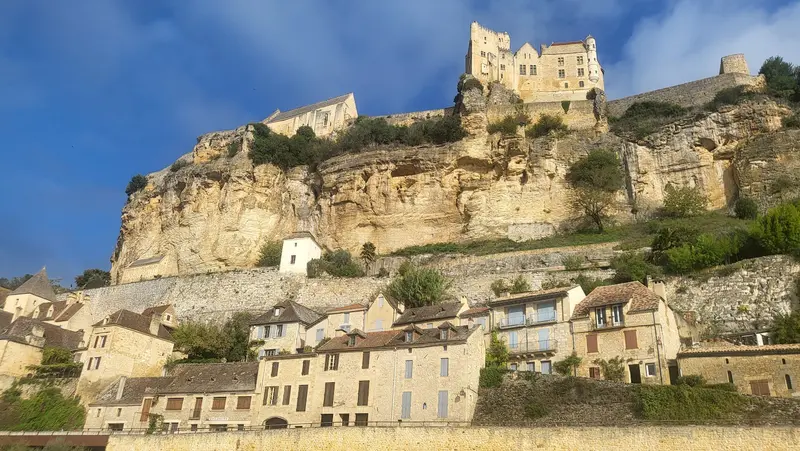
    Beynac-et-Cazenac lies about 10 kilometers southwest of Sarlat on the banks of the Dordogne in the Périgord Noir and is one of the Plus Beaux Villages de France.

    by Felix Gillen

    1. Home
    2. Destinations
    3. France
    4. Dordogne (Périgord)
    5. Beynac-et-Cazenac
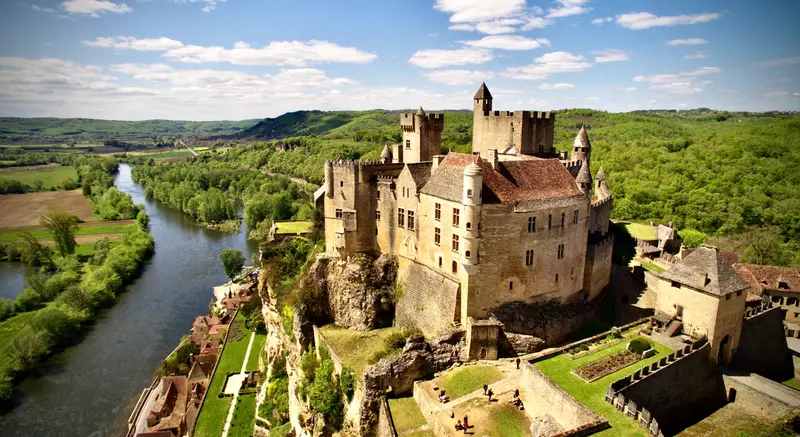
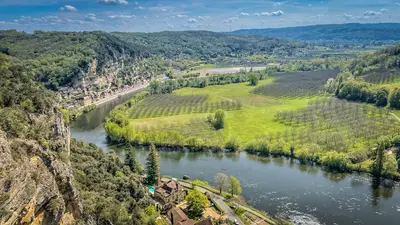
    Beynac-et-Cazenac lies about 10 kilometers southwest of Sarlat on the banks of the Dordogne in the Périgord Noir and is one of the Plus Beaux Villages de France. Above the village, on a 150-meter-high cliff stands Beynac Castle, dominating the valley for more than nine centuries. Cobbled lanes, small squares, houses with Lauzes stone slab roofs, and fortified gates lead from the river up to the castle.From the Kalvarienberg above the Dordogne, you overlook the valley with its castles. On the opposite bank lies Castelnaud, the English adversary of the French-aligned Beynac Castle during the Hundred Years' War. Down by the river, Gabarre boats depart for cruises, and canoe tours lead upstream from here, past Castelnaud and La Roque-Gageac.

    Sights in Beynac-et-Cazenac

    Discover the most important sights and attractions

    Gabarres de Beynac
    Point of Interest

    1Gabarres de Beynac

    Gabarres are the traditional flat-bottomed cargo boats of the Dordogne, with which goods were formerly transported downstream. From the banks of Beynac, they now embark on scenic river tours; from the water, you see the village beneath its castle cliff and the valley with its castles from a different perspective.
    Open in Google Maps
    Château de Beynac
    Castle

    2Château de Beynac

    Die Barone von Beynac errichteten die Burg im 12. Jahrhundert auf einer 150 Meter hohen Klippe über der Dordogne. Richard Löwenherz nahm sie Ende des 12. Jahrhunderts in Besitz, im Hundertjährigen Krieg stand sie auf französischer Seite gegenüber dem englisch besetzten Castelnaud. Seit 1944 ist sie Monument historique, gedreht wurden hier unter anderem „Les Visiteurs 2" und „The Last Duel". Die Burg ist ganzjährig zu besichtigen, mit Begleitheft oder Audioguide auf dem Handy; Führungen gibt es von April bis Oktober. Einen eigenen Parkplatz hat sie nicht, du gehst vom Dorf zu Fuß hinauf.
    Open in Google Maps

    Restaurants in Beynac-et-Cazenac

    Castle and History

    The Castle on the CliffThe Barons of Beynac had the castle built in the 12th century. At the end of the 12th century, Richard the Lionheart took possession of the fortress, while Simon de Montfort passed through here during the Albigensian Crusade. In the Hundred Years' War, the Dordogne formed the border between the French and English kingdoms: Beynac sided with France, while the opposing Castelnaud Castle was in English hands. Since 1944, the castle has been protected as a Monument historique.Film BackdropWith its walls and views over the valley, the castle served as a filming location, including for “Les Visiteurs 2” and “The Last Duel”.Village LifeThe former castle chapel is now the village church. A local producers' market is held on Monday mornings from mid-June to mid-September.

    Exploring locally

    Getting ThereFrom Sarlat, it's about 10 kilometers by car. The castle does not have its own car park: you park your car in the designated village car parks and walk up through the steep alleys.On the River and On FootGabarres, the traditional flat-bottomed river boats, depart from Beynac for scenic cruises on the Dordogne.Canoe rentals offer routes between Beynac, Castelnaud, La Roque-Gageac, Cénac and Carsac.The marked hiking trail from Domme to Beynac is about 12 kilometers long, easy and can be completed in approximately four hours; it passes through Cénac, La Roque-Gageac and Castelnaud.

    Accommodations in Beynac-et-Cazenac

    Find perfect stay in Beynac-et-Cazenac

    Booking.com* (Affiliate link)
    Search Hotels
    Agoda* (Affiliate link)
    Search Hotels
    Airbnb
    Vacation Rentals

    * Affiliate link: if you book through it, we earn a small commission. The price stays the same for you.

    Campgrounds in Beynac-et-Cazenac

    Find perfect campground in Beynac-et-Cazenac

    Search via Google Maps
    Campgrounds nearby (15km)
    Camping.info
    Find Campgrounds
    Park4Night
    RV Parks & Camping

    Plan your trip to Beynac-et-Cazenac

    Save places, build a route and plan your city trip, all in one place.

    1. 1
      Sunrise over alpine peaks and a sea of clouds
      1234

      Round trip

      12 days · 4 stops

      Saved

      Pick a route

      Pick a ready-made one or save places and plan your own.

      Open bookmarks
    2. 2

      Trip to Beynac-et-Cazenac

      Live
      • 1Gabarres de Beynac3 days
      • 2Château de Beynac4 days
      Budget

      Plan your trip

      The planner sorts stops, days and budget. Plan together in real time.

      Start trip planning
    3. 3
      9:41 No signal
      Beynac-et-Cazenac
      Available offline

      Use it on the road

      Download the guide to your phone and use it on site, even offline.

    Nearby

    Castelnaud-la-Chapelle

    Castelnaud-la-Chapelle

    Castelnaud-la-Chapelle in the Périgord Noir is known for its castle perched high above the Dordogne. The Château de Castelnaud was repeatedly held by the English during the Hundred Years' War, facing the French-held Château de Beynac. The complex, temporarily in ruins, was restored from the 1960s and now hosts the Musée de la Guerre au Moyen Âge with weapons, armour, and recreated siege engines. The village, with its stone houses and narrow alleys, nestles against the castle rock. It's best to combine your visit with Beynac on the opposite river bank. During the off-season, it is significantly quieter than in summer.
    La Roque-Gageac

    La Roque-Gageac

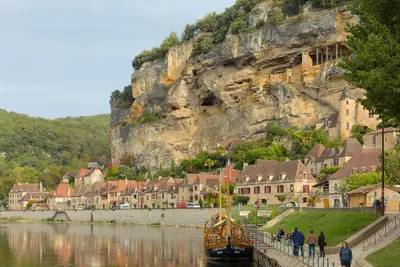
    La Roque-Gageac lies approximately 10 kilometers south of Sarlat on the Dordogne and is one of the Plus Beaux Villages de France. Its houses, made of golden-yellow limestone, line up in a narrow strip between the river and the cliff face; down by the bank stand the old houses of the Gabarriers, the river boatmen.High in the cliff above the village lies the Fort troglodytique, a 12th-century fortification built into the rock, to which a wooden staircase with 140 steps leads up. On the slope grows a narrow exotic garden with palms, papyrus, cycads, and oleander, laid out by Gérard Dorin. The row of houses is best viewed from a Gabarre, the boat trip also tells the story of the place.
    Domme

    Domme

    Domme, a 13th-century bastide, perches on a rocky plateau with expansive views over the Dordogne Valley. Its golden stone houses define the town's character, which you can explore through its narrow streets and the central Place de la Halle, where the Porte des Tours features historical Templar graffiti. A highlight is the Grottes de Domme, a cave system beneath the town, accessible by elevator. The Belvédère de la Barre offers panoramic views of the river's meanders and surrounding villages. Visit Domme in the early morning or late afternoon to savour its special atmosphere in peace.
    Sarlat-la-Canéda

    Sarlat-la-Canéda

    Sarlat-la-Canéda, the capital of the Périgord Noir, captivates with its exceptionally well-preserved medieval and Renaissance architecture. Here you'll find an abundance of golden stone buildings, winding alleys, and charming squares that reflect the region's history. Highlights include the Place de la Liberté with its bustling market activity, especially on Saturdays, and the impressive Cathédrale Saint-Sacerdos. Explore the narrow passages leading to hidden courtyards, and discover historic buildings such as the birthplace of Étienne de La Boétie. The city is also a hub for regional gastronomy, renowned for truffles, foie gras, and walnuts, which you can find in the local markets. To experience the authentic atmosphere without large crowds, a visit during the off-season is recommended, ideally in spring or autumn. For a comprehensive impression of the old town, you should take your time to appreciate the architectural details and sample the local specialties.
    Dordogne (Périgord)

    Dordogne (Périgord)

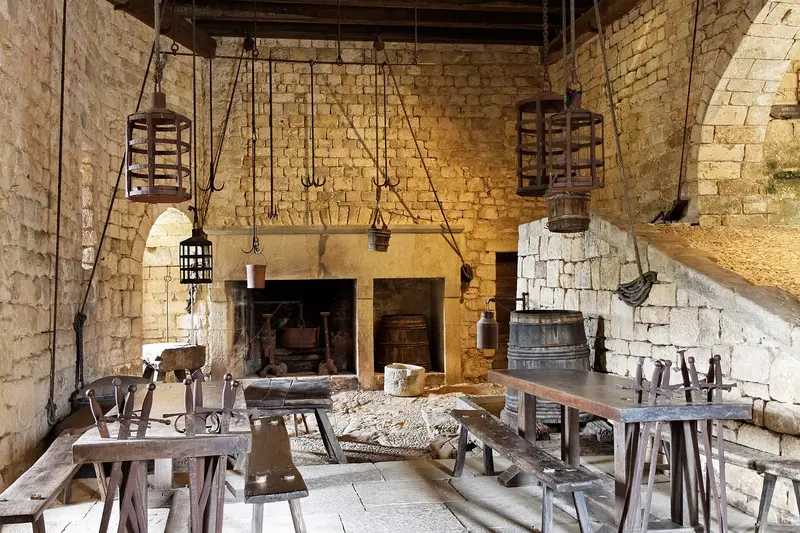
    The Dordogne, historically known as Périgord, is located in southwest France. The region is renowned for prehistoric cave art, medieval castles overlooking the river valley, villages of pale limestone, and a cuisine featuring duck, truffles, and walnuts.

    Sources & method

    • Photos: Wikimedia Commons, Google Maps. Each photo carries its credit.
    • Place data such as addresses and ratings comes from Google Maps.
    • The content is based on web research from public, traceable sources. How the content is made · The role of AI