Fernweh: Home
ExploreGuideDestinationsMy tripsMy trip
de|en
All Places & RegionsRound tripsNight trains in EuropeAll highlightsAbout FernwehFAQPrivacy PolicyImprint
Download on the App StoreGet it on Google Play
ExploreGuideDestinationsMy tripsMy trip
    • Neighborhoods & highlights
    • Recommendations
    • Walking tours
    • Eat & drink
    • Food culture
    • Culture
    • Getting around
    • Accommodation
    • Plan trip
    • Nearby
    Bibury

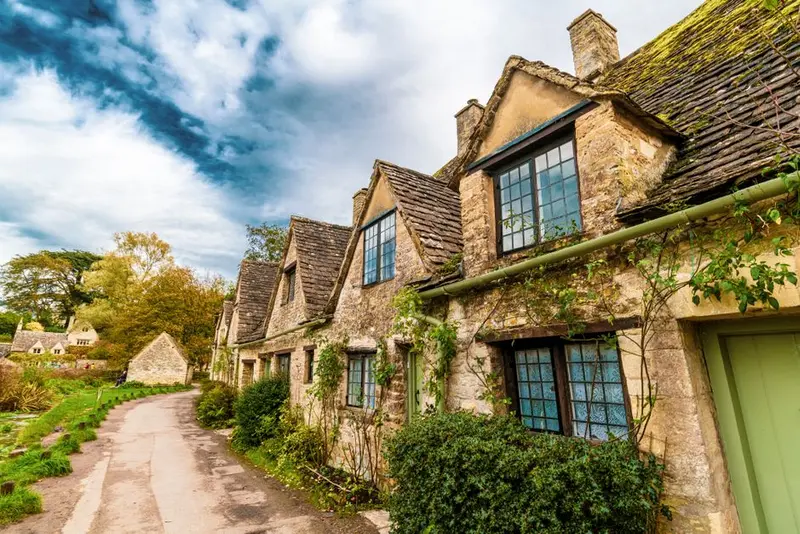
    Photo by Samuel Sweet on Pexels

    Great Britain

    Bibury

    CityCulture

    Bibury is a small village on the River Coln in the southern Cotswolds, about ten kilometres northeast of Cirencester.

    by Felix Gillen

    1. Home
    2. Destinations
    3. Great Britain
    4. Cotswolds
    5. Bibury
    Bibury is a small village on the River Coln in the southern Cotswolds, about ten kilometres northeast of Cirencester. In the 19th century, the artisan William Morris called it "the most beautiful village in England," a reputation that still draws visitors from across the globe.Its most famous motif is Arlington Row, a row of stone houses built around 1380 as a wool store and converted into weavers' houses in the 17th century. Also featured are the riverside trout farm, St Mary's Church with Anglo-Saxon components, and paths through the river meadows. The village is small and can be explored in an hour; mornings and evenings are the calmest.
    Great Britain travel guideRound trips in Great BritainPlan a trip with Bibury

    Contents

    • Neighborhoods & highlights
    • Recommendations
    • Walking tours
    • Eat & drink
    • Food culture
    • Culture
    • Getting around
    • Accommodation
    • Nearby

    Sights in Bibury

    Discover the most important sights and attractions

    1Bibury Trout Farm

    Founded in 1902 on the banks of the Coln, the Bibury Trout Farm is one of England's oldest trout farms. In its spring-fed pools, you can observe and feed rainbow trout at various stages of growth.The farm shop sells fresh and smoked trout; in season, you can fish in a dedicated pond. It's an easy family stop, though admission is charged. The farm lies on the village outskirts opposite the Swan Hotel, just minutes from Arlington Row.
    Open in Google Maps
    Arlington Row

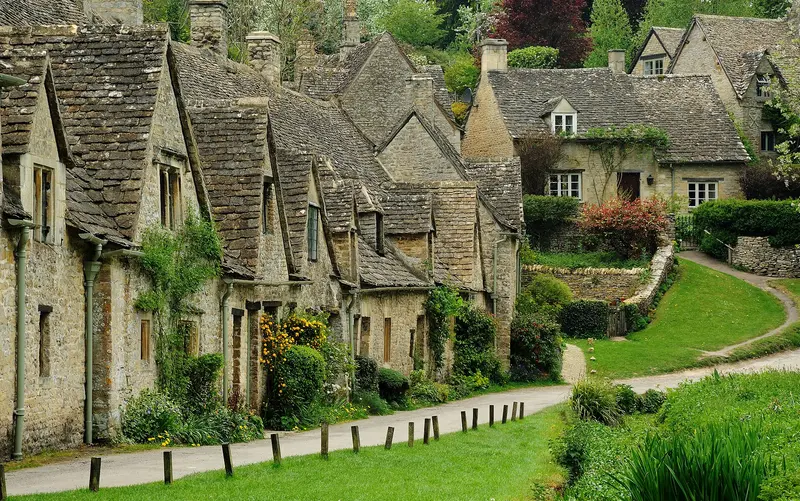
    “Arlington Row Bibury” by Saffron Blaze / Wikimedia Commons / CC BY-SA 3.0, mod.

    Park

    2Arlington Row

    Arlington Row is a row of stone houses with steep stone roofs, which originated around 1380 as a monastic wool store and was converted into weavers' cottages in the 17th century. The weavers processed the wool, which was then fulled in the nearby Arlington Mill. Today, the terrace belongs to the National Trust and is inhabited; the houses are not open to visitors.It is one of England's most photographed motifs; its image even appears in British passports. In front of it lies the water meadow Rack Isle, where cloth used to be dried. It is significantly quieter in the mornings before 9 am and in the evenings than at lunchtime when tour buses arrive.
    Open in Google Maps
    Church

    3St Mary's Church, Fairford

    The parish church of the small town of Fairford, eight kilometres southeast of Bibury, was rebuilt around 1500 by a wealthy wool merchant. It is the only parish church in England that still possesses its complete medieval stained glass: 28 windows which tell the biblical story in a continuous program from Creation to the Last Judgment.The large West Window with its red and blue devils is the most famous. During the Second World War, the panes were removed and hidden. Take half an hour and, if possible, binoculars with you; explanations for the individual windows are available in the church.
    Open in Google Maps
    Attraction

    4Chedworth Roman Villa

    About 12 km northwest of Bibury, in a wooded valley, lie the remains of one of Britannia's largest Roman villas. The villa reached its greatest extent in the 4th century, rediscovered by a gamekeeper in 1864.Mosaic floors are on display, including a depiction of the Four Seasons, two bath suites with underfloor heating, and a spring shrine. A protective structure with walkways covers the most fragile floors; a small museum shows finds. The National Trust manages the site; access is via narrow country roads.
    Open in Google Maps

    City walks in Bibury

    Curated walking tours through the city's highlights, handpicked by experienced travel journalists.

    Bibury: A Walk Through the Picture-Postcard Idyll of the Cotswolds
    Immerse yourself in the timeless beauty of Bibury, often called "the most beautiful village in England". This two-hour walk takes you to the iconic weavers' cottages of Arlington Row, along the idyllic River Coln and to hidden gems that perfectly capture the charm of the Cotswolds in Great Britain.
    ~2 Std.
    Open in Google Maps
    Stops (7)

    Restaurants in Bibury

    1

    Eleven Bibury

    A small café-restaurant on Bibury's main street, near the river and the Trout Farm. Serving breakfast, light lunches and cakes throughout the day. Convenient for a break during your village tour.
    Show on Google Maps
    2

    The Catherine Wheel

    A village pub in the Arlington hamlet, a few minutes' walk above Arlington Row. Serving pub dishes and Sunday Roast, it also has a garden. The property also has a few guest rooms. A quieter alternative to the day-trip cafés by the river.
    Show on Google Maps
    3

    The New Inn, Coln St Aldwyns

    A 16th-century ivy-clad inn in the neighbouring village of Coln St Aldwyns, four kilometres downstream from Bibury. In the bar with its stone floor and fireplace, and the restaurant serves British cuisine using local ingredients. A footpath along the Coln connects both villages in about an hour, and it's significantly quieter here than in Bibury.
    Show on Google Maps

    Eating & Drinking

    The culinary scene in Bibury is characterized by traditional inns and cosy tea rooms. Here you'll find hearty British classics like Fish and Chips or the Sunday Roast, often prepared with regional ingredients. Additionally, charming cafés offer homemade cakes and pastries.

    Trout from Bibury

    At the farm shop of the Trout Farm, fresh and smoked trout is available, also served in local restaurants.

    Cream Tea

    Scones with Clotted Cream and jam are a must in the Cotswolds' tearooms for afternoon tea.

    Pub food

    The village pub serves classic pub dishes and a roast on Sundays.

    Bibury: History and architectural heritage

    Bibury is a historic jewel of the Cotswolds, with origins dating back to Anglo-Saxon times. The village's development was significantly shaped by the flourishing wool trade of the Middle Ages, which brought considerable prosperity to the region. The River Coln was crucial for the operation of mills that processed wool, thus forming the early economic structure of the place.The architecture is a central element of Bibury's cultural heritage and defines its world-famous appearance. Characteristic are the honey-coloured limestone houses with their steep roofs, built from locally quarried stone, reflecting the typical Cotswolds building style. Globally renowned is Arlington Row, a picturesque row of 14th-century buildings that originally served as wool stores and were converted into weavers' cottages in the 17th century. This listed row is considered a landmark of English rural architecture.St. Mary's Church, with its Norman origins and later extensions, also tells of the village's long history and still serves today as the focal point of the community. The preservation of this unique historical building fabric and traditional village character is a cultural distinctive feature of Bibury. It reflects the endeavour to maintain an authentic image of past eras and makes the village itself a living testament to British history and craftsmanship.

    Local exploration

    On FootExplore the village on foot. A short circular walk starts at the bridge, passes Arlington Row, crosses Rack Isle and returns by the river. Longer paths follow the Coln Valley.Bus and TrainThe nearest train station is Kemble, near Cirencester. Buses run from Cirencester to Bibury, but only a few a day; check the timetable in advance.Car and ParkingThe most flexible way to reach Bibury is by car. Parking is scarce, especially at weekends; do not park on the grass verges by the river.

    Accommodations in Bibury

    Find perfect stay in Bibury

    Booking.com* (Affiliate link)
    Search Hotels
    Agoda* (Affiliate link)
    Search Hotels
    Airbnb
    Vacation Rentals

    * Affiliate link: if you book through it, we earn a small commission. The price stays the same for you.

    Campgrounds in Bibury

    Find perfect campground in Bibury

    Search via Google Maps
    Campgrounds nearby (15km)
    Camping.info
    Find Campgrounds
    Park4Night
    RV Parks & Camping

    Plan your trip to Bibury

    Save places, build a route and plan your city trip, all in one place.

    1. 1
      Sunrise over alpine peaks and a sea of clouds
      1234

      Round trip

      12 days · 4 stops

      Saved

      Pick a route

      Pick a ready-made one or save places and plan your own.

      Open bookmarks
    2. 2

      Trip to Bibury

      Live
      • 1Bibury Trout Farm3 days
      • 2Arlington Row4 days
      • 3St Mary's Church, Fairford5 days
      Budget

      Plan your trip

      The planner sorts stops, days and budget. Plan together in real time.

      Start trip planning
    3. 3
      9:41 No signal
      Bibury
      Available offline

      Photo by Samuel Sweet on Pexels

      Use it on the road

      Download the guide to your phone and use it on site, even offline.

    Nearby

    Cotswolds

    Cotswolds

    The Cotswolds are a hilly landscape in southwest England, roughly two hours west of London by car, and the country's largest Area of Outstanding Natural Beauty. They are known for their villages and market towns of honey-coloured limestone, which the medieval wool trade made rich, for dry stone walls, sheep pastures, and country gardens.The most famous places are overcrowded in summer and on weekends. Those who arrive early in the day, walk from village to village, or travel outside of peak season will experience the area much quieter.

    Unsplash

    Bourton-on-the-Water

    Bourton-on-the-Water

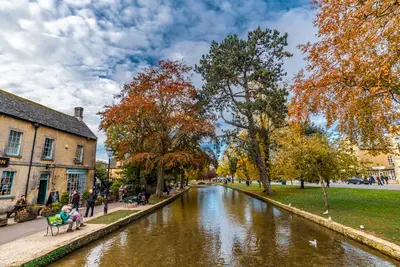
    Bourton-on-the-Water is situated in the Windrush Valley in the northern Cotswolds, a few kilometres south of Stow-on-the-Wold. The shallow river meanders through the heart of the village, bordered by grassy banks and low stone bridges, with houses of honey-coloured limestone rising behind them.Beyond the river, families can enjoy several attractions: the Model Village, the Motoring Museum, Birdland, and a hedge maze. Consequently, Bourton is one of the most visited villages in the Cotswolds. Arrive early in the morning or late in the afternoon, once the day visitors have departed.

    Samuel Sweet·Pexels

    Stow-on-the-Wold

    Stow-on-the-Wold

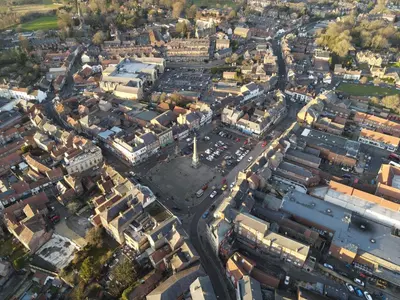
    Stow-on-the-Wold is, at around 240 metres, the highest market town in the Cotswolds, situated at the intersection of eight roads, including the Roman Fosse Way. Its location on the open uplands, the Wold, made it a meeting point for sheep traders; in the Middle Ages, thousands of animals changed hands at its sheep markets.The large market square, with its medieval Market Cross and St Edward's Church, forms the centre. Narrow alleyways, the tures, lead away from the square; through them, sheep were formerly driven. Today, antique shops, galleries, and pubs characterise the town. In 1646, the last battle of the First English Civil War took place near Stow.

    Lewis Ashton·Pexels

    Chipping Campden

    Chipping Campden

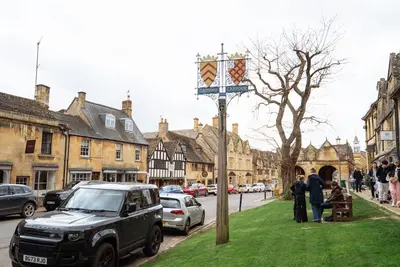
    Chipping Campden lies on the northern edge of the Cotswolds and was one of England's wealthiest wool trading towns in the Middle Ages. From this era dates the winding High Street, where houses built of honey-coloured limestone from the 14th to the 17th century remain almost unchanged. "Chipping" means market.The most important buildings include the Market Hall from 1627, the wool church of St James, and the house of wool merchant William Grevel. Around 1900, designer C. R. Ashbee moved here from London with his Guild of Handicraft; the Court Barn Museum commemorates this Arts and Crafts tradition. The Cotswold Way, a long-distance hiking trail of about 164 kilometres to Bath, begins in Chipping Campden.

    Daria Agafonova·Pexels

    Castle Combe

    Castle Combe

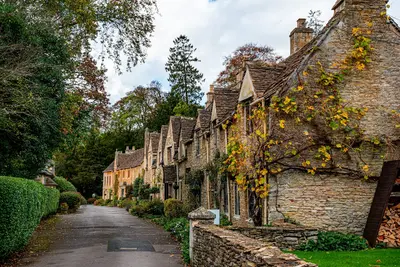
    Castle Combe lies in a wooded valley of the Bybrook on the southern edge of the Cotswolds in Wiltshire, about 20 kilometres north of Bath. The village is small; most houses date from the 14th to 17th centuries, when the place thrived on the cloth trade. Since the decline of this trade, little has changed: There are no new buildings, no power lines above the main street, and no TV aerials on the facades.Sights include the Market Cross, St Andrew's Church with its medieval clock, and the view from the bridge over the Bybrook. The castle that gave the village its name has disappeared, save for its earthworks. The village can be explored in an hour; come early or late, as it's crowded during the day.

    Adrian Limani·Pexels

    Your next steps

    Bibury is in Great Britain. Ways to carry on from here.

    • More in Great Britain

      Highlights, areas, routes and the best time to travel for all of Great Britain.

      Great Britain travel guide
    • Round trips in Great Britain

      Ready-made routes through Great Britain, with stops, nights and a map.

      See the routes

    Sources & method

    • Photos: Wikimedia Commons, Pexels. Each photo carries its credit.
    • Place data such as addresses and ratings comes from Google Maps.
    • The content is based on web research from public, traceable sources. How the content is made · The role of AI