Fernweh: Home
    ExploreTravel GuidesPlan a tripMy tripLast visited
    de|en
    All Places & RegionsAll highlightsAbout FernwehFAQPrivacy PolicyImprint
    ExploreTravel GuidesPlan a tripMy tripLast visited
    Condesa

    Mexico

    Condesa

    Neighborhood

    West of Roma, Condesa developed from the early 20th century on the land of the Hacienda of the Condesa de Miravalle. In the 1920s, the grounds of the former horse racetrack around today's Parque México were added.

    by Felix Gillen

    1. Home
    2. Destinations
    3. Mexico
    4. Mexico City
    5. Condesa
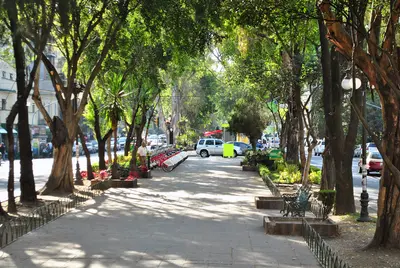
    West of Roma, Condesa developed from the early 20th century on the land of the Hacienda of the Condesa de Miravalle. In the 1920s, the grounds of the former horse racetrack around today's Parque México were added. It is characterized by Art Deco residential buildings, wide green median strips, and the México and España parks. The district is quiet and green, but comes alive in the evenings with restaurants and bars on Avenidas Tamaulipas and Michoacán.

    Sehenswürdigkeiten

    Discover the most important sights and attractions

    1Parque México

    The oval park is the green heart of Condesa. It was laid out in the 1920s on the site of a former horse racing track, whose shape is still traced today by the encircling Avenida Ámsterdam. Art déco fountains, a pond, and many dogs with their walkers set the scene.
    Open in Google Maps

    2Parque España

    The smaller park northwest of Parque México has playgrounds and shady paths, and is a morning spot for joggers and families.
    Open in Google Maps

    3Avenida Amsterdam

    The oval street around Parque México has a green median strip where you can walk. Along it stand numerous Art Deco and Colonial style houses from the 1920s to the 1940s.
    Open in Google Maps

    Essen & Trinken

    1

    Lardo

    Elena Reygadas's restaurant in northern Condesa, featuring Mediterranean-inspired cuisine, wood-fired pizzas, and pastries from its own bakery. A popular spot for breakfast.
    Show on Google Maps
    2

    El Tizoncito

    The Taquería on Avenida Tamaulipas has existed since the 1960s and claims to have invented Tacos al pastor. Simple, affordable, and open until late at night.
    Show on Google Maps
    3

    Azul Condesa

    Sister restaurant of Azul Histórico with regional Mexican cuisine and monthly changing dishes from a federal state.
    Show on Google Maps
    4

    Merotoro

    Restaurant on Avenida Ámsterdam with cuisine from Baja California, especially fish, seafood, and meat.
    Show on Google Maps

    History & Culture

    From Hacienda to Residential NeighborhoodThe area belonged to the hacienda of the Condesa de Miravalle, after whom the neighborhood is named; the Colonia was officially founded in 1902. In 1924, the Jockey Club sold its racetrack to a developer, and the Colonia Hipódromo was built on the site. Only the racetrack itself remained free: there, in 1927, Parque México was laid out, designed by Leonardo Noriega and Javier Stávoli.Art Deco in Everyday LifeParque México is known for its Art Deco features, including a clock tower and the Foro Lindbergh open-air theater, opened in 1928, with reliefs by Roberto Montenegro. In the surrounding streets are apartment buildings from the 1920s to 1940s with geometric wrought-iron grilles and curved facades. After the 1985 earthquake, rents dropped; young people, and later cafés, restaurants, and bars, moved in and continue to shape the neighborhood today.

    Arrival & On the Go

    Metro and MetrobúsMetro stations are located at the edges of the neighborhood: Chilpancingo and Patriotismo (Line 9) to the south, Chapultepec and Juanacatlán (Line 1) to the north. Metrobús Line 1 runs along Avenida Insurgentes on the eastern edge; the Sonora, Campeche, and Chilpancingo stations are closest to the neighborhood. A Metro ride costs 5 Pesos, a Metrobús ride costs 6 Pesos.On Foot and By BikeBetween Parque México, Parque España, and Roma, walking is the best option, for example, on the green median of Avenida Ámsterdam. Ecobici bike-sharing stations are available throughout the neighborhood.

    Accommodations in Condesa

    Find perfect stay in Condesa

    Booking.com* (Affiliate link)
    Search Hotels
    Agoda* (Affiliate link)
    Search Hotels
    Airbnb
    Vacation Rentals

    * Affiliate link: if you book through it, we earn a small commission. The price stays the same for you.

    Nearby

    Roma Norte

    Roma Norte

    Roma Norte emerged circa 1900 as a wealthy residential area. French-style villas, Art Nouveau, and Art Deco buildings line tree-lined streets like Avenida Álvaro Obregón and Calle Colima. Today, the district features cafés, galleries, bars, and top city restaurants, plus popular lodging.
    Polanco

    Polanco

    Polanco, north of Chapultepec Park, is one of the city's most affluent neighborhoods. Avenida Presidente Masaryk is lined with luxury shops, while side streets feature embassies, hotels, and some of Mexico's most renowned restaurants. In the northwest, in Nuevo Polanco, are the Soumaya and Jumex museums.
    Centro Histórico

    Centro Histórico

    The Historic Centre of Mexico City has been a UNESCO World Heritage site since 1987. Around the Zócalo you'll find the Templo Mayor, Cathedral, and National Palace, while to the west, Madero pedestrian street leads to Bellas Artes and the Alameda. In the side streets, you'll discover colonial palaces, churches, markets, and traditional cafes; the major sights are detailed on the Mexico City page.
    Mexico City

    Mexico City

    Mexico City, the country's capital, is located at approximately 2,240 meters in a high valley surrounded by volcanoes, and its metropolitan area has nearly 22 million inhabitants. You travel here for the ruins of the Aztec capital Tenochtitlán beneath the colonial center, a UNESCO World Heritage site since 1987; for museums like the National Museum of Anthropology; and for a cuisine ranging from taco stands to tasting menus. Green residential neighborhoods like Roma and Condesa, the canals of Xochimilco, and day trips to Teotihuacán round out the stay.
    Coyoacán

    Coyoacán

    Coyoacán in southern Mexico City was an independent town even before its incorporation; Hernán Cortés established his first headquarters here after the conquest. Cobblestone streets, colonial houses, and tree-lined squares give the district a peaceful character. The most famous address is the Casa Azul, Frida Kahlo's home.

    Sources & method

    • Photos: Pexels. Each photo carries its credit.
    • Place data such as addresses and ratings comes from Google Maps.
    • The content is based on web research from public, traceable sources. How the content is made · The role of AI