Fernweh: Home
    ExploreTravel GuidesPlan a tripMy tripLast visited
    de|en
    All Places & RegionsAll highlightsAbout FernwehFAQPrivacy PolicyImprint
    ExploreTravel GuidesPlan a tripMy tripLast visited
    • Neighborhoods & highlights
    • Recommendations
    • Walking tours
    • Eat & drink
    • Food culture
    • Culture
    • Getting around
    • Accommodation
    • Plan trip
    • Nearby
    Kanchanaburi City

    Thailand

    Kanchanaburi City

    CityCulture

    Kanchanaburi is located at the confluence of the Khwae Yai and Khwae Noi rivers, which merge here to form the Mae Klong.

    by Felix Gillen

    1. Home
    2. Destinations
    3. Thailand
    4. West Thailand (Kanchanaburi and area)
    5. Kanchanaburi City
    Kanchanaburi is located at the confluence of the Khwae Yai and Khwae Noi rivers, which merge here to form the Mae Klong. The city is known for the Bridge on the River Kwai, part of the Thailand-Burma Railway, which Allied prisoners of war and Asian forced laborers were compelled to build under Japanese occupation during World War II. You can cross the bridge on foot and ride a segment of the historic railway by train. Museums and war cemeteries tell the story of the prisoners. Excursions lead to Erawan National Park and Hellfire Pass. It's most pleasant from November to February.

    Sights in Kanchanaburi City

    Discover the most important sights and attractions

    1Skywalk Kanchanaburi City

    Glass-floored viewpoint at the confluence of Khwae Yai and Khwae Noi, where they form the Mae Klong. From up high, you overlook the rivers and city. If you have a fear of heights, be careful. Mornings and late afternoons are less hot.

    Open in Google Maps

    2Death Railway Museum and Research Centre

    The Death Railway Museum and Research Centre in Kanchanaburi is dedicated to documenting the tragic history of the Thailand-Burma Railway, known as the 'Death Railway'. It was built during World War II by the Imperial Japanese Army using Allied prisoners of war and Asian forced labourers. Here you will find comprehensive documentation of the inhumane conditions and immense human suffering associated with the construction of this 415-kilometre stretch. The exhibitions showcase a variety of artefacts, personal accounts, photographs, and models that vividly illustrate the construction methods and daily hardships. The museum serves not only to commemorate the tens of thousands of victims but also as a research centre that meticulously processes historical facts. It offers a profound insight into a dark chapter of war history and the resilience of human spirit. Practical Tip: Plan your visit to also include the Kanchanaburi War Cemetery directly opposite, to honour the graves of the fallen. For a quieter and more contemplative experience, an early morning or late afternoon visit is recommended to avoid the largest crowds and the heat.
    Open in Google Maps

    3Bridge on the Khwae Yai

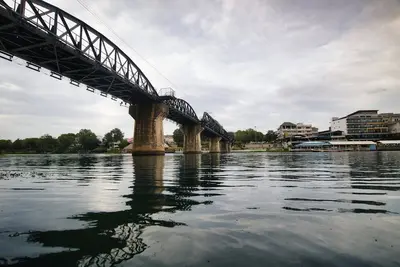
    The steel bridge on the northern outskirts is the most famous section of the Thailand-Burma Railway. It was built from 1942 by Allied prisoners of war and Asian forced laborers under Japanese occupation. Most of the curved spans are original; two straight spans were replaced after air raids towards the end of the war. You may walk across the tracks; refuge balconies are available for trains. Avoid it at night. The film "The Bridge on the Kwai" has little to do with the historical events.
    Open in Google Maps

    City walks in Kanchanaburi City

    Curated walking tours through the city's highlights, handpicked by experienced travel journalists.

    Lokale Schätze: Märkte, Tempel und Alltagsleben

    Dieser Spaziergang führt Sie abseits der bekannten Touristenpfade ins Herz des lokalen Lebens von Kanchanaburi. Entdecken Sie pulsierende Märkte, altehrwürdige Tempel und authentische Einblicke in den Alltag der Stadtbewohner.

    ~2 Std. 15 Min.
    Open in Google Maps
    Stops (5)

    Essen & Trinken

    1

    Klin Khwan Mu Kratha (Thai-BBQ)

    Restaurant in 112 Tambon Tha Ma Kham.
    Show on Google Maps
    2

    Ran Che Ubon

    Local Thai eatery with an authentic daily menu, off the backpacker trail. Order in Thai or by pointing. Menu items change with daily market finds.
    Show on Google Maps
    3

    Som Tam Kanittha

    Som-Tam cuisine with an Isaan menu: Papaya salad in various spice levels, grilled chicken, sticky rice. Simple decor, ordering usually in Thai or by pointing. If you don't like fermented fish sauce, mention it when ordering.
    Show on Google Maps
    4

    Lan Pho Kuaitiao Mo Din (Khao Pun)

    Noodle restaurant specializing in Kuay Teow Mor Din: The soup arrives at your table in a clay pot, staying hot. Small local eatery in the Khao Pun district, outside the riverside tourist strip.
    Show on Google Maps
    5

    Che Pao Bistro

    Bistro in Kanchanaburi with a compact menu, quieter than the downtown street kitchens. Indoor seating, evening service. For those seeking an alternative after days of street food, this is the place.
    Show on Google Maps

    Food and Drink in Kanchanaburi

    In Kanchanaburi, you'll find authentic Thai cuisine, from riverside eateries to lively street food stalls. Local specialties are particularly popular, such as Moo Krata, a Thai barbecue you can savor at places like กลิ่นควันหมูกะทะ เมืองกาญจน์. Complementing this, many establishments, including ร้านส้มตำกนิษฐา, offer fresh Som Tam variations.

    Som Tam and Gai Yang

    Pounded papaya salad, with grilled chicken and sticky rice. Isan cuisine is widespread in Kanchanaburi; you can adjust the spiciness when ordering.

    Khwae River Restaurants

    Around the bridge and along the bank are pontoon restaurants right on the water, with river fish, curries, and fried vegetables. Evenings are more pleasant than lunchtimes.

    Night markets

    Late afternoon sees food stalls set up downtown: grilled skewers, curries to go, fried snacks, and fruit.

    Morning Fresh Market

    Busiest in the mornings. A good opportunity to buy fruit and provisions for excursions into the National Parks.

    History and Remembrance

    The Thailand-Burma RailwayFrom 1942, the Japanese army constructed the Thailand-Burma Railway to supply its troops. Allied POWs and tens of thousands of Asian forced laborers endured murderous conditions, with many dying from exhaustion, disease, and abuse. The Bridge on the River Kwai is its most famous section; the curved spans are mostly original, while two straight sections were replaced after air raids near war's end.Sites of RemembranceThe central war cemetery contains 6,858 POWs, mainly British, Australians, and Dutch. Opposite, the Thailand-Burma Railway Centre details the route's history. The JEATH War Museum's name signifies the nations: Japan, England, America, Australia, Thailand, and Holland. Twelve kilometers out, Wat Tham Sua and Wat Tham Khao Noi temples sit side-by-side on a limestone hill.

    Traveling locally

    In the CityBikes and Scooters: available at many guesthouses, perfect for trips between the Bridge, museums, and cemeteries. Scooters require a motorcycle license and helmet.Songthaews: run fixed routes; agree price upfront.Grab: available, with upfront pricing.Beyond the CityTo Erawan National Park, Hellfire Pass, and Sangkhlaburi, buses and minivans depart from the bus station. The historic railway line runs from Kanchanaburi, across the Bridge, to Nam Tok.

    Accommodations in Kanchanaburi City

    Find perfect stay in Kanchanaburi City

    Booking.com* (Affiliate link)
    Search Hotels
    Agoda* (Affiliate link)
    Search Hotels
    Airbnb
    Vacation Rentals

    * Affiliate link: if you book through it, we earn a small commission. The price stays the same for you.

    Plan your trip to Kanchanaburi City

    Save places, build a route and plan your city trip, all in one place.

    1. 1
      Sunrise over alpine peaks and a sea of clouds
      1234

      Round trip

      12 days · 4 stops

      Saved

      Pick a route

      Pick a ready-made one or save places and plan your own.

      Open bookmarks
    2. 2

      Trip to Kanchanaburi City

      Live
      • 1Skywalk Kanchanaburi City3 days
      • 2Death Railway Museum and Research Centre4 days
      • 3Bridge on the Khwae Yai5 days
      Budget

      Plan your trip

      The planner sorts stops, days and budget. Plan together in real time.

      Start trip planning
    3. 3
      9:41 No signal
      Kanchanaburi City
      Available offline

      Use it on the road

      Download the guide to your phone and use it on site, even offline.

    Nearby

    West Thailand (Kanchanaburi and area)

    West Thailand (Kanchanaburi and area)

    Western Thailand, around the province of Kanchanaburi, combines war history and nature. This is where the Thailand-Burma Railway ran, built during World War II under Japanese occupation by prisoners of war and forced labourers, and known as the Death Railway.Attractions include the Bridge on the Khwae Yai, the war cemeteries and museums in Kanchanaburi, Hellfire Pass, the tiered waterfalls in Erawan National Park, and further north, Sangkhlaburi with its long wooden bridge.
    Erawan National Park

    Erawan National Park

    Erawan National Park is located approximately 65 to 70 kilometers northwest of Kanchanaburi. Established in 1975 as Thailand's twelfth national park, it covers around 550 square kilometers and is primarily known for the seven-tiered Erawan Waterfall with its turquoise-green pools. The name Erawan refers to the three-headed white elephant of Hindu mythology.A path follows the stream from tier to tier; the lower levels are easily accessible, while further up, the trail becomes steeper and rockier. Bathing is permitted in several pools, where small fish will nibble at your feet. Shoes with good grip are recommended as the edges can be slippery.Beyond the waterfall, there are forested limestone mountains and the stalactite cave Tham Phra That. Early mornings on weekdays are the quietest, while weekends and public holidays see many day-trippers.
    Nakhon Pathom

    Nakhon Pathom

    Nakhon Pathom, west of Bangkok, was the largest settlement of the Dvaravati culture. Historically, the place is therefore more significant than its current image as a provincial town suggests.The centre is the Phra Pathom Chedi, at around 120 metres, Thailand's tallest stupa. Its orange-brown tiled bell shape covers an older structure and is an important pilgrimage site. Viharas with Buddha figures line its circumambulatory path.On the outskirts is the Sanam-Chandra Palace of King Vajiravudh, its buildings currently closed for restoration. In the markets, you'll find pomelos from the province. Nakhon Pathom is on the Southern Railway and can be visited from Bangkok as a half-day trip.
    Sai Yok National Park

    Sai Yok National Park

    The Sai Yok National Park is situated about 100 kilometers northwest of Kanchanaburi along the Khwae Noi river, extending to the Myanmar border. Established in 1980, it covers some 500 square kilometers of limestone mountains, forest, and the river.The most visited is the approximately 15-meter-high Sai Yok Noi waterfall, right by the main road. About 40 kilometers further, by the park administration, is the Sai Yok Yai waterfall, plunging directly into the river over a rock edge. You can cross to the other bank via a suspension bridge.Some of the park's limestone caves are home to the Kitti's hog-nosed bat, the world's smallest mammal at about 2 grams. The largest cave is Tham Lawa, approximately 500 meters long. Along the river, remains of a Thailand-Burma Railway bridge and a Japanese camp have also been preserved.
    Hellfire Pass

    Hellfire Pass

    The Hellfire Pass Interpretive Centre commemorates the construction of the Thailand-Burma Railway, built during World War II under Japanese occupation by Allied prisoners of war and Asian forced laborers. The name refers to the Konyu Cutting: during night work, illuminated by oil lamps and bamboo fires, the scene with the emaciated prisoners looked like a depiction of hell.Opened in 1998 and operated by Australia, the museum documents working conditions, diseases, and mortality with photos, artifacts, and eyewitness accounts.From the museum, a path leads down into the cutting, where drilling marks in the rock are still visible. Visitors can follow the former railway track several kilometers further through the forest. An audio guide provides context for the stations. The memorial is located about 80 kilometers northwest of Kanchanaburi on Highway 323.

    Sources & method

    • Photos: Unsplash. Each photo carries its credit.
    • The content is based on web research from public, traceable sources. How the content is made · The role of AI