Nakhon Pathom, west of Bangkok, was the largest settlement of the Dvaravati culture. Historically, the place is therefore more significant than its current image as a provincial town suggests.
Nakhon Pathom, west of Bangkok, was the largest settlement of the Dvaravati culture. Historically, the place is therefore more significant than its current image as a provincial town suggests.The centre is the Phra Pathom Chedi, at around 120 metres, Thailand's tallest stupa. Its orange-brown tiled bell shape covers an older structure and is an important pilgrimage site. Viharas with Buddha figures line its circumambulatory path.On the outskirts is the Sanam-Chandra Palace of King Vajiravudh, its buildings currently closed for restoration. In the markets, you'll find pomelos from the province. Nakhon Pathom is on the Southern Railway and can be visited from Bangkok as a half-day trip.
Sights in Nakhon Pathom
Discover the most important sights and attractions
1Phaya Kong Phaya Phan Monument
Monument to Phaya Kong and Phaya Phan, father and son from tradition, who, according to legend, fought each other without recognizing each other; the founding of Phra Pathom Chedi is interpreted in the same tale as an atonement. For locals, it is a place of veneration with offerings, not a museum piece.
Temple surrounding a chedi whose core dates back to the Dvaravati period, making it older than the current structure of Phra Pathom Chedi. A broad, stepped brick base remains; a later superstructure sits atop it. A quiet complex away from the center, rarely visited.
Village temple on the city's outskirts, located by the water and shaded by trees. No tourist traffic, a focal point for the surrounding settlements. Only sensibly reached by private vehicle.
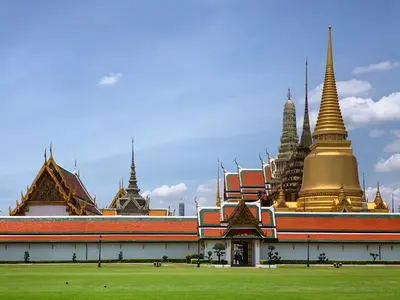
The bell-shaped stupa, approximately 120 meters high, is the city's center and Thailand's tallest. King Mongkut had it built over an older, ruined structure; the complex was completed in 1870. King Vajiravudh's ashes rest in the base of the gilded Buddha statue, Phra Ruang Rojanarit. Major temple festival usually in November. Remove shoes before entering halls, cover shoulders and knees.
King Vajiravudh's palace complex, built 1902-1911, features buildings blending Thai and European styles within an extensive park. A section of the grounds has belonged to Silpakorn University since 1965. Important: The palace buildings have been closed for restoration since 2022, likely until at least mid-2027. The grounds are open for walks only in the mornings and evenings.
Toh-Chine, Nakhon Pathom's specialty: Set-menu banquets, typical for weddings and temple festivals. Tables seat ten; smaller groups please inquire. Spacious venues, not for tourists.
Vietnamese home cooking in Nakhon Pathom, featuring rice paper rolls, noodle soups, and grilled dishes for DIY wrapping. Small eatery, concise menu. One of the city's few non-Thai eateries.
Vegetarian food in Jay-style: without meat, fish, egg, and strong spices like garlic and onion. Counter service; you point at the pots and get rice with it. Usually only open for lunch.
Noodle kitchen specializing in Kuay Teow Kai, the chicken noodle soup. Select your noodle width and toppings, then adjust to taste with chili, vinegar, sugar, and fish sauce from the table. Small, fast, drawing a local crowd.
Nakhon Pathom ist eine Marktstadt, und das merkt man beim Essen. Um den Chedi liegen Markthallen und Straßenzüge mit Ständen, die von morgens bis in den Abend arbeiten; die Provinz ist zudem für Obst und für Schweinefleischprodukte bekannt. Dazu kommen chinesisch geprägte Küchen und die Toh-Chine-Betriebe, eine Eigenheit der Stadt.
Khanom Jeen
Fermented rice noodles with curries and fresh herbs, available at markets and small eateries.
The Chedi Market
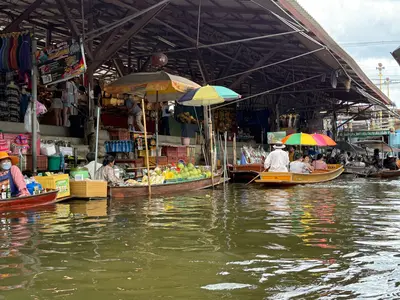
Around the temple complex, a fresh market and food stalls offer grilled skewers, snacks, takeaway curries, and fruit.
Pomelo of the Province
The province is renowned for its pomelos, with the fruit cut and sold in portions at the stands.
Vegetarian Cuisine
Jay eateries cook without meat, fish, and strong spices, identifiable by yellow signs with red lettering.
Dvaravati and the Chedi
An Ancient SiteNakhon Pathom was the largest settlement of the Dvaravati culture, roughly from the 6th to 8th centuries. Its most important monuments include the core of the Phra Pathom Chedi and the nearby Phra Prathon Chedi. Finds such as Dharmachakra stones and Buddha figures are exhibited at the National Museum by the Chedi.The Phra Pathom ChediThe current stupa is a reconstruction: King Mongkut found the old structure in ruins in 1831 as a monk and, after his ascension to the throne, had it rebuilt in the Sri Lankan style; the stupa and temple were completed in 1870. At approximately 120 meters, it is Thailand's tallest stupa. The ashes of King Vajiravudh rest in the base of the gilded standing Buddha figure, Phra Ruang Rojanarit.The Chedi is an active pilgrimage site. A large temple festival takes place in the twelfth lunar month, usually in November.ConductKeep shoulders and knees covered in the Chedi district, remove shoes before entering the Vihara, and walk around clockwise.Do not sit on pedestals or masonry.During ceremonies, stay at the edges and keep entrances clear.
Local exploration
The city center is centered on the Chedi district. Station, market, museum are within walking distance; all else by Songthaew or Motorradtaxi.Train: Nakhon Pathom is on the Southern Line, the station north of the Chedi, within walking distance. Also practical as a stopover for Kanchanaburi.Bus and Minivan: Frequent connections to Bangkok and Kanchanaburi, Ratchaburi, and Damnoen Saduak.Songthaew and Motorradtaxi: Standard city transport. Agree fare before riding.On Foot: Chedi, museum, market, station form a 1-hour walking tour. Little shade, best in morning or late afternoon.