Fernweh: Home
    ExploreTravel GuidesPlan a tripMy tripLast visited
    de|en
    All Places & RegionsAll highlightsAbout FernwehFAQPrivacy PolicyImprint
    ExploreTravel GuidesPlan a tripMy tripLast visited
    • Overview
    • Places in the region
    • Eat & drink
    • Food culture
    • Culture
    • Getting around
    • Nearby
    West Thailand (Kanchanaburi and area)

    Thailand

    West Thailand (Kanchanaburi and area)

    Region

    Western Thailand, around the province of Kanchanaburi, combines war history and nature.

    by Felix Gillen

    1. Home
    2. Destinations
    3. Thailand
    4. West Thailand (Kanchanaburi and area)
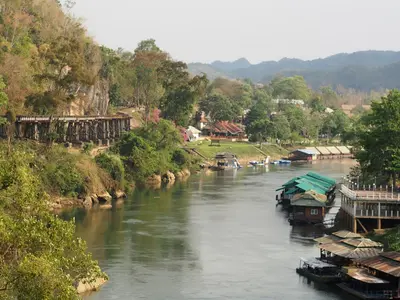
    Western Thailand, around the province of Kanchanaburi, combines war history and nature. This is where the Thailand-Burma Railway ran, built during World War II under Japanese occupation by prisoners of war and forced labourers, and known as the Death Railway.Attractions include the Bridge on the Khwae Yai, the war cemeteries and museums in Kanchanaburi, Hellfire Pass, the tiered waterfalls in Erawan National Park, and further north, Sangkhlaburi with its long wooden bridge.
    Western Thailand begins about a hundred kilometers west of Bangkok and extends to the border with Myanmar. Its heart is Kanchanaburi, the country's third-largest province. The region is ideal for history centered around the Death Railway, waterfalls and national parks, as well as train journeys on the preserved section of the line to Nam Tok.
    Erawan National Park

    Place 1 of 4

    Erawan National Park

    Erawan National Park is located approximately 65 to 70 kilometers northwest of Kanchanaburi.

    Discover
    Hellfire Pass

    Place 2 of 4

    Hellfire Pass

    The Hellfire Pass Interpretive Centre commemorates the construction of the Thailand-Burma Railway, built during World War II under Japanese occupation by Allied prisoners of war and Asian forced laborers.

    Discover
    Kanchanaburi City

    Place 3 of 4

    Kanchanaburi City

    Kanchanaburi is located at the confluence of the Khwae Yai and Khwae Noi rivers, which merge here to form the Mae Klong.

    Discover
    Sai Yok National Park

    Place 4 of 4

    Sai Yok National Park

    The Sai Yok National Park is situated about 100 kilometers northwest of Kanchanaburi along the Khwae Noi river, extending to the Myanmar border. Established in 1980, it covers some 500 square kilometers of limestone mountains, forest, and the river.

    Discover

    More places in West Thailand (Kanchanaburi and area)

    Sangkhlaburi

    Sangkhlaburi

    Sangkhlaburi is the northernmost district of Kanchanaburi Province, situated on the shore of the Khao Laem Reservoir near the Myanmar border. Besides Thais, Mon and Karen people live here, which is reflected in their language, cuisine, and temple architecture.Its landmark is the Mon Bridge (Uttamanusorn Bridge), Thailand's longest wooden bridge at around 445 meters. It connects the Mon village of Wang Kha with the town. Early in the morning, the monks' alms collection can be observed here. On the Mon side stands Wat Wang Wiwekaram with a gilded chedi modelled after Indian prototypes.During the dry season, usually in March and April, the walls and ordination hall of the old temple emerge from the lake, remnants of the settlement that was flooded with the construction of the Vajiralongkorn Dam in 1984. The cooler months from November to February are the most pleasant time to travel.
    Floating Market Damnoen Saduak

    Floating Market Damnoen Saduak

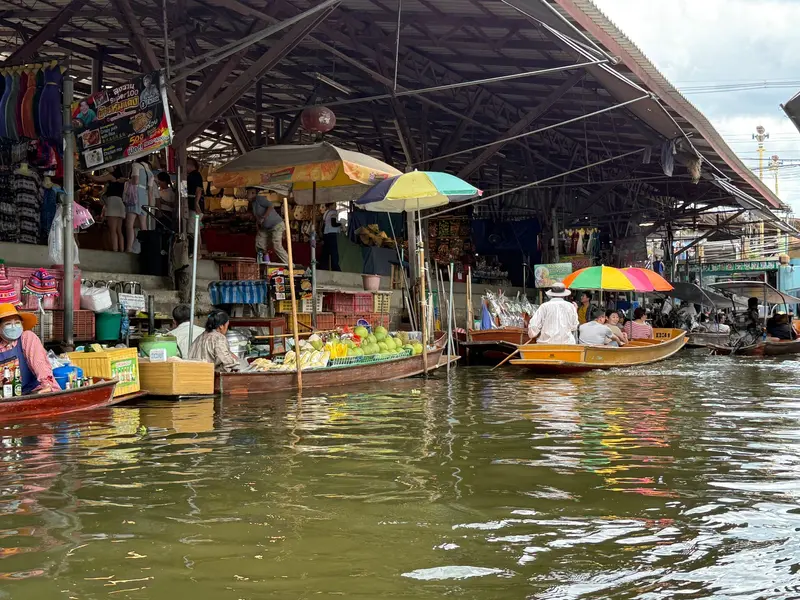
    The Damnoen Saduak Floating Market is located in Ratchaburi Province, approximately 100 kilometres southwest of Bangkok, on a 32-kilometre-long canal dug between 1866 and 1868 by order of King Mongkut to connect the Mae Klong and Tha Chin rivers. Vendors sell fruit, noodle soups, and snacks from flat wooden boats.The market is very well-known and heavily geared towards visitors: Besides the vendor boats, souvenir stalls crowd the banks, and longtail boats take groups through the canals. It's busiest between approximately 7 and 9 AM; the market remains active until midday.Prices are negotiable, including for boat trips. An alternative with a predominantly Thai audience is the Amphawa evening market in Samut Songkhram, which takes place from Friday to Sunday.

    Sights in West Thailand (Kanchanaburi and area)

    Discover the most important sights and attractions

    Skywalk Kanchanaburi City

    Glass Skywalk on the banks of the Khwae Yai in the city, approx. 150 meters long and 12 meters high, overlooking the confluence of the rivers. Most beautiful in the late afternoon.
    Open in Google Maps

    Death Railway Museum and Research Centre

    Museum mit informativen Ausstellungen zur Geschichte der Thailand-Burma-Eisenbahn.
    Open in Google Maps

    Bridge on the Khwae Yai

    The steel bridge on the northern edge of Kanchanaburi is part of the railway line built in 1942 and 1943 by Allied prisoners of war and forced Asian laborers. It is still in use and can be crossed on foot. For context, a visit to the city's museums and war cemeteries is worthwhile.
    Open in Google Maps

    Hellfire Pass Memorial

    The Konyu Cutting, northwest of Kanchanaburi, was hewn through the rock by prisoners of war with hand tools; its name derives from the night work torches. An Interpretive Centre documents the history with eyewitness accounts, and a walking trail follows the old railway line several kilometres through the forest.
    Open in Google Maps

    Erawan National Park

    Open in Google Maps

    Historical Park Mueang Sing

    Fortified Khmer city on the Khwae Noi in Sai Yok District, in Bayon style from the time of King Jayavarman VII. Preserved are a central prang, a 7-meter high laterite wall, and moats and ramparts covering an area of approximately 880 by 1,400 meters. Discoveries show the site was settled around 200 AD.
    Open in Google Maps

    Essen & Trinken

    1

    Klin Khwan Mu Kratha (Thai-BBQ)

    Restaurant in 112 Tambon Tha Ma Kham.
    Show on Google Maps
    2

    Ran Che Ubon

    Restaurant in 2G36+5C8.
    Show on Google Maps
    3

    Som Tam Kanittha

    Restaurant in XGW3+29V.
    Show on Google Maps
    4

    Lan Pho Kuaitiao Mo Din (Khao Pun)

    Restaurant in XGW3+JX6 Unnamed Road Tambon Nong Ya.
    Show on Google Maps
    5

    Che Pao Bistro

    Restaurant in 2G25+X99.
    Show on Google Maps

    Dining and Drinking

    Central Thai cooking prevails: Curries with coconut milk, clear soups, rice dishes, and noodle soups, usually milder than in the south or northeast. What makes the region unique are two ingredients: freshwater fish from the rivers and reservoirs, and the sugarcane and fruit cultivation of the plains. Towards the northwest, a Burmese-Mon influence emerges; in Sangkhlaburi, you'll find dishes rarely seen elsewhere in Thailand.

    Freshwater fish from Khwae Yai and Khwae Noi

    In the river restaurants and on the rafts, fish is served grilled, steamed, or fried, often with a spicy lime and garlic sauce.

    Mon Cuisine in Sangkhlaburi

    In Wang Kha’s Mon quarter, you’ll find curries and salads that are closer to Burmese than Thai cuisine, along with condensed milk tea.

    Khanom Jeen

    Fermented rice noodles with curry and fresh herbs, a widespread breakfast found in the region's markets.

    Sugarcane and Palm Sugar

    Freshly pressed sugarcane juice is sold at stalls, palm sugar as blocks or in sweets.

    River Valley Fruit

    During harvest season, stands with local fruit line country roads, cheaper than in the cities.

    Culture and History

    West Thailand is a border region. For centuries, military campaigns between Siam and Burma crossed the passes to present-day Myanmar. To this day, Mon, Karen, and Burmese migrant workers live here alongside the Thai population, most visibly in Sangkhlaburi.The region's most defining memory is more recent. In 1942 and 1943, the Japanese army built the 415-kilometer railway line from Ban Pong to Thanbyuzayat in Burma, which was later named the Death Railway. Approximately 61,800 Allied prisoners of war worked on it, with about 12,600 of them dying. Additionally, at least 180,000 conscripted Asian laborers were involved, an estimated 90,000 of whom lost their lives. The Kanchanaburi and Chungkai war cemeteries are located in and near Kanchanaburi, along with museums and the preserved cutting at Hellfire Pass.Museums: The Thailand-Burma Railway Centre in Kanchanaburi and the Hellfire Pass Interpretive Centre provide detailed historical context.Older Layers can be found along the Khwae Noi: Mueang Sing was a fortified Khmer city in the Bayon style dating from the time of Jayavarman VII.Nature Conservation: The forest complexes of Thungyai Naresuan and Huai Kha Khaeng on the border are UNESCO World Heritage sites and are largely closed to visitors.

    Exploring the area

    From Bangkok to Kanchanaburi, it's about 130 kilometers; buses and minivans take two to three hours, depending on traffic.The train is more appealing: A branch line runs from Bangkok Thonburi to Kanchanaburi and continues over the Bridge on the Khwae Yai to Nam Tok. It is the preserved section of the Death Railway, with approximately 130 kilometers still in operation. The train runs only a few times a day; check the current timetable.To the north and west, Highway 323 follows the Khwae Noi via Sai Yok and Thong Pha Phum to Sangkhlaburi. The route is winding but well-maintained.For the national parks, the easiest way is by private vehicle or transfer; a public bus also goes to Erawan.In Kanchanaburi, a scooter or bicycle suffices; the sights are lined up along the river.Between November and February, it is dry and mild, making it the most pleasant time. From March to May, it gets very hot. The rainy season fills the waterfalls, though some paths in the national parks may then be closed. For safety advice in the border area with Myanmar, consult the German Federal Foreign Office.

    Nearby

    Kanchanaburi City

    Kanchanaburi City

    Kanchanaburi is located at the confluence of the Khwae Yai and Khwae Noi rivers, which merge here to form the Mae Klong. The city is known for the Bridge on the River Kwai, part of the Thailand-Burma Railway, which Allied prisoners of war and Asian forced laborers were compelled to build under Japanese occupation during World War II. You can cross the bridge on foot and ride a segment of the historic railway by train. Museums and war cemeteries tell the story of the prisoners. Excursions lead to Erawan National Park and Hellfire Pass. It's most pleasant from November to February.
    Erawan National Park

    Erawan National Park

    Erawan National Park is located approximately 65 to 70 kilometers northwest of Kanchanaburi. Established in 1975 as Thailand's twelfth national park, it covers around 550 square kilometers and is primarily known for the seven-tiered Erawan Waterfall with its turquoise-green pools. The name Erawan refers to the three-headed white elephant of Hindu mythology.A path follows the stream from tier to tier; the lower levels are easily accessible, while further up, the trail becomes steeper and rockier. Bathing is permitted in several pools, where small fish will nibble at your feet. Shoes with good grip are recommended as the edges can be slippery.Beyond the waterfall, there are forested limestone mountains and the stalactite cave Tham Phra That. Early mornings on weekdays are the quietest, while weekends and public holidays see many day-trippers.
    Nakhon Pathom

    Nakhon Pathom

    Nakhon Pathom, west of Bangkok, was the largest settlement of the Dvaravati culture. Historically, the place is therefore more significant than its current image as a provincial town suggests.The centre is the Phra Pathom Chedi, at around 120 metres, Thailand's tallest stupa. Its orange-brown tiled bell shape covers an older structure and is an important pilgrimage site. Viharas with Buddha figures line its circumambulatory path.On the outskirts is the Sanam-Chandra Palace of King Vajiravudh, its buildings currently closed for restoration. In the markets, you'll find pomelos from the province. Nakhon Pathom is on the Southern Railway and can be visited from Bangkok as a half-day trip.
    Sai Yok National Park

    Sai Yok National Park

    The Sai Yok National Park is situated about 100 kilometers northwest of Kanchanaburi along the Khwae Noi river, extending to the Myanmar border. Established in 1980, it covers some 500 square kilometers of limestone mountains, forest, and the river.The most visited is the approximately 15-meter-high Sai Yok Noi waterfall, right by the main road. About 40 kilometers further, by the park administration, is the Sai Yok Yai waterfall, plunging directly into the river over a rock edge. You can cross to the other bank via a suspension bridge.Some of the park's limestone caves are home to the Kitti's hog-nosed bat, the world's smallest mammal at about 2 grams. The largest cave is Tham Lawa, approximately 500 meters long. Along the river, remains of a Thailand-Burma Railway bridge and a Japanese camp have also been preserved.
    Hellfire Pass

    Hellfire Pass

    The Hellfire Pass Interpretive Centre commemorates the construction of the Thailand-Burma Railway, built during World War II under Japanese occupation by Allied prisoners of war and Asian forced laborers. The name refers to the Konyu Cutting: during night work, illuminated by oil lamps and bamboo fires, the scene with the emaciated prisoners looked like a depiction of hell.Opened in 1998 and operated by Australia, the museum documents working conditions, diseases, and mortality with photos, artifacts, and eyewitness accounts.From the museum, a path leads down into the cutting, where drilling marks in the rock are still visible. Visitors can follow the former railway track several kilometers further through the forest. An audio guide provides context for the stations. The memorial is located about 80 kilometers northwest of Kanchanaburi on Highway 323.

    Sources & method

    • Photos: Pexels. Each photo carries its credit.
    • The content is based on web research from public, traceable sources. How the content is made · The role of AI