Khao Yai National Park was Thailand's first national park in 1962 and is part of the Dong Phayayen-Khao Yai Forest Complex, a UNESCO World Heritage site.
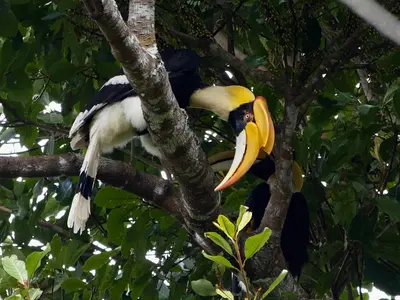
Khao Yai National Park was Thailand's first national park in 1962 and is part of the Dong Phayayen-Khao Yai Forest Complex, a UNESCO World Heritage site. Covering 2,168 square kilometers, it is the country's third-largest and spans four provinces: mountainous terrain with evergreen rainforest, grasslands, and streams.Best known are the Haew Suwat and Haew Narok waterfalls, the latter currently closed. Marked hiking trails begin at the visitor center; for longer routes through the forest, you need a guide.The main reason to visit is wildlife viewing: wild elephants, white-handed gibbons, macaques, sambar deer, and several hornbill species. Observation towers near salt licks and meadows, such as at Nong Phak Chi, are best early morning and at dusk. Guided spotlighting drives are offered in the evenings.Elephants regularly cross the roads: keep your distance, stay in your vehicle, do not honk. Accommodation is available at campsites and in park-managed bungalows. Access points are in the north near Pak Chong and in the south near Prachinburi.
Sehenswürdigkeiten
Discover the most important sights and attractions
1Khao Khiao Grassland
Open grasslands on the slopes of Khao Khiao, situated amidst the dense mountain forest. These areas are maintained as grazing grounds for deer and gaurs, making them one of the best spots for wildlife viewing in the park. At dusk, it's worth driving slowly and stopping there. Bring binoculars.
Rock edge in the park with a view over the forest towards the Prachinburi plain. There is no continuous railing; keep your distance from the edge. In the morning, fog often lies in the valleys. Accessible only by private vehicle or tour.
Viewpoint on Park Road with a view over the forest canopy towards the mountains. Quick stop from the vehicle, no hiking required. Late afternoon sun is ideal; mornings often bring fog over the forest.
Smaller waterfall in the park area, off the main attractions and consequently little visited. Several tiers over rocks with pools below, surrounded by dense forest. It carries the most water after the rainy season; little remains in the dry season. The access is wet and slippery; sturdy footwear is necessary.
The park's highest waterfall in the south, three tiers, totalling about 150 meters. Elephants have repeatedly fallen from its top edge; eleven animals died here in 2019. Access is currently closed until further notice, after a wooden bridge collapsed due to heavy rainfall. Enquire with the park administration before your visit.
The park's most famous waterfall, about 20 meters high, drops into a forest valley basin. From the car park, stairs lead to an upper viewing platform and down to the falls' foot. Water flow and access depend on the season; after heavy rain, the lower area closes. Bathing is not permitted everywhere; on-site signage applies.
Canteen at Khao Khiao Station in the park, run as a social enterprise. Simple Thai menu served over the counter, with covered seating. One of the few food options within the park, open during the day.
Im Park gibt es Verpflegung nur an wenigen Stellen: am Besucherzentrum bei Kong Kaeo, an der Station Khao Khiao und bei den größeren Wasserfällen. Es sind einfache Kantinen mit thailändischer Grundkarte, die tagsüber arbeiten und abends schließen. Alles andere liegt außerhalb: entlang der Thanarat-Straße zwischen Nordtor und Pak Chong reihen sich Cafés, Restaurants und Weingüter für das Wochenendpublikum.
Kantinen im Park
Am Besucherzentrum und an der Station Khao Khiao gibt es Ausgaben mit gebratenem Reis, Nudelsuppen, Pfannengerichten und Getränken. Einzige verlässliche Verpflegung innerhalb des Parks; öffnen morgens und schließen am späten Nachmittag.
Proviant für den Tag
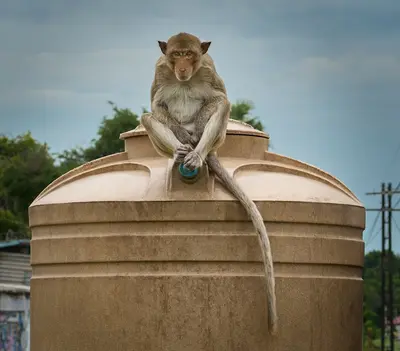
Zwischen den Zielen im Park findest du nichts. Nimm Wasser und Essen mit, verpackt so, dass Makaken nichts riechen und nichts sehen — an den Parkplätzen öffnen sie Taschen und Autofenster, wenn sie eine Chance sehen. Müll nimmst du wieder mit hinaus.
Restaurants an der Thanarat-Straße
Auf der Zufahrt vom Nordtor nach Pak Chong liegen Lokale mit thailändischer und westlicher Karte, dazu Grillrestaurants und Cafés mit Aussicht. Am Wochenende voll, an Wochentagen halb leer.
Weingüter der Region
In den Hügeln vor dem Nordtor liegen Weinbaubetriebe mit eigenen Restaurants, die zu den bekanntesten des Landes gehören. Führungen und Verkostungen werden angeboten; wer selbst fährt, sollte das einplanen.
Milchprodukte aus Pak Chong
Die Milchbetriebe der Region verkaufen Frischmilch, Joghurt und Milcheis — an den Ständen entlang der Zufahrt und in der Stadt. Praktische Erfrischung nach einem heißen Tag im Park.
Exploring on-site
The park lies at an elevation of approximately 400 to 1,350 meters. From one entrance to the other, it's over 50 kilometers of mountain road.Access: The North Entrance is located near Pak Chong on Thanarat Road, the South Entrance near Prachinburi. The road between the gates passes by the Visitor Center.Opening Hours and Admission: Gates daily 6 AM to 6 PM, 400 Baht for adults, 200 Baht for children.No Public Transport: Songthaews from Pak Chong stop at the North Gate. Without your own vehicle, you'll need a booked tour.Vehicle: Roads are paved but steep and winding. Drive slowly, especially at dusk, and expect macaques on the road.Hiking Trails: Several routes start at the Visitor Center. For longer trails, you'll need a guide; registration is available at the Visitor Center.Elephants: If you encounter an animal, keep the engine running, maintain distance, slowly reverse, do not exit your vehicle, and do not feed it.Equipment: Rain jacket, long trousers, and hiking boots. During the rainy season, there are many leeches; high socks help.Current safety and health advice can be found at the Federal Foreign Office.