Fernweh: Home
    ExploreTravel GuidesPlan a tripMy tripLast visited
    de|en
    All Places & RegionsAll highlightsAbout FernwehFAQPrivacy PolicyImprint
    ExploreTravel GuidesPlan a tripMy tripLast visited
    • Neighborhoods & highlights
    • Eat & drink
    • Food culture
    • Culture
    • Getting around
    • Accommodation
    • Plan trip
    • Nearby
    Nakhon Ratchasima (Korat)

    Thailand

    Nakhon Ratchasima (Korat)

    CityCulture

    Nakhon Ratchasima, commonly known as Korat, is one of the largest cities in Isan and, for travellers, primarily the gateway to the region. It lies beyond the ascent to the Khorat Plateau and is well-connected by train, bus, and road.

    by Felix Gillen

    1. Home
    2. Destinations
    3. Thailand
    4. Isan (Northeast Thailand)
    5. Nakhon Ratchasima (Korat)
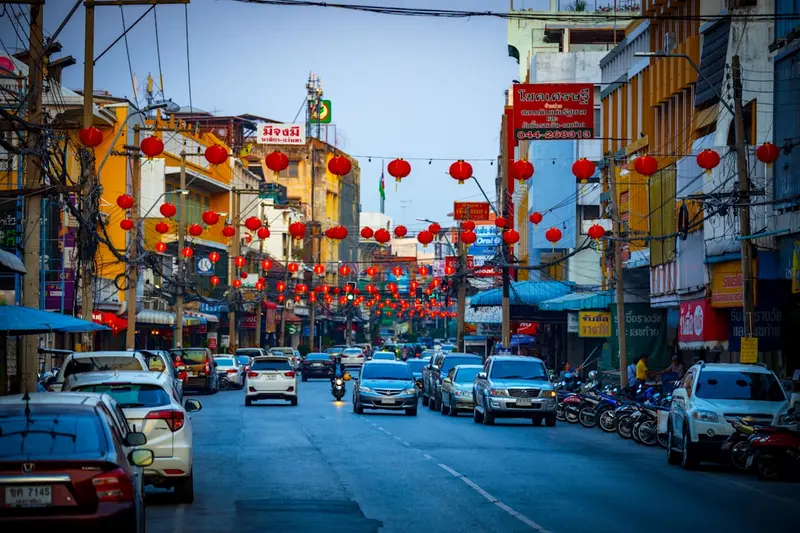
    Nakhon Ratchasima, commonly known as Korat, is one of the largest cities in Isan and, for travellers, primarily the gateway to the region. It lies beyond the ascent to the Khorat Plateau and is well-connected by train, bus, and road.From the historic city centre, parts of the city wall, the moat, and the Chumphon Gate are preserved. In front of it stands the Thao Suranari Monument, dedicated to a local heroine who is said to have organised resistance against troops from Vientiane in 1826. Here, she is honoured daily with flowers, incense sticks, and music.Korat is a good starting point for excursions: northeast to the Khmer complex Phimai, southwest to Khao Yai National Park. South of town, Dan Kwian village produces ceramics from iron-rich clay.Culinarily, the city is known for Pad Mi Korat, fried rice noodles. The easiest way to try them is at the night markets in the centre.

    Sights in Nakhon Ratchasima (Korat)

    Discover the most important sights and attractions

    1House of Phraya Kamthon Phayapthit

    Attraction in 379 ถนนอัษฎางค์ Tambon Nai Mueang.
    Open in Google Maps

    2Historic Water Wheel (Ruean Korat)

    Attraction in X4M7+694.
    Open in Google Maps

    3Lan Ya Mo (Thao-Suranari Square)

    Attraction in PFJ2+3WQ.
    Open in Google Maps

    4Wat Sala Loi

    The Ubosot of this temple is built as a ship, with a hull in the shape of a Chinese junk and a facade made of ceramic tiles from Dan Kwian. The complex dates back to Thao Suranari and her husband; within the grounds stands a Chedi that preserves their ashes. The modern structure dates from the 1970s.
    Open in Google Maps

    5Maha-Wirawong National Museum

    Small regional museum on the grounds of Wat Sutthachinda, showcasing Khmer sculptures, lintels, and artifacts from the surrounding area. It's easily explored in an hour and offers good preparation before heading to Phimai.
    Open in Google Maps

    6Wat Phra Narai Maharat

    City temple in the historic core, named after a Vishnu figure (Phra Narai) of sandstone from the Khmer era, worshipped here. The present-day buildings are more recent; the complex is an everyday temple with continuous activity.
    Open in Google Maps

    Essen & Trinken

    Laab Somphit

    Restaurant in 169 Jant Rd.
    Show on Google Maps

    Charoenphan Bakery (Mahatthai Road)

    Bakery in ชั้น 4 143 Thanon Mahatthai.
    Show on Google Maps

    Kuaitiao Mu Soi Chuen

    Restaurant in 112 San-Prasit Rd.
    Show on Google Maps

    Mingter Vegeterian restaurant

    Restaurant in 698 Thanon Rajadamnern.
    Show on Google Maps

    Essen und Trinken

    Korat kocht an der Nahtstelle zweier Küchen: Isan-Gerichte mit Klebreis, Grillfleisch und Chili treffen auf zentralthailändische Milde und eine ausgeprägte sino-thailändische Nudelkultur. Ein Gericht trägt den Namen der Stadt und wird hier anders gemacht als überall sonst.

    Pad Mi Korat

    Gebratene Reisnudeln mit einer Soßenbasis aus Palmzucker, Tamarinde und Sojasauce, dazu Sojasprossen und Schnittlauch. Süßer und dunkler als Pad Thai und das Gericht, das man mit der Stadt verbindet.

    Larb und Nam Tok

    Fleischsalate mit gerösteten Reiskörnern, Minze und Limette — Larb aus gehacktem, Nam Tok aus gegrilltem und geschnittenem Fleisch. Beide werden lauwarm mit Klebreis gegessen.

    Som Tum

    Papayasalat, in Korat häufig etwas milder abgestimmt als weiter nördlich im Isan. Wenn du es scharf willst, musst du das hier ausdrücklich sagen.

    Kuai Tiao Mu

    Schweinefleisch-Nudelsuppe, die Grundlage der Nudelshops im Zentrum. Morgens und mittags geöffnet, mild, günstig und die verlässlichste Wahl, wenn dir Chili zu viel wird.

    Sai Krok Isan

    Kurze, saure Reiswürste, fermentiert und dann gegrillt, dazu rohe Chilis, Ingwer und Kohl. An den Marktständen überall zu finden.

    Nachtmärkte im Zentrum

    Am Abend bauen im Stadtkern Garküchen und Stände auf: Grillspieße, Papayasalat, Nudeln, Rotis und Säfte. Der einfachste Ort, um sich durch die regionale Küche zu probieren, ohne eine Karte zu brauchen.

    Culture and History

    Korat was for a long time the gateway between central Siam and the Northeast. In its current form, the city developed in the 17th century under Ayutthaya as a fortified outpost with a wall, moat, and four gates. Only the Chumphon Gate remains in its original state.The defining figure is Thao Suranari, known as Ya Mo in everyday life. According to tradition, in 1826 she organized resistance against the troops from Vientiane who had occupied the city. In her honor, a city festival takes place every year from late March to early April. Her ashes rest in a Chedi in the Wat Sala Loi temple.In Korat, a distinct dialect is spoken, blending Central Thai and Isan. The province is home to numerous Khmer-era sites, with artifacts displayed at the Maha-Wirawong National Museum.Artisanally, the province is known for Dan Kwian pottery with its rust-brown surface and for hand-woven silk.

    Exploring locally

    The historic core is walkable: From Chumphon Gate, it's just minutes to the monument, temples, and museum. Otherwise, the city is car-centric.Songthaews run on numbered lines; if unsure, ask if it goes to your destination. Motorcycle taxis, tuk-tuks, and ride-hailing apps are also available.Phimai is reachable by bus or minibus from the bus station in about 90 minutes. For Khao Yai and Dan Kwian, a rental car or driver is more practical.Korat is on the railway line from Bangkok to Isan, with connections to Ubon Ratchathani and Nong Khai. Buses run from two terminals; the larger is outside the center. Scheduled flights are few, so plan by train or bus. By car, allow about three to four hours from Bangkok.

    Accommodations in Nakhon Ratchasima (Korat)

    Find perfect stay in Nakhon Ratchasima (Korat)

    Booking.com* (Affiliate link)
    Search Hotels
    Agoda* (Affiliate link)
    Search Hotels
    Airbnb
    Vacation Rentals

    * Affiliate link: if you book through it, we earn a small commission. The price stays the same for you.

    Plan your trip to Nakhon Ratchasima (Korat)

    Save places, build a route and plan your city trip, all in one place.

    1. 1
      Sunrise over alpine peaks and a sea of clouds
      1234

      Round trip

      12 days · 4 stops

      Saved

      Pick a route

      Pick a ready-made one or save places and plan your own.

      Open bookmarks
    2. 2

      Trip to Nakhon Ratchasima (Korat)

      Live
      • 1House of Phraya Kamthon Phayapthit3 days
      • 2Historic Water Wheel (Ruean Korat)4 days
      • 3Lan Ya Mo (Thao-Suranari Square)5 days
      Budget

      Plan your trip

      The planner sorts stops, days and budget. Plan together in real time.

      Start trip planning
    3. 3
      9:41 No signal
      Nakhon Ratchasima (Korat)
      Available offline

      Use it on the road

      Download the guide to your phone and use it on site, even offline.

    Nearby

    Phimai Historical Park

    Phimai Historical Park

    The Phimai Historical Park in Nakhon Ratchasima Province encompasses the grand Khmer temple complex Prasat Hin Phimai. The main prang was begun around 1080 under King Jayavarman VI, with additions made in the 13th century. Unlike most Khmer temples, Phimai was dedicated to Mahayana Buddhism from the outset.The main prang, built of light sandstone, stands within a rectangular walled enclosure with four gateways. The complex opens to the south, towards the old Royal Road to Angkor. Lintels and pediments display Buddhist and Hindu motifs.The complex is located in the heart of Phimai town and is easily accessible on foot, while the National Museum showcases sculptures and lintels from the region. On the outskirts of town is the Banyan Grove Sai Ngam, with food stalls by the water. Phimai is a day trip from Nakhon Ratchasima.
    Pak Chong

    Pak Chong

    Pak Chong is the northern gateway to Khao Yai National Park. It's a bustling provincial town on the railway and main road from Bangkok to Korat; most accommodations are along the road to the park entrance.The hilly area between town and park is known for its wineries, like PB Valley Khao Yai Winery with tours and tastings. You'll also find dairy farms, farm shops, and cafés for weekend guests from Bangkok.Along the main road stands the temple Wat Thep Phithak Punnaram with a large white Buddha figure on a hill. The market and evening stalls offer Isan dishes and grilled food.It's most pleasant from November to February. On weekends and public holidays, accommodations book up fast.
    Khao Yai National Park Region

    Khao Yai National Park Region

    The Khao Yai Region lies about 180 kilometers northeast of Bangkok. Its heart is the Khao Yai National Park, founded in 1962 as Thailand's first national park and part of the UNESCO World Heritage Site Dong Phayayen-Khao Yai. The park offers rainforest, waterfalls, wild elephants, gibbons, and hornbills.Around Pak Chong, outside the park gate, are wineries, cafés, and amusement parks, popular with Bangkok day-trippers on weekends.
    Phanom Rung Historical Park

    Phanom Rung Historical Park

    Prasat Hin Phanom Rung stands on the rim of an extinct volcano in Buriram province and is one of the most complete Khmer sites in Thailand. The temple was built in several phases from the 10th to the 13th century and was dedicated to the Hindu god Shiva. The mountain was considered an image of his abode, Kailash.Access is via a paved processional road, across a bridge lined with Naga snakes, and up a staircase to the main prang. Lintels and pediments with scenes from Hindu mythology are preserved at the portals, including the Narai-Bandhomsindhu lintel, which returned from Chicago in 1988.On a few days annually, the sun aligns through all 15 doorways at sunrise or sunset. Crowds are huge then. Shade is minimal; come early morning. The smaller sanctuary Prasat Muang Tam lies a few kilometers away at the mountain's foot.
    Khao Yai National Park

    Khao Yai National Park

    Khao Yai National Park was Thailand's first national park in 1962 and is part of the Dong Phayayen-Khao Yai Forest Complex, a UNESCO World Heritage site. Covering 2,168 square kilometers, it is the country's third-largest and spans four provinces: mountainous terrain with evergreen rainforest, grasslands, and streams.Best known are the Haew Suwat and Haew Narok waterfalls, the latter currently closed. Marked hiking trails begin at the visitor center; for longer routes through the forest, you need a guide.The main reason to visit is wildlife viewing: wild elephants, white-handed gibbons, macaques, sambar deer, and several hornbill species. Observation towers near salt licks and meadows, such as at Nong Phak Chi, are best early morning and at dusk. Guided spotlighting drives are offered in the evenings.Elephants regularly cross the roads: keep your distance, stay in your vehicle, do not honk. Accommodation is available at campsites and in park-managed bungalows. Access points are in the north near Pak Chong and in the south near Prachinburi.

    Sources & method

    • Photos: Unsplash. Each photo carries its credit.
    • The content is based on web research from public, traceable sources. How the content is made · The role of AI