Fernweh: Home
    ExploreTravel GuidesPlan a tripMy tripLast visited
    de|en
    All Places & RegionsAll highlightsAbout FernwehFAQPrivacy PolicyImprint
    ExploreTravel GuidesPlan a tripMy tripLast visited
    • Overview
    • Places in the region
    • Eat & drink
    • Food culture
    • Culture
    • Getting around
    • Nearby
    Isan (Northeast Thailand)

    Thailand

    Isan (Northeast Thailand)

    Region

    Isan is Thailand's Northeast and the country's largest region: a vast, agricultural plateau bordered by the Mekong to the north and east.

    by Felix Gillen

    1. Home
    2. Destinations
    3. Thailand
    4. Isan (Northeast Thailand)
    Isan is Thailand's Northeast and the country's largest region: a vast, agricultural plateau bordered by the Mekong to the north and east. Touristically, it is less developed than the coasts and the north, and you'll less often get by with English.Culturally, the region is close to Laos. The spoken language is related to Laotian, as are its music, festivals, and cuisine. On the plate, you'll find Som Tam, Laab, and sticky rice, usually spicier than in Central Thailand.From the time of the Khmer Empire, several temple complexes are preserved in the south of the region, including Phanom Rung and Phimai. Additionally, there is silk weaving and its own festival calendar, such as the Rocket Festival at the start of the rainy season and the Candle Festival in Ubon Ratchathani.The cooler dry season from November to February is the most pleasant time to travel. From March to May, it gets very hot.
    Isan covers about 20 provinces on the Khorat Plateau. Its culture, language, and cuisine are Lao-influenced, featuring the Rocket Festival Bun Bang Fai and Mor Lam music. In the south stand Khmer temples like Phanom Rung and Phimai; in the north lie UNESCO sites Ban Chiang and Phu Phra Bat. Quiet border towns like Nong Khai and That Phanom line the Mekong. The largest cities are Nakhon Ratchasima, Khon Kaen, Udon Thani, and Ubon Ratchathani. Travel is most pleasant from November to February.
    Nong Khai

    Place 1 of 4

    Nong Khai

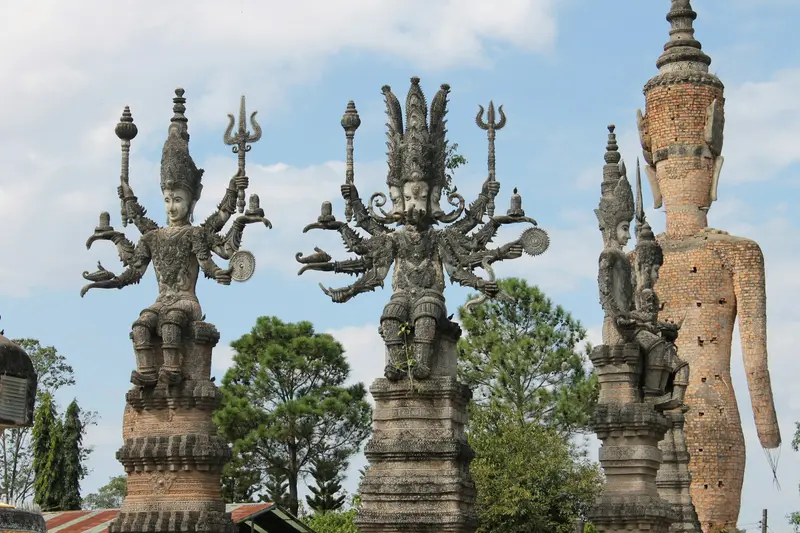
    Nong Khai is located on the Mekong, opposite Laos, with the Laotian capital Vientiane about 25 kilometers upstream. The First Thai-Lao Friendship Bridge connects both countries by road and rail.

    Discover
    Buriram

    Place 2 of 4

    Buriram

    Buriram, in southern Isan, combines Khmer heritage with professional sports. The province is known for Phanom Rung Historical Park, a Khmer temple complex atop an extinct volcano, and the nearby sanctuary Muang Tam with its water features.

    Discover
    Khon Kaen

    Place 3 of 4

    Khon Kaen

    Khon Kaen, centrally located in Isan, is an administrative, economic, and university city.

    Discover
    Nakhon Ratchasima (Korat)

    Place 4 of 4

    Nakhon Ratchasima (Korat)

    Nakhon Ratchasima, commonly known as Korat, is one of the largest cities in Isan and, for travellers, primarily the gateway to the region. It lies beyond the ascent to the Khorat Plateau and is well-connected by train, bus, and road.

    Discover

    More places in Isan (Northeast Thailand)

    Phanom Rung Historical Park

    Phanom Rung Historical Park

    Prasat Hin Phanom Rung stands on the rim of an extinct volcano in Buriram province and is one of the most complete Khmer sites in Thailand. The temple was built in several phases from the 10th to the 13th century and was dedicated to the Hindu god Shiva. The mountain was considered an image of his abode, Kailash.Access is via a paved processional road, across a bridge lined with Naga snakes, and up a staircase to the main prang. Lintels and pediments with scenes from Hindu mythology are preserved at the portals, including the Narai-Bandhomsindhu lintel, which returned from Chicago in 1988.On a few days annually, the sun aligns through all 15 doorways at sunrise or sunset. Crowds are huge then. Shade is minimal; come early morning. The smaller sanctuary Prasat Muang Tam lies a few kilometers away at the mountain's foot.
    Phimai Historical Park

    Phimai Historical Park

    The Phimai Historical Park in Nakhon Ratchasima Province encompasses the grand Khmer temple complex Prasat Hin Phimai. The main prang was begun around 1080 under King Jayavarman VI, with additions made in the 13th century. Unlike most Khmer temples, Phimai was dedicated to Mahayana Buddhism from the outset.The main prang, built of light sandstone, stands within a rectangular walled enclosure with four gateways. The complex opens to the south, towards the old Royal Road to Angkor. Lintels and pediments display Buddhist and Hindu motifs.The complex is located in the heart of Phimai town and is easily accessible on foot, while the National Museum showcases sculptures and lintels from the region. On the outskirts of town is the Banyan Grove Sai Ngam, with food stalls by the water. Phimai is a day trip from Nakhon Ratchasima.
    Surin

    Surin

    Surin, located in the south of Isan, is closely linked to Thailand's elephant culture. The province is shaped by the Kui people, who have caught and guided elephants for generations. The annual Elephant Round-up in November is the city's biggest event.Beyond that, Surin is a tranquil provincial town. At the Talat Mai market, you'll find Isan cuisine and silk, still hand-woven in the surrounding villages.The surrounding area features Khmer sanctuaries like Prasat Sikhoraphum with its five brick towers. The most pleasant time to visit is the cooler dry season from November to February.
    Ubon Ratchathani

    Ubon Ratchathani

    Ubon Ratchathani is the largest city in eastern Isan, located near the border with Laos and on the Mun River. It is an administrative and university city, relying less on tourism and more on its role as a regional hub.City temples include Wat Thung Si Muang, featuring a wooden scripture library set on stilts in the middle of a pond, and Wat Nong Bua, whose white chedi is modeled after the Bodhgaya stupa in India. The National Museum, housed in a former royal residence, showcases the region's history.Ubon is best known for its Candle Festival (Hae Thian Phansa) in July, marking the start of Buddhist Lent: City temples commission large wax relief sculptures, which are then paraded through the city center. Accommodation is scarce during this period.The surrounding area features Pha Taem National Park with prehistoric rock paintings high above the Mekong, and the water-eroded rock pools of Sam Phan Bok, exposed during low water levels. The cooler dry season from November to February is the most pleasant time to visit.
    Udon Thani

    Udon Thani

    Udon Thani, a major city in northern Isan, serves as an ideal starting point for exploring the UNESCO World Heritage Site Ban Chiang Archaeological Site and itself offers a lively market scene and relaxed parks.

    Sights in Isan (Northeast Thailand)

    Discover the most important sights and attractions

    Wat Phra That Phanom

    One of Isan's most important stupas, Laotian-style, and a pilgrimage site for believers from Northeast Thailand and Laos. The tower collapsed in 1975 after heavy rain and was rebuilt. Tens of thousands of pilgrims visit for the temple festival in February.
    Open in Google Maps

    Pha Taem National Park

    National Park on Thailand's eastern border, perched on a cliff above the Mekong. Preserved on the rock walls are red ochre paintings, estimated to be 3,000 to 4,000 years old: handprints, fish traps, humans, and animals. The largest group stretches over approximately 180 meters. Also within the park are the rock pillars of Sao Chaliang, and further north along the river, the rock formations of Sam Phan Bok, which are exposed during the dry season.
    Open in Google Maps

    Phu Phra Bat Historical Park

    Sandstone landscape in Udon Thani Province, a UNESCO World Heritage site since 2024. Among weathered mushroom rocks stand upright boundary stones (Sema) from the Dvaravati period and rock shrines with Buddha figures, plus prehistoric rock paintings. Hiking trails connect the individual sites.
    Open in Google Maps

    Prasat Muang Tam

    A flat Khmer complex a few kilometers below Phanom Rung, featuring four L-shaped water basins bordered by stone Naga. This structure is older than the neighboring temple on the mountain and significantly less visited. Both can easily be combined in one day.
    Open in Google Maps

    Prasat Sikhoraphum

    Khmer temple east of Surin with five brick towers on a shared platform, surrounded by a moat. Above the entrance of the central tower, a finely carved lintel depicts the dancing Shiva, alongside Apsara figures. The town of Sikhoraphum has a railway station on the line to Ubon Ratchathani.
    Open in Google Maps

    Prasat Phanom Wan

    Open in Google Maps

    Essen & Trinken

    1

    Kuaitiao Yai On Kao Ngio

    An Isan noodle soup spot, named after its female owner – typical of many of the country's best food stalls. As is typical, you choose your noodles and toppings, seasoning at the table with chili, sugar, fish sauce, and vinegar. The setup is simple: a few tables, guests from the neighborhood. Meals are quick, usually in the morning or at noon.
    Show on Google Maps
    2

    Khrua Khru Io

    A simple eatery in Isan serving regional cuisine – in the Northeast, that means sour, spicy, and with sticky rice instead of jasmine rice. The decor is unpretentious; meals are eaten at simple tables. Guests are almost exclusively locals; you should not expect an English menu.
    Show on Google Maps
    3

    Khrua Ta Noi

    A small kitchen in Isan, whose name translates to “Grandpa Noi's Secret Delicacies”. It serves the everyday cuisine of Northeast Thailand, which is noticeably spicier and sourer than Central Thai. The eatery caters to locals, not to travelers.
    Show on Google Maps
    4

    Ran Ko Phai (Bamboo Grove)

    A rural eatery in Isan, whose name alludes to the bamboo thicket. Serving Northeast Thai cuisine, unpretentious and without adaptation for foreign palates – be prepared for the heat. The setting is simple, the clientele is local.
    Show on Google Maps
    5

    Cafe de Phanom Rung

    Café in HW8P+3MW.
    Show on Google Maps
    6

    Khrua Baan Mae by Tuanjai

    Restaurant in 20 หมู่ 17 บ้านบุ ต.จรเข้มาก Amphoe Prakhon Chai.
    Show on Google Maps
    7

    Che Phen (Aahan Tam Sang)

    Restaurant in GWJW+R8C.
    Show on Google Maps
    8

    Suan Hom Khanun (Jackfruit Garden)

    Restaurant in บ้านโคกเมือง GX4G+M87.
    Show on Google Maps
    9

    green restorant

    Restaurant in GXM9+CMM บร.3054 Tambon Chorakhe Mak.
    Show on Google Maps

    Dining and Drinks

    Die Küche des Isan ist eng mit der laotischen verwandt und unterscheidet sich deutlich vom Rest Thailands. Grundlage ist Klebreis, den Du mit den Fingern zu Kugeln formst und als Werkzeug benutzt, um Sauce und Fleisch aufzunehmen. Gewürzt wird mit fermentiertem Fisch, gerösteter Reismehlmischung, Limette, Chili und frischen Kräutern; Kokosmilch spielt kaum eine Rolle. Vieles davon ist inzwischen in ganz Thailand verbreitet, hier bekommst Du es schärfer und mit mehr Pla Ra.

    Som Tam

    Shredded green papaya salad, pounded with chili, garlic, lime, palm sugar, tomato in a mortar. The Som Tam Pla Ra version adds fermented fish, making it bolder, saltier. Served with sticky rice and grilled chicken.

    Larb and Nam Tok

    Finely chopped meat with lime, fish sauce, chili, toasted rice flour, and herbs like mint. Nam Tok is the variant with grilled, sliced meat. Served with raw cabbage and beans.

    Gai Yang

    Marinated chicken grilled over charcoal, usually with a tamarind and chili dipping sauce. Together with Som Tam and sticky rice, it's the region's standard trio you'll find at stalls along many country roads.

    Sai Krok Isan

    Short pork sausages, in which meat is fermented with rice and garlic, imparting a sour note. Grilled and served with raw cabbage, ginger, and chili.

    Kaeng Om and Herbal Soups

    Herb-rich stews with meat or fish, dill and lemongrass. Kaeng No Mai with bamboo shoots is a common variant. Isan cuisine makes extensive use of wild herbs.

    Culture and History

    From the 10th to the 13th century, southern Isan was part of the Khmer Empire's sphere of influence. Temples like Phimai and Phanom Rung were located on roads leading to Angkor. Even older are the Bronze Age finds of Ban Chiang and the Dvaravati-era boundary stones in Phu Phra Bat.Later, many people immigrated from present-day Laos. Most inhabitants still speak Isan, a form of Laotian; Thai is the official language. Typical is the music Mor Lam, played with the khaen mouth organ.Well-known festivals include the Rocket Festival Bun Bang Fai in May, especially in Yasothon, and the Ghost Festival Phi Ta Khon in Dan Sai in Loei Province. In many villages, silk is woven, often using the ikat technique Mudmee.

    Exploring locally

    The distances are considerable: From Bangkok to Nakhon Ratchasima it's about 260 kilometers, to Khon Kaen around 450, and to Nong Khai over 600. Plan for a domestic flight or long travel legs.The Northeastern railway splits in Nakhon Ratchasima: One branch runs via Khon Kaen and Udon Thani to Nong Khai and across the bridge to Laos, the other via Surin to Ubon Ratchathani. Buses depart from Bangkok at Mo Chit Terminal. Highway 2 is the main road axis up to Nong Khai.Flights from Bangkok go to Khon Kaen, Udon Thani, Ubon Ratchathani, Buriram, Roi Et, Sakon Nakhon, Nakhon Phanom, and Loei, among other destinations, usually in just over an hour.Rental cars are worthwhile because many temples, national parks, and Mekong sections are located outside the cities.Songthaews and Minivans connect the provincial towns with the districts. Clarify your return trip beforehand; often none run in the afternoon.From November to February, it's dry and cool at night, with Loei's highlands sometimes dropping below ten degrees. Over 40 degrees are possible from March to May. In the rainy season (June to October), rice fields turn green.Up-to-date information on safety and health, including the border region with Cambodia, can be found at the Federal Foreign Office.

    Nearby

    Khon Kaen

    Khon Kaen

    Khon Kaen, centrally located in Isan, is an administrative, economic, and university city. Its large university shapes the cityscape: with more cafés, bookstores, and evening venues than in comparable provincial towns, and the city serves many travelers as a convenient stopover on their journey through the region.The landmark is Wat Nong Wang on the shore of Bueng Kaen Nakhon lake: a nine-story pagoda whose floors house museum rooms on the city's history, offering panoramic views from the top gallery. The lake itself features a circular path, popular with strollers in the evenings.The city's National Museum displays finds from Isan, including objects from the Dvaravati period and prehistoric pottery. The province is known for Mudmee silk, an Ikat weaving technique primarily practiced in Chonnabot district.On weekends, a central street transforms into a pedestrian zone with stalls offering Isan cuisine and handicrafts. The cooler dry season from November to February is particularly pleasant.
    Phimai Historical Park

    Phimai Historical Park

    The Phimai Historical Park in Nakhon Ratchasima Province encompasses the grand Khmer temple complex Prasat Hin Phimai. The main prang was begun around 1080 under King Jayavarman VI, with additions made in the 13th century. Unlike most Khmer temples, Phimai was dedicated to Mahayana Buddhism from the outset.The main prang, built of light sandstone, stands within a rectangular walled enclosure with four gateways. The complex opens to the south, towards the old Royal Road to Angkor. Lintels and pediments display Buddhist and Hindu motifs.The complex is located in the heart of Phimai town and is easily accessible on foot, while the National Museum showcases sculptures and lintels from the region. On the outskirts of town is the Banyan Grove Sai Ngam, with food stalls by the water. Phimai is a day trip from Nakhon Ratchasima.
    Nakhon Ratchasima (Korat)

    Nakhon Ratchasima (Korat)

    Nakhon Ratchasima, commonly known as Korat, is one of the largest cities in Isan and, for travellers, primarily the gateway to the region. It lies beyond the ascent to the Khorat Plateau and is well-connected by train, bus, and road.From the historic city centre, parts of the city wall, the moat, and the Chumphon Gate are preserved. In front of it stands the Thao Suranari Monument, dedicated to a local heroine who is said to have organised resistance against troops from Vientiane in 1826. Here, she is honoured daily with flowers, incense sticks, and music.Korat is a good starting point for excursions: northeast to the Khmer complex Phimai, southwest to Khao Yai National Park. South of town, Dan Kwian village produces ceramics from iron-rich clay.Culinarily, the city is known for Pad Mi Korat, fried rice noodles. The easiest way to try them is at the night markets in the centre.
    Buriram

    Buriram

    Buriram, in southern Isan, combines Khmer heritage with professional sports. The province is known for Phanom Rung Historical Park, a Khmer temple complex atop an extinct volcano, and the nearby sanctuary Muang Tam with its water features.On the outskirts of the city are the Chang International Circuit, where MotoGP races, and the stadium of Buriram United. On race and match days, accommodation is scarce.For the temples, early morning and late afternoon are best, as there is little shade. Phanom Rung and Muang Tam are best combined with your own vehicle in one day. In the city, the markets offer a good impression of daily life and Isan cuisine.
    Surin

    Surin

    Surin, located in the south of Isan, is closely linked to Thailand's elephant culture. The province is shaped by the Kui people, who have caught and guided elephants for generations. The annual Elephant Round-up in November is the city's biggest event.Beyond that, Surin is a tranquil provincial town. At the Talat Mai market, you'll find Isan cuisine and silk, still hand-woven in the surrounding villages.The surrounding area features Khmer sanctuaries like Prasat Sikhoraphum with its five brick towers. The most pleasant time to visit is the cooler dry season from November to February.

    Sources & method

    • Photos: Unsplash. Each photo carries its credit.
    • The content is based on web research from public, traceable sources. How the content is made · The role of AI