Fernweh: Home
    ExploreTravel GuidesPlan a tripMy tripLast visited
    de|en
    All Places & RegionsAll highlightsAbout FernwehFAQPrivacy PolicyImprint
    ExploreTravel GuidesPlan a tripMy tripLast visited
    • Neighborhoods & highlights
    • Eat & drink
    • Food culture
    • Culture
    • Getting around
    • Accommodation
    • Plan trip
    • Nearby
    Udon Thani

    Thailand

    Udon Thani

    CityCulture

    Udon Thani, a major city in northern Isan, serves as an ideal starting point for exploring the UNESCO World Heritage Site Ban Chiang Archaeological Site and itself offers a lively market scene and relaxed parks.

    by Felix Gillen

    1. Home
    2. Destinations
    3. Thailand
    4. Isan (Northeast Thailand)
    5. Udon Thani
    Udon Thani, a major city in northern Isan, serves as an ideal starting point for exploring the UNESCO World Heritage Site Ban Chiang Archaeological Site and itself offers a lively market scene and relaxed parks.

    Sights in Udon Thani

    Discover the most important sights and attractions

    1City Pillar Shrine

    The City Pillar Shrine, the ritual focal point of every city's founding in Thailand. Locals visit with flowers, incense sticks and gold leaf; the site is accordingly bustling and not a museum piece.
    Open in Google Maps

    2Kromluang Prachak Sinlapakhom Monument

    Monument to Prince Prachak Sinlapakhom, who in the late 19th century established northern Isan's administration and is considered the city's founder. The square is central, serving as a landmark and place of veneration.
    Open in Google Maps

    3Thai-Chinese Cultural Center

    Chinese-style complex with a garden courtyard, hall, and exhibition rooms, commemorating Chinese immigration to Isan. It highlights a segment of the city's population that is otherwise rarely seen in the streetscape.
    Open in Google Maps

    4Wat Pothisompon

    Royal temple in the city center with a gilded chedi towering over the complex. A mid-level viewing platform offers views over the temple grounds and a section of the city. A working temple, cover shoulders and knees.
    Open in Google Maps

    5Udon Thani City Museum

    Museum in Thanon Pho Si.
    Open in Google Maps

    6Nong Prajak Park

    A park around a lake in the city's west, with lakeside paths, bridges, and sports areas. In the early morning and after sunset, it's the city's liveliest spot; at other times it's empty due to the heat.
    Open in Google Maps

    Essen & Trinken

    Laab Mu Worachai

    Restaurant in 26.
    Show on Google Maps

    Tete' Cafe'&Milk

    Restaurant in 19/1 Phran Phrao Rd.
    Show on Google Maps

    VT Namnueng Vietnamese Restaurant, Udon Thani City

    Vietnamese restaurant in Udon Thani and one of the city's most famous addresses. The highlight is Nam Nueang: grilled pork rolls that you roll yourself at the table with rice paper, herbs, lettuce, and sauce. Vietnamese cuisine has been part of daily life in northern Isan since immigration in the 20th century. The restaurant is large and usually busy.
    Show on Google Maps

    Essen und Trinken

    Udon kocht Isan-Küche und hat zusätzlich eine ausgeprägte vietnamesische Tradition, die auf die Zuwanderung des 20. Jahrhunderts zurückgeht. Dazu kommen internationale Lokale, ein Erbe der Jahre des Luftwaffenstützpunkts. Die Abendmärkte im Zentrum sind der einfachste Einstieg.

    Nam Nueang

    Vietnamesische Schweinefleischröllchen vom Spieß, die du selbst mit Reispapier, Kräutern, grüner Banane und Sauce einwickelst. In Udon so verbreitet, dass es als Lokalgericht gilt — die Portionen kommen als Baukasten auf den Tisch.

    Larb und Nam Tok

    Fleischsalate mit gerösteten Reiskörnern, Minze und Limette. Larb aus gehacktem, Nam Tok aus gegrilltem Fleisch, beide lauwarm und mit Klebreis. In Udon gibt es Lokale, die sich ausschließlich darauf spezialisieren.

    Som Tum

    Papayasalat mit Limette, Fischsauce und Chili; die Isan-Variante mit fermentierter Fischsauce Pla Ra ist salziger und kräftiger. Standardmäßig scharf, mild musst du ausdrücklich bestellen.

    Klebreis

    Im Bambuskörbchen gedampft und mit der Hand gegessen — im Isan Hauptnahrungsmittel, nicht Beilage. Er gehört zu Grillfleisch, Dips und Salaten immer dazu.

    Kai Yang und Sai Krok Isan

    Mariniertes Grillhähnchen und kurze, fermentierte Reiswürste vom Holzkohlerost, dazu Kohl, Ingwer und rohe Chilis. Die häufigste Kombination an den Abendmärkten.

    Abendmärkte im Zentrum

    Rund um den Markt Tung Si Mueang und die Bahnhofsgegend bauen abends Garküchen auf: Grillspieße, Papayasalat, Nudeln, Rotis und Säfte. Günstig, schnell und ohne Karte — bestellt wird, was in der Auslage liegt.

    Culture and History

    The area has been settled since the Bronze Age. At Ban Chiang, about 50 kilometres to the east, graves containing painted pottery, tools, and early bronze objects were discovered. Since 1992, the site has been a UNESCO World Heritage site. The pottery with red spiral patterns is now a landmark of the province.The city itself is young. Prince Prachak Sinlapakhom founded it in 1893 as an administrative centre for northern Isan, partly in response to French pressure on the Mekong. His monument stands in the centre.During the Vietnam War, a large US Air Force base was located near Udon Thani from the 1960s to the mid-1970s. This changed the economy and streetscape, a story told by the city museum.Isan is spoken, and sticky rice with papaya salad, Larb, and grilled meat are eaten. Thanks to Vietnamese immigration, Nam Nueang, a pork sausage to wrap yourself in rice paper, is almost a local dish in Udon.

    Local adventures

    The city is sprawling and car-centric. You can walk around Nong-Prajak-Park and the markets; otherwise, use numbered Songthaews, motorcycle taxis, tuk-tuks, or ride-hailing apps.The train line from Bangkok to Nong Khai stops here, and the airport has several daily flights from Bangkok. Buses and minibuses run to Nong Khai and across the Friendship Bridge to Vientiane.The Red Lotus Lake near Kumphawapi is about 45 kilometers to the south. Boats depart early in the morning as the blossoms close later in the day. Tours are available in the city.Ban Chiang is about 50 kilometers to the east. You'll be more flexible with your own vehicle or a driver than with Songthaews. For the museum and excavation pit, allow two to three hours.For current safety and health advice, including road traffic information, refer to the Federal Foreign Office.

    Accommodations in Udon Thani

    Find perfect stay in Udon Thani

    Booking.com* (Affiliate link)
    Search Hotels
    Agoda* (Affiliate link)
    Search Hotels
    Airbnb
    Vacation Rentals

    * Affiliate link: if you book through it, we earn a small commission. The price stays the same for you.

    Plan your trip to Udon Thani

    Save places, build a route and plan your city trip, all in one place.

    1. 1
      Sunrise over alpine peaks and a sea of clouds
      1234

      Round trip

      12 days · 4 stops

      Saved

      Pick a route

      Pick a ready-made one or save places and plan your own.

      Open bookmarks
    2. 2

      Trip to Udon Thani

      Live
      • 1City Pillar Shrine3 days
      • 2Kromluang Prachak Sinlapakhom Monument4 days
      • 3Thai-Chinese Cultural Center5 days
      Budget

      Plan your trip

      The planner sorts stops, days and budget. Plan together in real time.

      Start trip planning
    3. 3
      9:41 No signal
      Udon Thani
      Available offline

      Use it on the road

      Download the guide to your phone and use it on site, even offline.

    Nearby

    Nong Khai

    Nong Khai

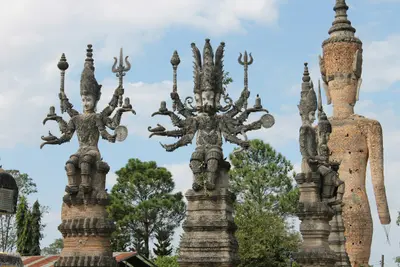
    Nong Khai is located on the Mekong, opposite Laos, with the Laotian capital Vientiane about 25 kilometers upstream. The First Thai-Lao Friendship Bridge connects both countries by road and rail. The main attraction is the Sala Kaew Ku sculpture park, featuring some figures over 20 meters tall. Around the full moon in October, the so-called Naga fireballs can be observed on the river.
    Khon Kaen

    Khon Kaen

    Khon Kaen, centrally located in Isan, is an administrative, economic, and university city. Its large university shapes the cityscape: with more cafés, bookstores, and evening venues than in comparable provincial towns, and the city serves many travelers as a convenient stopover on their journey through the region.The landmark is Wat Nong Wang on the shore of Bueng Kaen Nakhon lake: a nine-story pagoda whose floors house museum rooms on the city's history, offering panoramic views from the top gallery. The lake itself features a circular path, popular with strollers in the evenings.The city's National Museum displays finds from Isan, including objects from the Dvaravati period and prehistoric pottery. The province is known for Mudmee silk, an Ikat weaving technique primarily practiced in Chonnabot district.On weekends, a central street transforms into a pedestrian zone with stalls offering Isan cuisine and handicrafts. The cooler dry season from November to February is particularly pleasant.
    Nam-Nao National Park

    Nam-Nao National Park

    The Nam Nao National Park straddles the border of Phetchabun and Chaiyaphum provinces. Established in 1972, it covers approximately 970 square kilometers. Its highland terrain features a mix of pine forests, dry and mountain forests, and grasslands, giving the park a distinct character compared to the tropical parks in the south.Among its inhabitants are wild elephants, gaur, bantengs, and Sambar deer, plus around 360 bird species. Trails lead to viewpoints, waterfalls such as Haew Sai, and caves. The highest point is Phu Pha Chit, at 1,271 meters.Route 12, connecting Lom Sak and Chum Phae, passes through the park, ensuring easy access. The park headquarters offers bungalows and a campsite. Nights can get noticeably cool, particularly in December and January.
    Isan (Northeast Thailand)

    Isan (Northeast Thailand)

    Isan is Thailand's Northeast and the country's largest region: a vast, agricultural plateau bordered by the Mekong to the north and east. Touristically, it is less developed than the coasts and the north, and you'll less often get by with English.Culturally, the region is close to Laos. The spoken language is related to Laotian, as are its music, festivals, and cuisine. On the plate, you'll find Som Tam, Laab, and sticky rice, usually spicier than in Central Thailand.From the time of the Khmer Empire, several temple complexes are preserved in the south of the region, including Phanom Rung and Phimai. Additionally, there is silk weaving and its own festival calendar, such as the Rocket Festival at the start of the rainy season and the Candle Festival in Ubon Ratchathani.The cooler dry season from November to February is the most pleasant time to travel. From March to May, it gets very hot.
    Phu Thap Boek

    Phu Thap Boek

    Phu Thap Boek, at around 1,770 meters, is the highest point in Phetchabun province and the Phetchabun Mountains. The mountain is located in Lom Kao district near the border with Loei province, surrounded by Phu Hin Rong Kla National Park. From the ridge, the view stretches over the surrounding mountain ranges; in the mornings, fog often gathers in the valleys.The slopes are covered with cabbage fields, cultivated by the Hmong families of Ban Thap Boek village. Around these fields, many resorts, campsites, and local eateries have sprung up, some of which are considered illegally built. Many visitors stay overnight here to witness the sunrise.The climate is cool year-round, with December and January being the coldest months. Wild cherry trees also bloom during this time. Warm clothing is advisable even in the dry season.

    Sources & method

    • Photos: Unsplash. Each photo carries its credit.
    • The content is based on web research from public, traceable sources. How the content is made · The role of AI