ExploreTravel GuidesPlan a trip
    de|en
    All Places & RegionsAbout FernwehFAQPrivacy PolicyImprint
    ExploreTravel GuidesPlan a trip
    • Neighborhoods & highlights
    • Eat & drink
    • Food culture
    • Culture
    • Nightlife
    • Getting around
    • Accommodation
    • Plan trip
    • Nearby
    Hamburg

    Germany

    Hamburg

    CityUNESCO

    Hamburg, Germany's second-largest city at 1.9 million inhabitants, lies on the Lower Elbe, where the Alster is dammed in the city center to form Binnenalster and Außenalster.

    1. Home
    2. Destinations
    3. Germany
    4. Hamburg
    5. Hamburg
    Hamburg, Germany's second-largest city at 1.9 million inhabitants, lies on the Lower Elbe, where the Alster is dammed in the city center to form Binnenalster and Außenalster. Its port, a global transshipment hub, shapes the cityscape from Landungsbrücken to HafenCity.Here you'll experience the neo-Gothic brick ensemble of the Speicherstadt, the Elbphilharmonie (opened 2017), the baroque Michel, and the magnificent Rathaus. Evenings, St. Pauli beckons: Reeperbahn, Große Freiheit, and Hans-Albers-Platz form the city's best-known entertainment hub.
    Hamburg ist mit rund 1,9 Millionen Einwohnern und etwa 755 Quadratkilometern die zweitgrößte Stadt Deutschlands. Unterwegs bist du am besten mit dem HVV, zu dem vier U-Bahn- und vier S-Bahn-Linien sowie die HADAG-Hafenfähren gehören. Besonders ist das Wasser überall: Elbe, Alster, Fleete und fast 2500 Brücken. Rund um Rathaus und Binnenalster liegt die Innenstadt, südlich davon Speicherstadt und HafenCity mit der Elbphilharmonie. Westlich lohnen St. Pauli mit Landungsbrücken und Reeperbahn sowie die Sternschanze und Altona.

    More districts in Hamburg

    St. Pauli

    St. Pauli

    St. Pauli, located directly on the Elbe between the city center and Altona, has been a Hamburg district since 1894. The former suburb of Hamburger Berg has borne this name since 1833. The Reeperbahn recalls the rope makers who settled here from 1633 and spun ship ropes. Today, the Kiez around Reeperbahn, Große Freiheit and Spielbudenplatz, FC St. Pauli with its Millerntor Stadium, and the harbor define the district, which is considered politically left-leaning, diverse, and tolerant.During the day, you can climb the Grüner Bunker on Feldstraße or visit Beatles-Platz, while evenings offer a choice between the theaters on Spielbudenplatz, live music clubs, and Kiez pubs. The U3 stops at Landungsbrücken, St. Pauli, and Feldstraße stations, and S-Bahn lines S1 and S3 stop at Reeperbahn station.
    Old Town & New Town

    Old Town & New Town

    Around Domplatz, Hammaburg was Hamburg's genesis; by 1188, a merchant settlement had emerged at Nikolaifleet. The Great Fire of 1842 destroyed large parts of the Old Town; during reconstruction, the Alsterarkaden were built. Today, office buildings, department stores, and Mönckebergstraße, the main shopping street, define the Old Town; west of the Alsterfleet lies the Neustadt.Stroll along Jungfernstieg by the Binnenalster, take an Alster boat tour from the pier, walk under the Alsterarkaden, and ride the panoramic lift 76 meters high in Mahnmal St. Nikolai. On Deichstraße at Nikolaifleet, where the 1842 fire began, stands a Baroque merchant house from 1686 at number 37. At Jungfernstieg station, the U1, U2, U4, and S1 and S3 S-Bahn lines stop.
    Altona & Ottensen

    Altona & Ottensen

    Altona originated around 1535 as a fishing settlement. On August 23, 1664, it received city rights from Danish King Frederick III and grew into the second-largest city in the Danish realm. It only became part of Hamburg in 1938. Neighboring Ottensen, first mentioned in 1310 as the village of Ottenhusen, developed into an industrial hub after 1866 and became part of Altona in 1889. Today, Ottensen, with some 35,000 residents across 2.9 square kilometers, is a popular district for shopping and going out.From Altona Balcony, you can see across the Elbe to the Köhlbrand Bridge; along the Palmaille stand grand bourgeois buildings from the early 19th century. In Ottensen, you'll find the Fabrik cultural center with its crane and the Zeise Kinos featuring a ship's propeller from the former propeller factory. The S-Bahn lines S1, S2, and S3 stop at Altona Station.
    HafenCity & Speicherstadt

    HafenCity & Speicherstadt

    The HafenCity has been developing since its groundbreaking on April 9, 2001, on the former Großer Grasbrook, a port area of approximately 157 hectares, which was released from the Free Port on January 1, 2003, to allow for residential construction. Since March 1, 2008, it has been its own district. To its north lies the Speicherstadt, opened in 1888, for which the residential quarters Kehrwieder and Wandrahm were cleared starting in 1883.You'll walk across the Magellan and Marco Polo Terraces along the water, visit the International Maritime Museum in Kaispeicher B, and learn at the Speicherstadtmuseum how storekeepers stored coffee, tea, and rubber. The U4 stops at the stations Überseequartier, HafenCity Universität, and Elbbrücken.
    Blankenese & Övelgönne

    Blankenese & Övelgönne

    Blankenese was a fishing village, first documented in 1301. Later, captains and pilots lived here; today, it is one of Hamburg's most affluent districts. In 1938, it became part of Hamburg along with Altona. The old village center is formed by the Treppenviertel on the steep Elbe slope with winding stairs and alleys, above which rises the 74.7-meter-high Süllberg. Upriver, in Othmarschen, lies Övelgönne with its kilometer-long Elbe beach and the museum harbor at Neumühlen pier.You descend the 170 steps of the Strandtreppe to the Strandweg, stroll through parks like the Römischer Garten, and watch the ships on the Elbe from the Elbe beach. You reach Blankenese with the S1; the small bus 488, the "Bergziege," runs through the steep streets. To Övelgönne, the HADAG Ferry 62 takes you from the Landungsbrücken to Neumühlen.
    Sternschanze

    Sternschanze

    Sternschanze, mostly known as Schanzenviertel, is Hamburg's smallest district at roughly half a square kilometre, gaining independence only on March 1, 2008. Its name dates back to a star-shaped defensive fortification established in 1682. Solid blocks of old buildings and the Rote Flora, occupied since 1989, define a quarter that has primarily drawn students and young people since the 1970s.Along Schulterblatt, the main commercial street, cafés, bakeries, restaurants, and shops line up. To take a breather, visit the approximately 12-hectare Sternschanzenpark, featuring the 59-meter-high water tower built in 1910. At Sternschanze U- and S-Bahn station in the north of the district, the U3 underground line, among others, makes a stop.

    Sights in Hamburg

    Discover the most important sights and attractions

    Speicherstadt
    Attraction

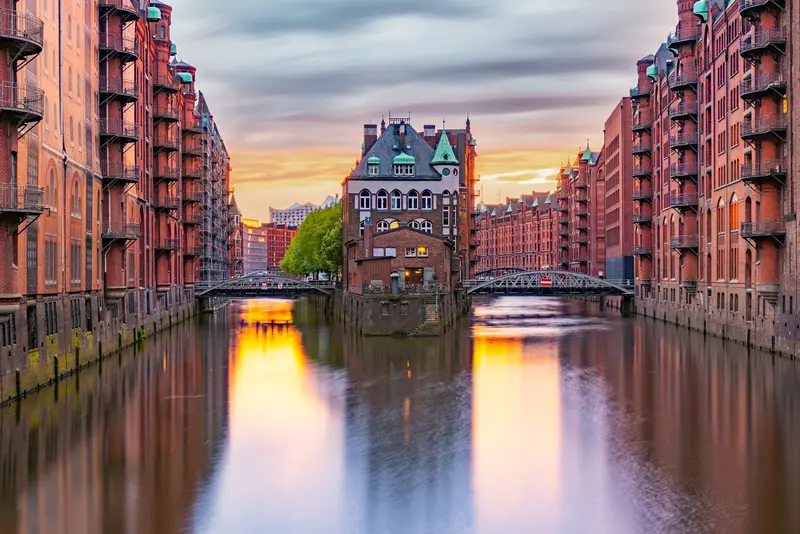
    1Speicherstadt

    The world's largest historical warehouse complex was built from 1883 in Neo-Gothic brick on wooden piles and stretches about 1.5 kilometers along the Fleete. Since 2015, it has been a UNESCO World Heritage Site together with the Kontorhausviertel.
    Open in Google Maps
    Elbphilharmonie
    Attraction

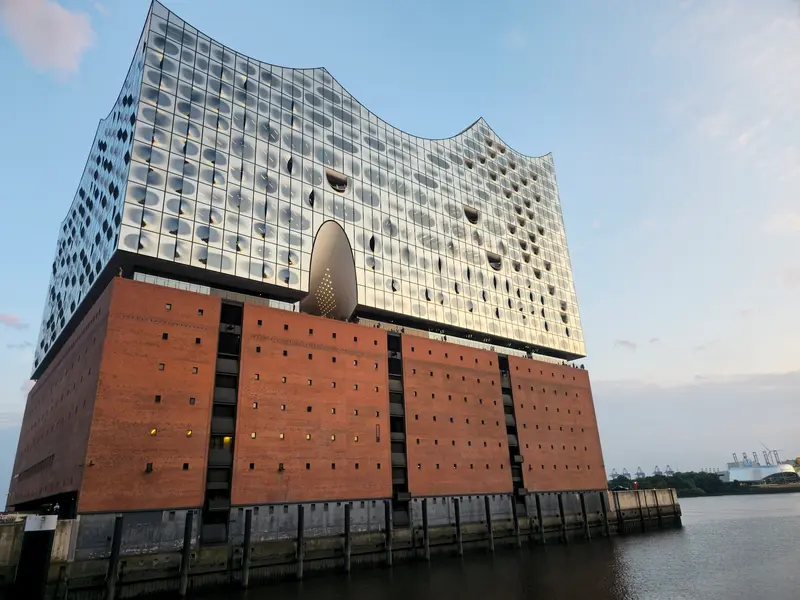
    2Elbphilharmonie

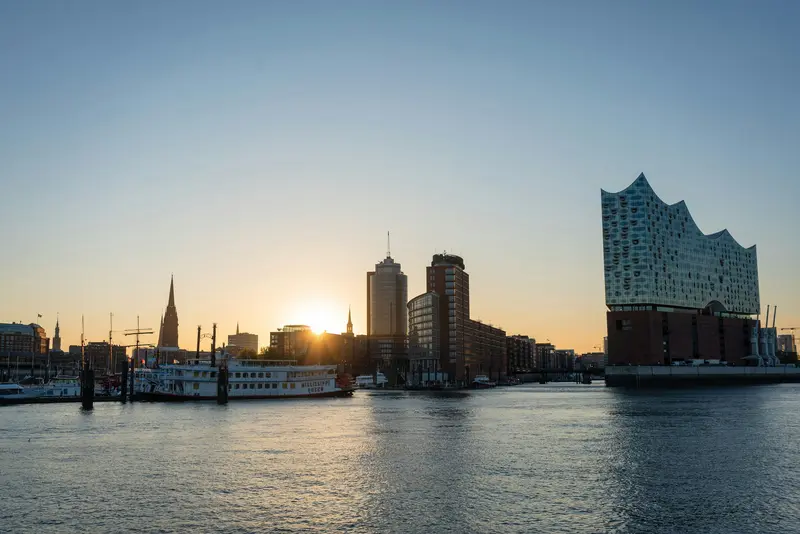
    The concert hall by Herzog & de Meuron sits atop the brick base of the former Kaispeicher A and opened in January 2017. An approximately 80-meter-long curved escalator takes you up to the Plaza at a height of 37 meters, whose visit is free with a ticket.
    Open in Google Maps
    Miniature Wonderland
    Museum

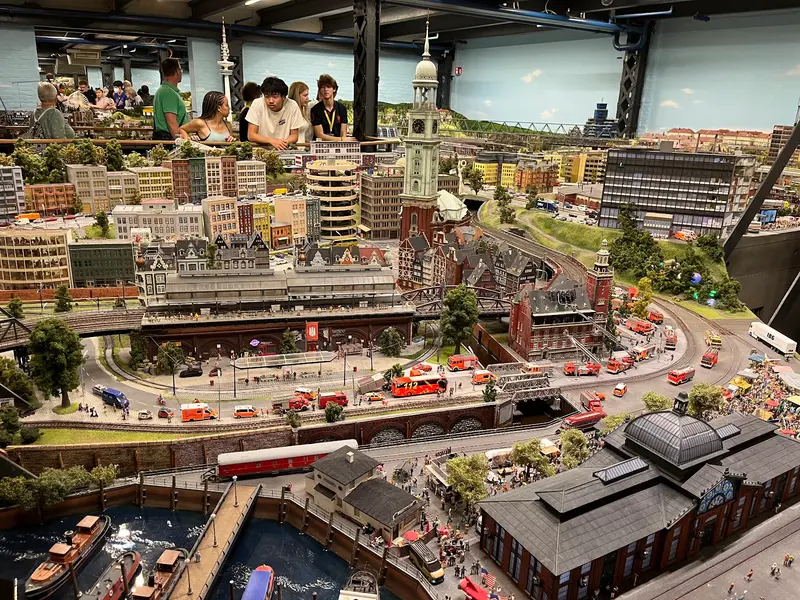
    3Miniature Wonderland

    The world's largest model railway layout, per Guinness World Records, in the Speicherstadt, opened in 2001, displaying over 16 km of 1:87 scale tracks across approx. 1700 sq m. The Monaco and Provence section was most recently added in 2024.
    Open in Google Maps
    St. Pauli Landing Piers
    Historic Landmark

    4St. Pauli Landing Piers

    The 205-meter-long tuff stone terminal building was constructed from 1907 to 1909. In front of it are 688 meters of pontoons, from which HADAG ferries (at HVV tariff) and launches for harbor tours depart. At the east end lies the three-masted ship Rickmer Rickmers, which you can visit.
    Open in Google Maps
    Old Elbe Tunnel
    Historic Landmark

    5Old Elbe Tunnel

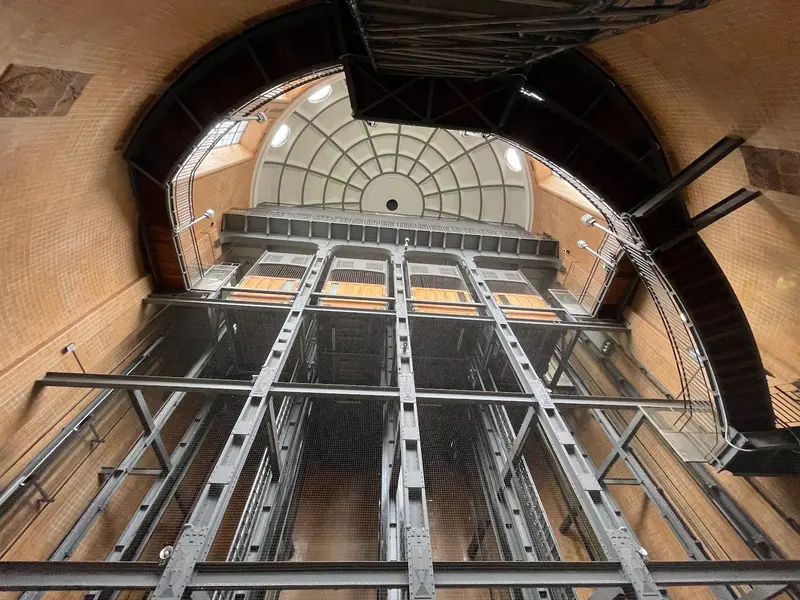
    Opened in 1911, the St. Pauli Elbe Tunnel runs in two tubes 426.5 meters under the Norderelbe from Landungsbrücken to Steinwerder; vehicles are lowered by lift. Since May 4, 2026, after extensive renovation, both tubes are open again, and the passage is free for pedestrians and cyclists.
    Open in Google Maps
    Main Church St. Michaelis (Michel)
    Church

    6Main Church St. Michaelis (Michel)

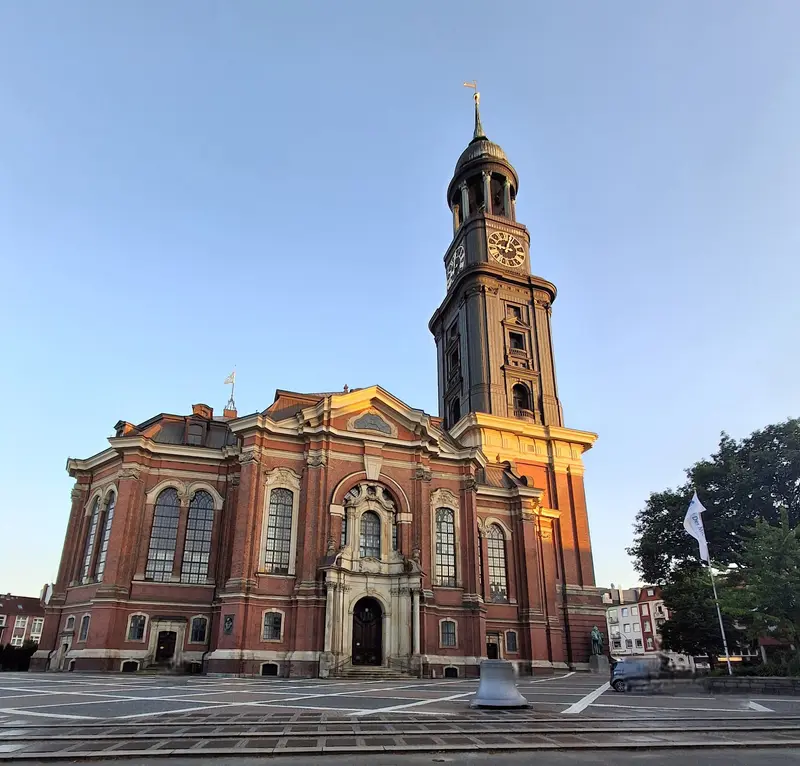
    The Michel is North Germany's most significant Baroque church and a Hamburg landmark, its tower reaching 132.14 meters. From the observation platform, about 83 meters up, you can see across the harbor and city center.
    Open in Google Maps

    Restaurants in Hamburg

    1

    Edmondo

    Italian restaurant on Hohe Bleichen in Neustadt, with Mediterranean cuisine and pizza.
    Show on Google Maps
    2

    Luigi's

    Casual pizzeria serving wood-fired pizza and homemade pasta, its walls adorned with colourful Italian-themed murals.
    Show on Google Maps
    3

    Panthera Rodizio

    Brazilian Rodizio restaurant, where grilled meat is carved tableside from skewers, complemented by a buffet and a cocktail lounge.
    Show on Google Maps
    4

    Seaman's Hall

    North German fish and meat dishes in an artfully wood-paneled hall with maritime artifacts.
    Show on Google Maps
    5

    Bullerei

    Popular restaurant in chic industrial style in Schanzenviertel with steaks, sauces, fries and salads, plus beer and cocktails.
    Show on Google Maps

    Food & Drink in Hamburg

    Hamburg's cuisine includes hearty stews, fish dishes, and sweet pastries. Many classics are best sampled right by the harbor or at a local bakery.

    Fish Sandwich

    A bread roll with fish or seafood, classically with Bismarck herring, Matjes, fried herring, or shrimp, served with onions, pickles, or remoulade. At the Landungsbrücken, you can get it for example at Brücke 10.

    Franzbrötchen

    Sweet pastry of Danish pastry dough with a sugar and cinnamon filling, caramelizing at the sides during baking. The name is often linked to Hamburg's French occupation from 1806 to 1814. The oldest record is a baker's ad from 1825, promoting 'Franzbrot' from an Altona baker's recipe.

    Hamburg Eel Soup

    Hearty broth made from smoked ham bones with vegetables, peas, and stewed fruit like plums, apples, and pears, served with eel, floating dumplings, and fresh herbs. The stewed fruit gives it a sweet-sour note; whether eel belongs in it is often debated in Hamburg.

    Labskaus

    Sailing ship era dish: Potatoes, corned beef or salted meat, beetroot, and pickled gherkins are processed into a mash and served with a fried egg, Rollmops, or Matjes.

    Pears, Beans and Bacon

    A stew of small green cooking pears, green beans with savory, smoked bacon, and potatoes. It is primarily served in August and September when cooking pears are in season. In Low German, it is also called Gröön Hinnerk.

    Rote Grütze

    A typical Hamburg dessert, called Rode Grütt in Low German, which you eat with milk or liquid cream.

    Hanseatic City of Stage Tradition

    Hamburg was a leading member of the Hanseatic League and still officially bears the name Free and Hanseatic City of Hamburg. The first German opera premiered at Gänsemarkt in 1678, the Hamburgische Nationaltheater was founded in 1767, and the Ohnsorg-Theater still performs in Low German today.Around Spielbudenplatz on the Reeperbahn, you'll find the Operettenhaus, Schmidt Theater, Schmidts Tivoli, and the St. Pauli Theater. In the early 1960s, the Beatles performed in clubs like Kaiserkeller, Star-Club, and Indra, a fact commemorated today by Beatles-Platz.

    Nightlife

    1

    Molotow Music Club

    Multi-level indie rock club in St. Pauli featuring concerts by diverse live bands and an outdoor area.
    Show on Google Maps
    2

    Indra Music Club

    Rustic music club on Große Freiheit with beer garden, where the Beatles played some of their first Hamburg concerts.
    Show on Google Maps
    3

    Zum Silbersack

    Local pub from 1949 with neon-lit facade, Hamburg beers, jukebox, and FC St. Pauli games on TV.
    Show on Google Maps
    4

    Knust

    Small, popular club in a former slaughterhouse with live music from rock and indie bands.
    Show on Google Maps
    5

    Birdland Hamburg

    Lively basement jazz club with cocktails, plus jazz and blues concerts.
    Show on Google Maps

    Travelling with HVV and harbor ferry

    The Hamburger Verkehrsverbund (HVV) combines buses, four U-Bahn lines of the Hochbahn, and four S-Bahn lines. The HADAG harbor ferries also operate on the HVV tariff, allowing you to cross the Elbe from the Landungsbrücken with a standard ticket.You can easily explore the city center between the Rathaus, Binnenalster, and Speicherstadt on foot. The Alter Elbtunnel offers free passage to Steinwerder, allowing you to go under the Elbe either on foot or by bike.

    Accommodations in Hamburg

    Find perfect stay in Hamburg

    Booking.com* (Affiliate link)
    Search Hotels
    Agoda* (Affiliate link)
    Search Hotels
    Airbnb
    Vacation Rentals

    * Affiliate link: if you book through it, we earn a small commission. The price stays the same for you.

    Campgrounds in Hamburg

    Find perfect campground in Hamburg

    Search via Google Maps
    Campgrounds nearby (15km)
    Camping.info
    Find Campgrounds
    Park4Night
    RV Parks & Camping

    Plan your trip to Hamburg

    Save places, build a route and plan your city trip, all in one place.

    1. 1
      1234

      Round trip

      12 days · 4 stops

      Saved

      Pick a route

      Pick a ready-made one or save places and plan your own.

      Open bookmarks
    2. 2

      Trip to Hamburg

      Live
      • 1Speicherstadt3 days
      • 2Elbphilharmonie4 days
      • 3Miniature Wonderland5 days
      Budget

      Plan your trip

      The planner sorts stops, days and budget. Plan together in real time.

      Start trip planning
    3. 3
      9:41 No signal
      Available offline

      Use it on the road

      Download the guide to your phone and use it on site, even offline.

    Nearby

    Hamburg

    Hamburg

    The Free and Hanseatic City of Hamburg lies where the Alster and Bille rivers flow into the Lower Elbe, about 100 kilometers before the Elbe's mouth into the North Sea. As Germany's second-largest city, Hamburg is simultaneously a city-state and one of the world's most important port cities. Nearly 2500 bridges span its canals, waterways, and streams.For you, that means: brick warehouses and glass concert halls on the waterfront, barges and harbor ferries, the Inner and Outer Alster right in the city, and a nightlife that made history around the Reeperbahn in St. Pauli. Speicherstadt and Kontorhausviertel have been a UNESCO World Heritage site since 2015.

    Old Town & New Town

    Around Domplatz, Hammaburg was Hamburg's genesis; by 1188, a merchant settlement had emerged at Nikolaifleet. The Great Fire of 1842 destroyed large parts of the Old Town; during reconstruction, the Alsterarkaden were built. Today, office buildings, department stores, and Mönckebergstraße, the main shopping street, define the Old Town; west of the Alsterfleet lies the Neustadt.Stroll along Jungfernstieg by the Binnenalster, take an Alster boat tour from the pier, walk under the Alsterarkaden, and ride the panoramic lift 76 meters high in Mahnmal St. Nikolai. On Deichstraße at Nikolaifleet, where the 1842 fire began, stands a Baroque merchant house from 1686 at number 37. At Jungfernstieg station, the U1, U2, U4, and S1 and S3 S-Bahn lines stop.

    HafenCity & Speicherstadt

    The HafenCity has been developing since its groundbreaking on April 9, 2001, on the former Großer Grasbrook, a port area of approximately 157 hectares, which was released from the Free Port on January 1, 2003, to allow for residential construction. Since March 1, 2008, it has been its own district. To its north lies the Speicherstadt, opened in 1888, for which the residential quarters Kehrwieder and Wandrahm were cleared starting in 1883.You'll walk across the Magellan and Marco Polo Terraces along the water, visit the International Maritime Museum in Kaispeicher B, and learn at the Speicherstadtmuseum how storekeepers stored coffee, tea, and rubber. The U4 stops at the stations Überseequartier, HafenCity Universität, and Elbbrücken.

    St. Pauli

    St. Pauli, located directly on the Elbe between the city center and Altona, has been a Hamburg district since 1894. The former suburb of Hamburger Berg has borne this name since 1833. The Reeperbahn recalls the rope makers who settled here from 1633 and spun ship ropes. Today, the Kiez around Reeperbahn, Große Freiheit and Spielbudenplatz, FC St. Pauli with its Millerntor Stadium, and the harbor define the district, which is considered politically left-leaning, diverse, and tolerant.During the day, you can climb the Grüner Bunker on Feldstraße or visit Beatles-Platz, while evenings offer a choice between the theaters on Spielbudenplatz, live music clubs, and Kiez pubs. The U3 stops at Landungsbrücken, St. Pauli, and Feldstraße stations, and S-Bahn lines S1 and S3 stop at Reeperbahn station.

    Sternschanze

    Sternschanze, mostly known as Schanzenviertel, is Hamburg's smallest district at roughly half a square kilometre, gaining independence only on March 1, 2008. Its name dates back to a star-shaped defensive fortification established in 1682. Solid blocks of old buildings and the Rote Flora, occupied since 1989, define a quarter that has primarily drawn students and young people since the 1970s.Along Schulterblatt, the main commercial street, cafés, bakeries, restaurants, and shops line up. To take a breather, visit the approximately 12-hectare Sternschanzenpark, featuring the 59-meter-high water tower built in 1910. At Sternschanze U- and S-Bahn station in the north of the district, the U3 underground line, among others, makes a stop.