Photo by Zoe Jackson on Pexels
Round trip · Great Britain
Wales: North to South
by Felix Gillen
- 10 Days / 9 Nights
- Conwy → Cardiff
The route crosses Wales from Conwy on the North Coast, via Eryri, the Pembrokeshire coast and the Bannau Brycheiniog, to Cardiff. Main roads run east-west, so the journey along the west coast takes longer than the mileage suggests. By train, you will travel sections through England.
At a glance
- Duration
- 10 Days / 9 Nights
- Stops
- 5 · Conwy → Cardiff
- Arrival
- Flight · Manchester (MAN)
- Departure
- Flight · Cardiff (CWL)
- Best Time to Go
- May–September
5 stops
Why This Route?
For hikers and castle enthusiasts who want to combine mountains, a coastal path, and Welsh culture on short stages.
Hidden Gems
- Barafundle Bay near Stackpole, only accessible on foot via the cliffs
- Portmeirion near Porthmadog, the Italianate village by architect Clough Williams-Ellis
- Henrhyd Falls near Coelbren, South Wales' highest waterfall
Getting there and back
Open jaw: start and end are in different places
- Arrival
- Flight · Manchester (MAN)From Manchester Airport station, Transport for Wales runs hourly direct to Llandudno, and you'll need around 2h 20m to Llandudno Junction, one stop before Conwy. From North America, you can fly partly nonstop to Manchester, otherwise with a transfer at a European hub.
- Departure
- Flight · Cardiff (CWL)From Cardiff Central station, Great Western Railway takes about 30 minutes to Rhoose Cardiff International Airport, where shuttle bus 905 runs hourly to the terminal in about ten minutes; by car it is around 25 minutes. Cardiff has only a few scheduled routes, so for Germany or North America you usually connect in Amsterdam.
Itinerary
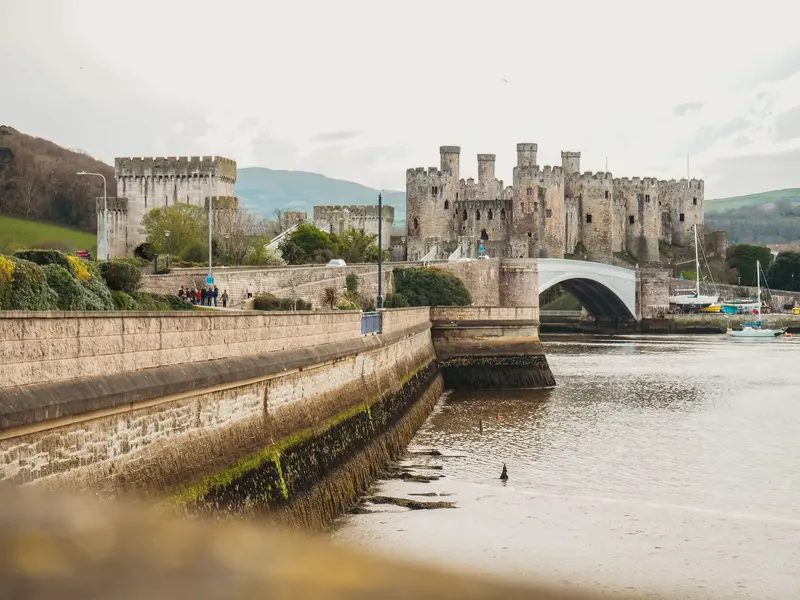
Conwy
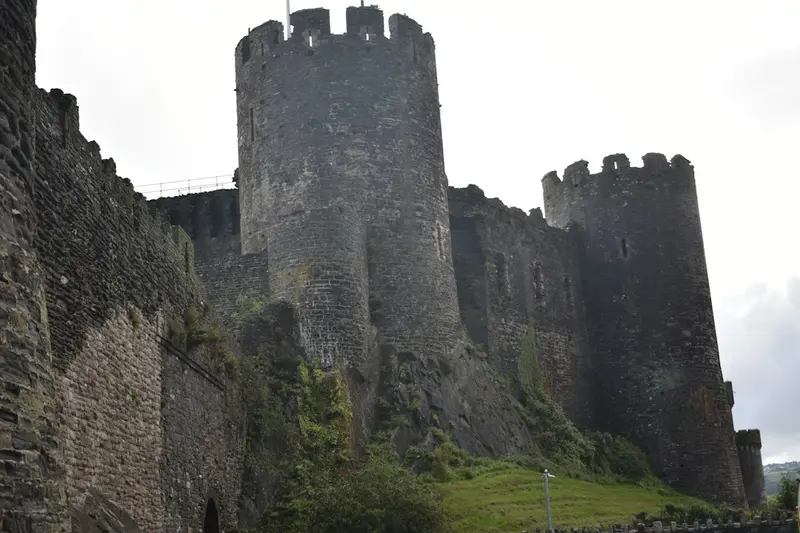
Conwy, on the north coast of Wales, is one of Europe's most completely preserved fortified towns. Edward I had the castle and town walls built between 1283 and 1287 in just four years, as part of the iron ring of fortresses with which he secured the conquered Gwynedd. The master builder was James of St. George from Savoy.The town walls are preserved intact for 1.3 kilometers, with 21 towers and three gates, and are largely walkable. The castle, with its eight towers, stands on a rock above the Conwy estuary. Both have been UNESCO World Heritage Sites since 1986.On the quay stands the Smallest House in Great Britain, 3.05 meters high and 1.8 meters wide, inhabited until 1900. Three bridges span the river side by side, including Thomas Telford's suspension bridge from 1826, whose towers are deliberately modelled on the castle's battlements.
Start on the north coast. The castle and the completely preserved town walls take one day; on the second, take a side trip to Caernarfon or Beaumaris to see the other World Heritage castles.
3 Sights
5 Restaurants
Legacy
Conwy is not an organically grown town, but a **master-planned town of unified design**. Edward I had it built from 1283 after the conquest of Gwynedd: the castle and town walls were erected in just a few years, designed by the Savoyard master builder James of St. George. The wall encloses the old town for approximately 1.3 kilometers with 21 towers and three gates and is one of the most complete in Europe. Since 1986, this ensemble, along with Caernarfon, Beaumaris, and Harlech, has been a UNESCO World Heritage site.The perspective on it in Wales is still not neutral today: these castles were instruments of subjugation, and the Welsh population was initially not allowed to live within the walls. Conwy is located in an area where Welsh is an everyday language.From later eras are **Plas Mawr**, an Elizabethan townhouse from 1585 with preserved stucco, and Aberconwy House from around 1420. On the quay stands the **Smallest House in Great Britain**: just over three meters high, less than two meters wide, inhabited until 1900 — by a fisherman who could not stand upright in it.
Eryri (Snowdonia) National Park
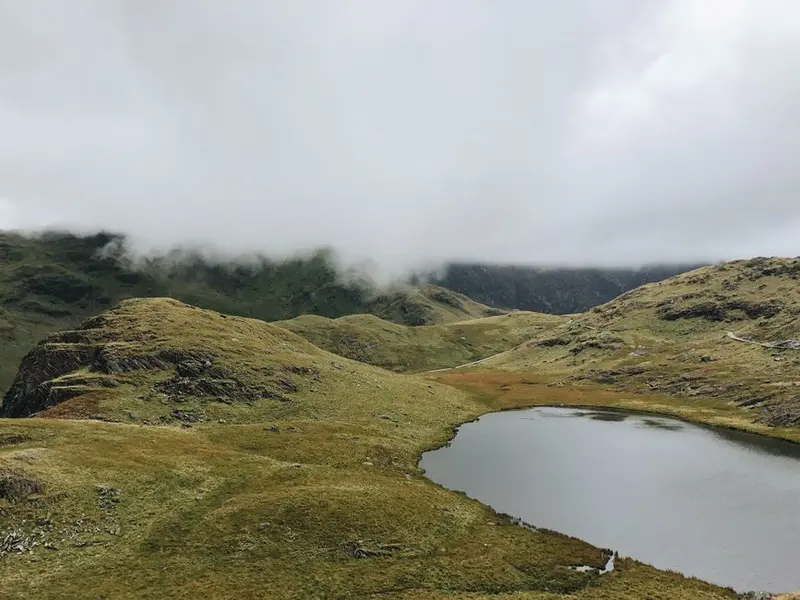
Eryri, officially Snowdonia until the end of 2022, is Wales' oldest national park, covering 2,130 square kilometres of mountains, lakes, and coastline in the country's northwest. Here stands Yr Wyddfa, Snowdon, Wales' highest mountain at 1,085 metres, surrounded by glacial valleys, old slate quarries, and villages where Welsh is the everyday language.Unlike German national parks, Eryri is a cultural landscape: around 26,000 people live here, over half of whom speak Welsh, and its slopes have been grazed for centuries. Six marked paths lead up Yr Wyddfa, along with a rack railway from Llanberis. The rock is predominantly of Ordovician volcanic origin, shaped by glaciers that left behind characteristic cirques and U-shaped valleys.Slate mining is also a defining feature. The quarries of Blaenau Ffestiniog and Llanberis once roofed half of Europe; the landscape, with its grey spoil heaps, has been on the World Heritage List since 2021. Yr Wyddfa is heavily frequented, while the Carneddau in the north and the Rhinogydd in the south are quieter.
Base yourself in Llanberis or Betws-y-Coed. One day for Yr Wyddfa, one day for Cwm Idwal and the Glyderau, one day for the slate landscape and Harlech Castle.
3 Sights
3 Restaurants
Culture
Language and NamesEryri is one of the core regions of Welsh. In late 2022, the park authority decided to use the Welsh names even in English texts: Yr Wyddfa instead of Snowdon, Eryri instead of Snowdonia. These names often describe the landscape: Llyn means lake, Cwm valley, Moel bare hill.SlateThe slate industry shaped life in the 19th century. The labour dispute at the Penrhyn Quarry near Bethesda from 1900 to 1903 was one of the longest strikes in British history. Since 2021, the Slate Landscape of Northwest Wales has been a UNESCO World Heritage site.LegendsMany places are linked to legends. Beddgelert is said to be named after Gelert, Prince Llywelyn's faithful dog, whose alleged grave lies on the edge of the village; however, the story was spread in the 18th century by an innkeeper to promote tourism.
Pembrokeshire Coast National Park
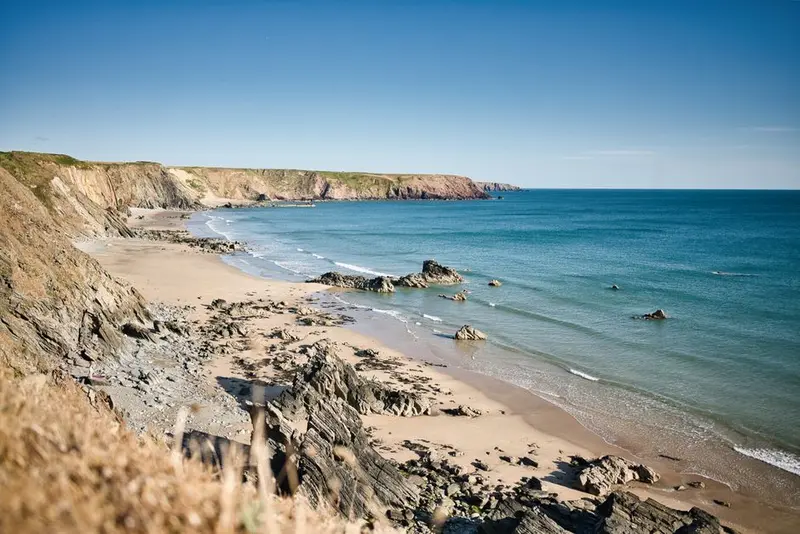
The Pembrokeshire Coast National Park in southwest Wales is Great Britain's only national park consisting predominantly of coastline. It stretches as a narrow strip for over 400 kilometres of coastline and is in places only a few hundred metres wide.The rock types vary over short distances between Precambrian volcanite, Old Red Sandstone, and limestone, creating bays, rock arches, and sea cliffs in close proximity. The Pembrokeshire Coast Path follows the entire route; whoever walks its full length ascends more metres in elevation than climbing Everest.Off the coast lie Skomer and Skokholm, two islands with one of the world's largest colonies of Manx Shearwaters; in early summer, tens of thousands of puffins also breed here. On land, the density of prehistoric monuments is striking, including the Pentre Ifan Dolmen. The bluestones of Stonehenge demonstrably originate from the Preseli Hills in the north of the park.
The drive along the west coast takes longer than expected. Once there: St Davids, sections of the coast path and, when the sea is calm, the boat trip to Skomer.
3 Sights
3 Restaurants
Legacy
Saint DavidWales' national saint, Dewi, was, according to tradition, born on the coast near St Davids. On March 1st, St David's Day, many Welsh people wear daffodils or leeks, and parades take place in St Davids.The Last InvasionIn 1797, French troops landed near Fishguard, the last invasion of mainland Britain. They surrendered after two days. A 30-meter-long tapestry in Fishguard's town library tells the story.English and WelshPembrokeshire is linguistically divided by the so-called Landsker Line: More Welsh is spoken in the north, while the south was shaped by Norman and Flemish settlers in the Middle Ages, which is why it is also called Little England beyond Wales.
Bannau Brycheiniog (Brecon Beacons)
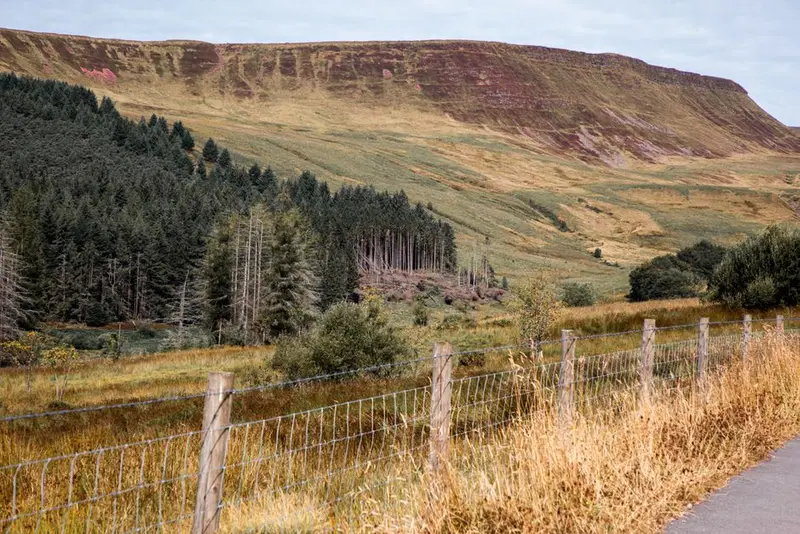
Bannau Brycheiniog, known as Brecon Beacons until 2023, is located in South Wales and consists of four distinct mountain ranges of Old Red Sandstone. The characteristic shape is uniform throughout: gently sloping southern slopes and abruptly dropping northern faces, carved out by glaciers. The highest point is Pen y Fan at 886 metres.The reversion to the Welsh name was a deliberate decision by the park authorities: Beacon refers to signal fires and thus to fossil fuels, which no longer seemed appropriate given the park's climate goals. Bannau simply means peaks.To the south, Waterfall Country around Ystradfellte is a zone where limestone and sandstone meet; several waterfalls cascade over rock steps, and behind Sgwd yr Eira, one can walk through. Beneath these lie extensive cave systems. The entire park is designated as an International Dark Sky Reserve, where the Milky Way is visible to the naked eye on clear nights.
On the way east, Waterfall Country around Ystradfellte with the Sgwd yr Eira waterfall, which you can walk behind. On a clear night the sky over the Dark Sky Reserve is worth a look.
3 Sights
3 Restaurants
Culture
Brecon and its HistoryBrecon grew up around a Norman castle and a priory, whose church has been a cathedral since 1923. The Regimental Museum commemorates the South Wales Borderers and their deployment at Rorke's Drift in 1879.Jazz and BooksThe Brecon Jazz Festival in August has a long tradition. To the east lies Hay-on-Wye, which markets itself as the world's first book town and hosts the Hay Festival for literature every year at the end of May.Dark SkiesIn 2013, the park was recognised as an International Dark Sky Reserve. Several car parks and viewpoints are designated as observation sites, and guided stargazing sessions are offered in winter.
Cardiff
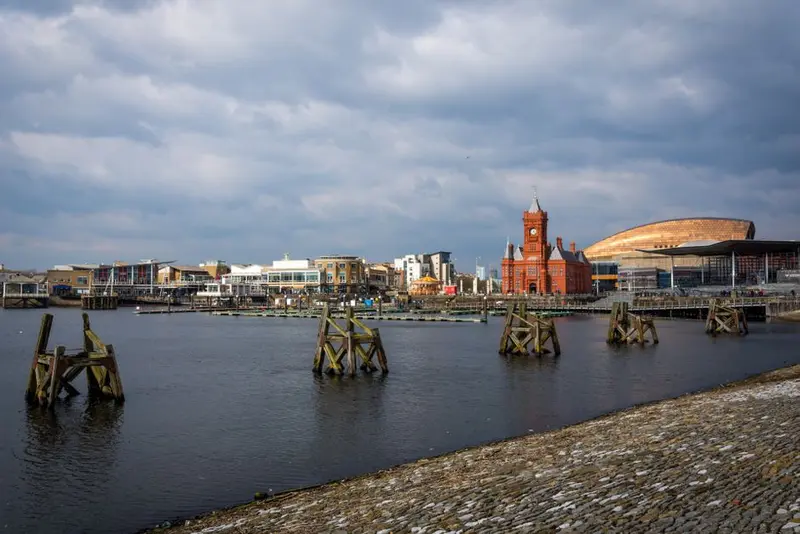
Cardiff has only been the official capital of Wales since 1955, having been an insignificant coastal town until the 19th century. Coal from the valleys to its north then transformed the city into the world's largest coal port. The Bute family, controlling the docks and mines, was for a time considered Britain's richest family.This wealth is reflected in the opulently designed Cardiff Castle and the Coal Exchange in the Bay, where the first million-pound contract was allegedly signed in 1904. After coal exports ceased, the docks fell into disrepair; since the 1990s, Cardiff Bay has been transformed by a dam into a freshwater basin and revitalized with cultural buildings like the Wales Millennium Centre.The city centre is compact and easily walkable, crisscrossed by covered Victorian shopping arcades. On rugby match days at the Principality Stadium, located right in the city centre, Cardiff becomes a single human tide.
The trip ends in the capital: the castle, the Bay and the National Museum are central and within walking distance.
3 Sights
6 Restaurants
Culture
Cardiff has only officially been the capital of Wales since 1955 — later than almost any other European capital. Its rapid rise before that had a single cause: coal from the valleys north of the city. By 1900, Cardiff was one of the world's largest coal ports, and a significant portion of global coal trade was negotiated at the Coal Exchange in Butetown.The docklands, then known as Tiger Bay, were one of Britain's oldest multi-ethnic communities, home to sailors from Somalia, Yemen, West Africa, and the Caribbean. Shirley Bassey grew up here. Little remains of the old Tiger Bay; the regenerated Cardiff Bay, home to the Wales Millennium Centre, is a redevelopment from the 1990s. Lines by poet Gwyneth Lewis are inscribed in Welsh and English on the Centre's facade.Cardiff Castle combines a Roman fort, a Norman keep on the motte, and the opulent Victorian-Gothic interiors designed by William Burges for the third Marquess of Bute — one of the wealthiest men of his era. The National Museum Cardiff offers free admission and, thanks to the legacy of the Davies sisters, houses one of Europe's most important Impressionist collections outside France. Welsh is omnipresent in the streetscape: signage is legally bilingual.
Plan this route as your trip
All stops, trains and nights go into your trip planner. You adjust dates and places to stay afterwards.
This route is a suggestion from our research. Please check timetables, times in port, opening hours and prices before you book – what your tour operator or carrier says is what counts.
Fernweh is a free travel guide and trip planner: routes researched by people, taken over in one click, used day by day on the road. More about Fernweh
5 stops
Route Summary
Duration10 Days
Stops5 Places
TypeMixed