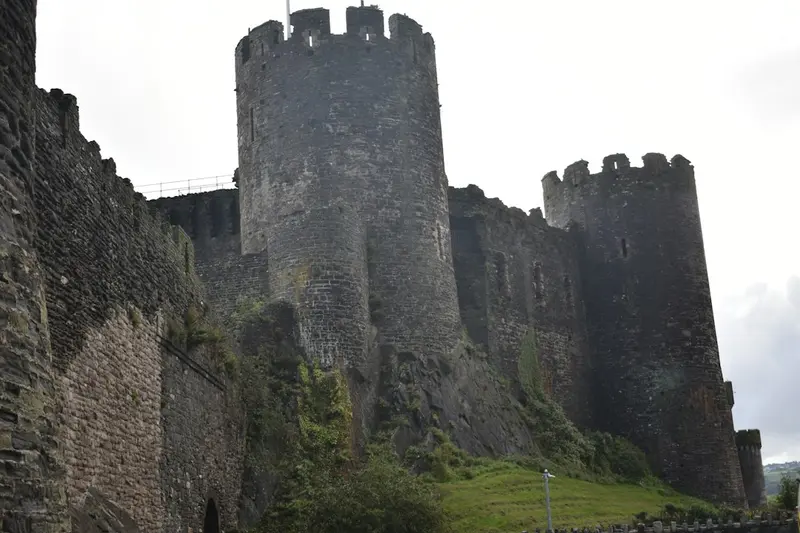
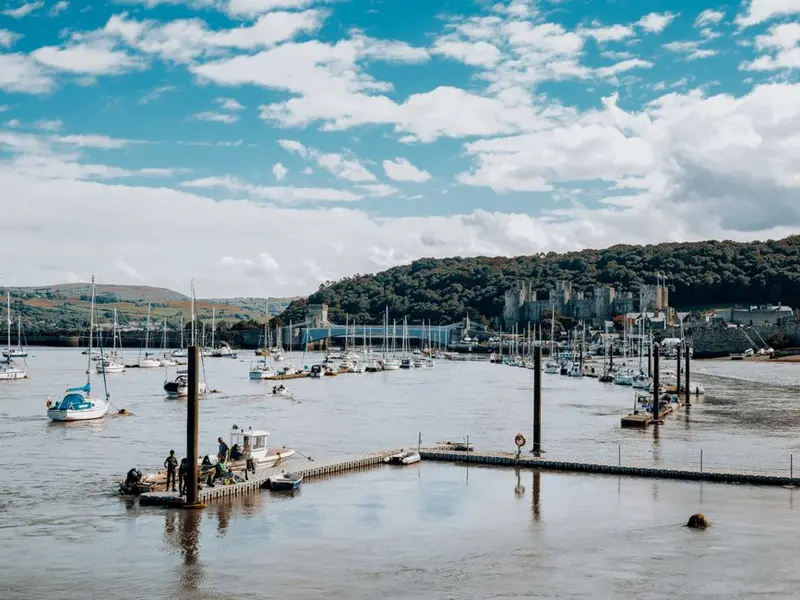
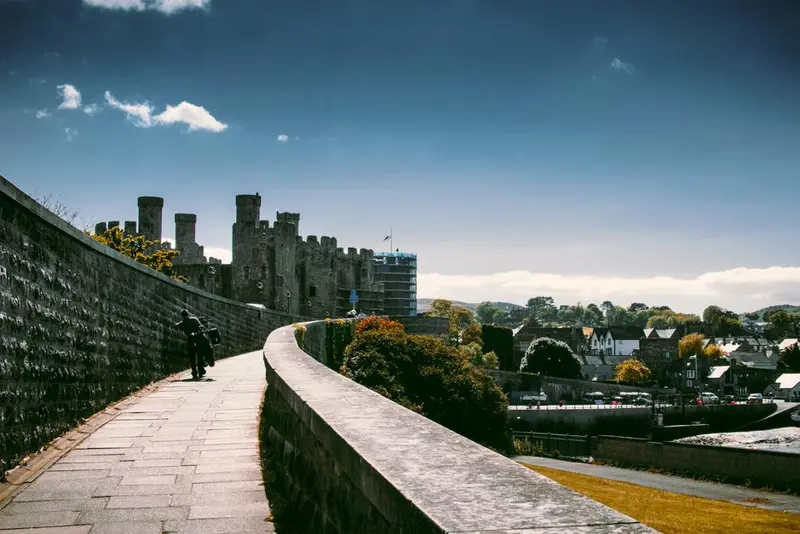
Conwy, on the north coast of Wales, is one of Europe's most completely preserved fortified towns. Edward I had the castle and town walls built between 1283 and 1287 in just four years, as part of the iron ring of fortresses with which he secured the conquered Gwynedd. The master builder was James of St. George from Savoy.The town walls are preserved intact for 1.3 kilometers, with 21 towers and three gates, and are largely walkable. The castle, with its eight towers, stands on a rock above the Conwy estuary. Both have been UNESCO World Heritage Sites since 1986.On the quay stands the Smallest House in Great Britain, 3.05 meters high and 1.8 meters wide, inhabited until 1900. Three bridges span the river side by side, including Thomas Telford's suspension bridge from 1826, whose towers are deliberately modelled on the castle's battlements.
Places in Conwy
Discover the most important sights and attractions
Sights in Conwy
1Conwy Castle
Conwy Castle was built between 1283 and 1287 in just four building seasons, an extraordinary feat for medieval standards, costing around £15,000, many times the Crown's annual income at the time. It was constructed on a rock ridge above the river, which is why it has an elongated, rather than a round, shape.Eight towers and two gatehouses are fully preserved, as are the foundations of the royal chambers, considered Britain's best-preserved medieval royal rooms. Nearly the entire complex can be explored via the wall walks. The view from the towers takes in the estuary, the town walls, and the mountains of Eryri in the background.
The Conwy Town Walls, preserved for their full 1.3-kilometre length, feature 21 semi-circular towers and three gates. They were built concurrently with the castle, enclosing a planned English settler town from which Welsh people were initially excluded.Much of the wall walk is accessible. The steep northwest section offers the best views of the rooftops, castle, and estuary. Externally, the wall features twelve medieval latrine chutes, unique in Britain for surviving in such numbers. Together with the castle, the wall belongs to the World Heritage of Edward I's Fortifications.
Britain's smallest house, painted red, stands on Conwy's quay, measuring 3.05 metres in height and 1.8 metres in width. It was built in the 16th century as an infill between two houses and was continuously inhabited until 1900.The last occupant was the fisherman Robert Jones, who, at 1.90 metres tall, could not stand upright in his own home. The authorities declared it uninhabitable in 1900. Jones then collected evidence from across the country to prove that his house was the smallest, thus establishing its current title. Inside, there are two levels: a fireplace and a tap downstairs, a bed in an alcove upstairs.
These places are nearby — perfect for additional days or a day trip.
Eryri (Snowdonia) National Park
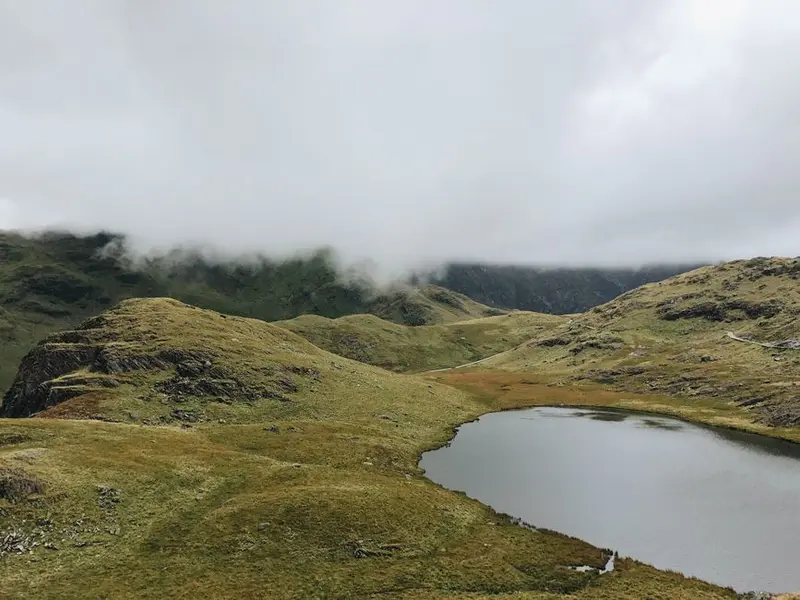
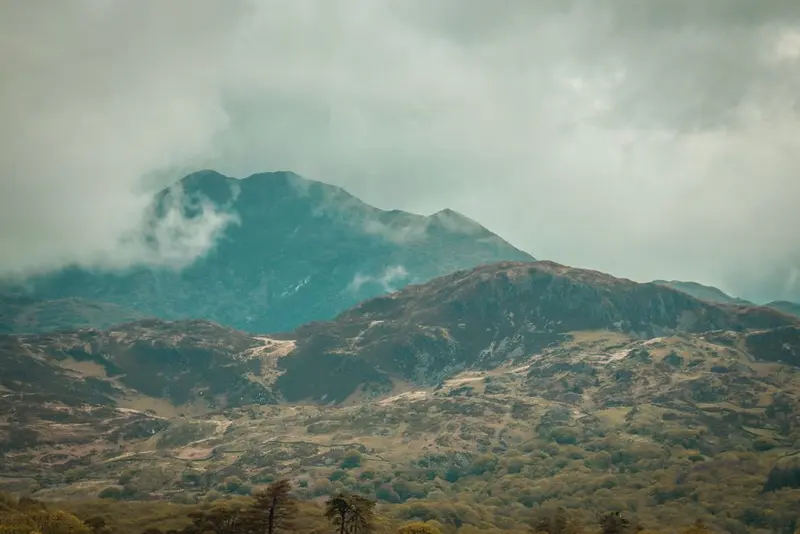
Eryri, officially Snowdonia until 2023, is Wales' oldest national park and covers 2,130 square kilometres in the northwest of the country. Unlike German national parks, it is a cultural landscape: around 26,000 people live within it, more than half of whom speak Welsh, and the slopes have been grazed for centuries.The highest point is Yr Wyddfa at 1,085 metres. Six marked paths lead up to it, along with a rack railway from Llanberis. The rock is predominantly of Ordovician volcanic origin, shaped by glaciers that left behind the characteristic corries and U-shaped valleys. The park is so well geologically exposed that significant parts of geological research originated here in the 19th century.Slate mining is also a defining feature. The quarries of Blaenau Ffestiniog and Llanberis once covered the roofs of half of Europe; the landscape with its grey spoil heaps has been on the World Heritage List since 2021. Yr Wyddfa is heavily frequented, while the Carneddau in the north and the Rhinogydd in the south are quieter.
Wales
Wales, at just over 20,000 square kilometers, is smaller than Hesse, yet it boasts three national parks, five mountain ranges, and a continuously accessible coastline. The country was conquered by England in 1284 and formally incorporated in 1536, but it has retained its language: About a fifth of the population speaks Welsh, significantly more in the northwest. All place signs are bilingual, and since 2023, the national parks officially bear their Welsh names.Mountains, Coast, CastlesThe north is dominated by Eryri, formerly Snowdonia, home to the 1,085-meter-high Yr Wyddfa. To the south lie the Bannau Brycheiniog, formerly Brecon Beacons, with their sweeping sandstone ridges. In between stretches thinly populated Mid Wales. The Wales Coast Path, since 2012, spans over 1,400 kilometers around the entire country, the first such project worldwide. Wales also boasts the highest density of castles in Europe: Around 600 sites, many from Edward I's campaign.Industry and SongThe valleys south of Merthyr Tydfil supplied a significant portion of the world's coal production in the 19th century. While mining disappeared in the 1980s, its culture has endured: The male voice choirs, rugby enthusiasm, and the Eisteddfod festival trace their origins back to this period and older bardic traditions. The former industrial facilities of Blaenavon and the Slate Landscape of Northwest Wales are now on the World Heritage List.When to VisitWales is among the rainiest regions of Great Britain, with over 3,000 millimeters falling annually on the western slopes of Eryri. May to September are the most reliable months. In the mountains, the weather changes quickly, so waterproof clothing is a year-round necessity, not a luxury.
Buxton
Buxton, a historic spa town in Derbyshire, is renowned for its thermal springs and impressive architecture. The Buxton Crescent, a masterpiece of Georgian architecture, attests to its rich spa heritage and now houses a luxurious hotel and thermal spa. You'll also find the imposing Devonshire Dome here, once stables, now part of the university, as well as the picturesque Pavilion Gardens with their Victorian greenhouses and the Buxton Opera House. At St Ann's Well, you can taste the famous spring water that has attracted visitors for centuries. The town also serves as an ideal gateway to the Peak District National Park, inviting you to hikes and explorations, such as the nearby Pooles Cavern. For a relaxed atmosphere, a visit in spring or autumn is recommended, to experience the town and the surrounding nature without the largest crowds.
Peak District National Park
The Peak District National Park, Britain's first national park, is a breathtaking landscape of contrasting moors, valleys, and imposing limestone formations.It invites you to explore the wild beauty of nature and offers countless opportunities for adventure and relaxation in its unique hilly landscape.
Dark Peak
This northern region is characterized by its rugged, vast moorlands and dramatic sandstone ridges, ideal for challenging hikes.