Fernweh: Home
ExploreGuideDestinationsMy tripsMy trip
de|en
All Places & RegionsRound tripsNight trains in EuropeAll highlightsAbout FernwehFAQPrivacy PolicyImprint
Download on the App StoreGet it on Google Play
ExploreGuideDestinationsMy tripsMy trip
    • Places & highlights
    • Recommendations
    • Eat & drink
    • Food culture
    • Culture
    • Getting around
    • Accommodation
    • Round trips
    • Nearby
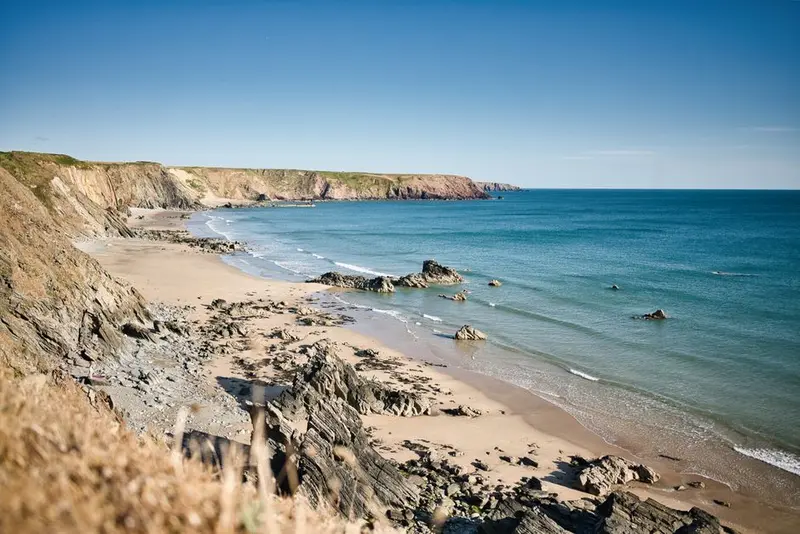
    Pembrokeshire Coast National Park

    Photo by Dominik Gryzbon on Pexels

    Great Britain

    Pembrokeshire Coast National Park

    National Park

    The Pembrokeshire Coast National Park in southwest Wales is Great Britain's only national park consisting predominantly of coastline.

    by Felix Gillen

    1. Home
    2. Destinations
    3. Great Britain
    4. Wales
    5. Pembrokeshire Coast National Park
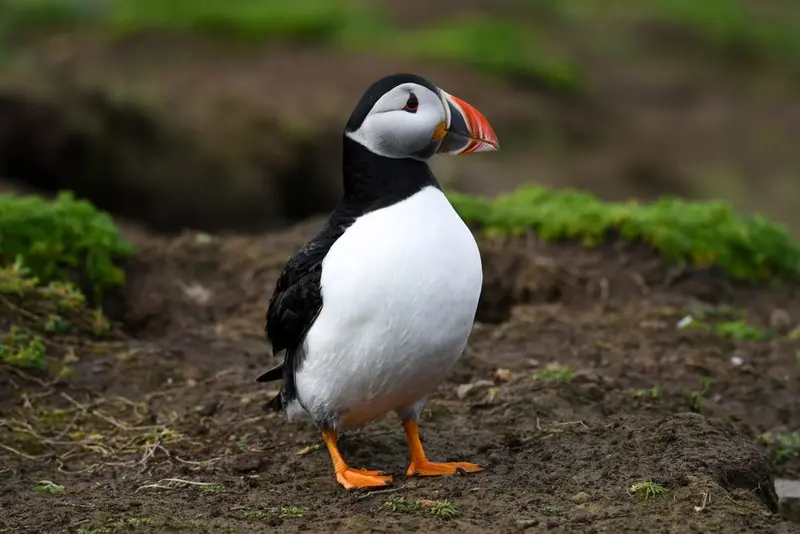
    The Pembrokeshire Coast National Park in southwest Wales is Great Britain's only national park consisting predominantly of coastline. It stretches as a narrow strip for over 400 kilometres of coastline and is in places only a few hundred metres wide.The rock types vary over short distances between Precambrian volcanite, Old Red Sandstone, and limestone, creating bays, rock arches, and sea cliffs in close proximity. The Pembrokeshire Coast Path follows the entire route; whoever walks its full length ascends more metres in elevation than climbing Everest.Off the coast lie Skomer and Skokholm, two islands with one of the world's largest colonies of Manx Shearwaters; in early summer, tens of thousands of puffins also breed here. On land, the density of prehistoric monuments is striking, including the Pentre Ifan Dolmen. The bluestones of Stonehenge demonstrably originate from the Preseli Hills in the north of the park.
    Great Britain travel guideSee the round tripPlan a trip with Pembrokeshire Coast National Park

    Contents

    • Places & highlights
    • Recommendations
    • Eat & drink
    • Food culture
    • Culture
    • Getting around
    • Accommodation
    • Round trips
    • Nearby

    Sights in Pembrokeshire Coast National Park

    Discover the most important sights and attractions

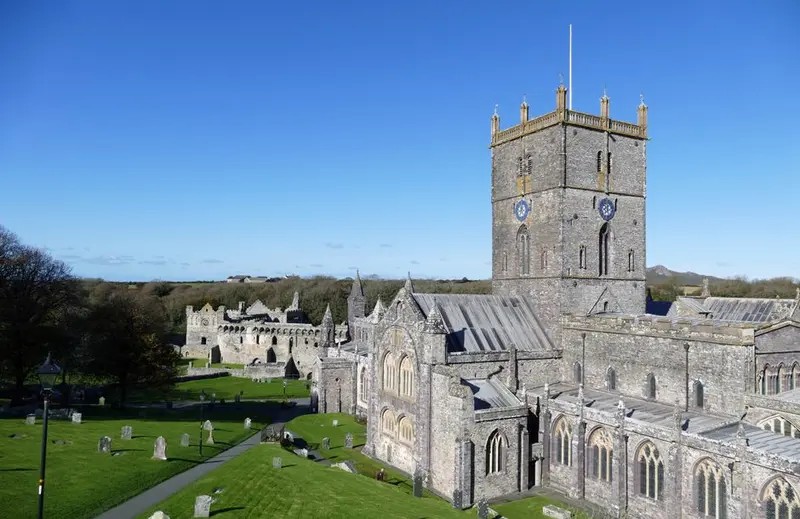
    St Davids Cathedral

    Photo by Anthony on Pexels

    1St Davids Cathedral

    St Davids, with around 1,800 inhabitants, is Britain's smallest city and owes this status solely to its cathedral. It stands on the site of the monastery founded by the Welsh patron saint Dewi in the 6th century, nestled in a hollow so it wouldn't be visible from the sea and Vikings wouldn't immediately find it. This proved largely ineffective, as the complex was plundered multiple times.The current structure dates from the 12th century; its floor noticeably slopes by about four metres from the west to the east end, and the nave columns visibly lean outwards. The painted 16th-century oak ceiling is original. In the Middle Ages, two pilgrimages here were considered equivalent to one to Rome. Adjacent to it lie the ruins of the Bishop's Palace.
    Open in Google Maps
    Skomer Island

    Photo by Tim Morgan on Pexels

    2Skomer Island

    Skomer lies just under a kilometre off the coast near Marloes and is home to one of Europe's most significant seabird colonies. Approximately half of the world's population of Manx shearwaters breed here, over 300,000 breeding pairs, which are at sea during the day and only return after dusk to avoid large gulls like the great black-backed gull.More noticeable for day visitors are the puffins, which breed in burrows between April and July and are largely unconcerned by people. The island also boasts extensive carpets of sea campion and bluebells. Boats depart from Martin's Haven, though sailings are weather-dependent and have limited capacity; crossings are regularly fully booked. There are no facilities on the island, so food and drink must be brought with you.
    Open in Google Maps
    Barafundle Bay

    Green0w / Wikimedia Commons / CC BY-SA 4.0, mod.

    3Barafundle Bay

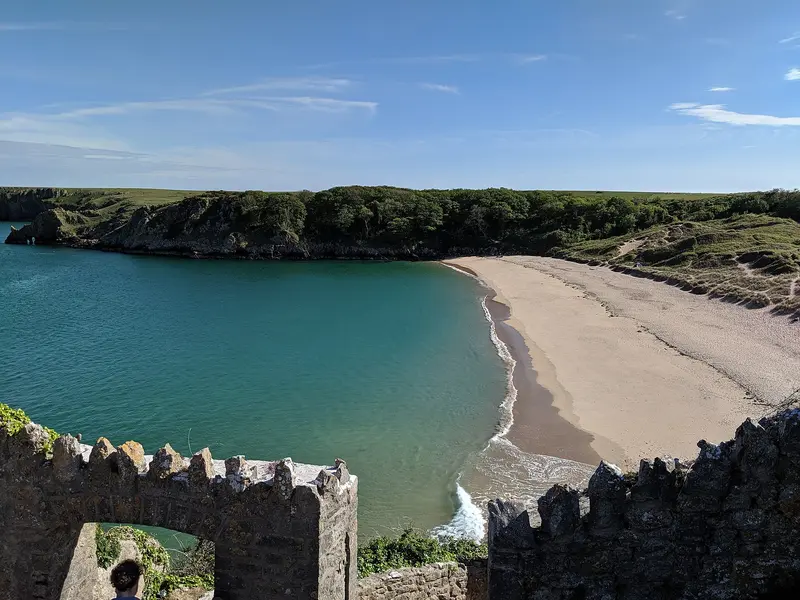
    Barafundle Bay is part of the Stackpole Estate in south Pembrokeshire and is only accessible on foot: about one kilometer from Stackpole Quay car park, via a cliff staircase and through a stone archway, behind which the bay suddenly opens up.The sand is light and coarse; behind it are dunes and a small pine wood, planted by the Cawdor family, who shaped the landscape here in the 18th century. Because there is no road, no kiosk, and no waste bins, the bay remains comparatively quiet even in high summer. Nearby are the Bosherston Lily Ponds, artificial ponds from the same period, which are full of water lilies in June.
    Open in Google Maps

    Restaurants in Pembrokeshire Coast National Park

    1

    The Shed Fish & Chip Bistro

    A fish restaurant in a former workshop building by the harbour of Porthgain, a small village on the north coast with remnants of its former brick and stone industry. It serves regional fish and seafood, with Fish and Chips also available at lunchtime. The Coast Path passes right by, making it a popular destination for hikers.
    Show on Google Maps
    2

    The Stackpole Inn

    A country inn in the village of Stackpole in the south of the park, a few minutes from Barafundle Bay and the Bosherston Lily Ponds. The kitchen focuses on dishes with Pembrokeshire ingredients, along with Welsh beers. A natural stop after a hike on the Coast Path; the inn has several guest rooms.
    Show on Google Maps
    3

    St Brides Inn

    A family-friendly pub in Little Haven, a small seaside resort on St Brides Bay, just steps from the beach and the Coast Path. The menu features pub classics and local fish, plus draught beers. In summer, you can sit in the beer garden; reviews are consistently good.
    Show on Google Maps

    Food and Drink

    Crabs and Lobsters

    From small harbours like Porthgain, Solva and Little Haven, boats fish for lobster and brown crabs; you can get them fresh in pubs and huts.

    Pembrokeshire Early Potatoes

    These early potatoes from the mild coastal climate boast a protected geographical indication and are available from May.

    Laverbread

    The seaweed purée is traditionally gathered here and eaten for breakfast with bacon.

    Ice cream

    You'll find ice cream from several Pembrokeshire farm dairies in almost every coastal resort.

    Legacy

    Saint DavidWales' national saint, Dewi, was, according to tradition, born on the coast near St Davids. On March 1st, St David's Day, many Welsh people wear daffodils or leeks, and parades take place in St Davids.The Last InvasionIn 1797, French troops landed near Fishguard, the last invasion of mainland Britain. They surrendered after two days. A 30-meter-long tapestry in Fishguard's town library tells the story.English and WelshPembrokeshire is linguistically divided by the so-called Landsker Line: More Welsh is spoken in the north, while the south was shaped by Norman and Flemish settlers in the Middle Ages, which is why it is also called Little England beyond Wales.

    Exploring locally

    Getting ThereTrains from Cardiff and Swansea run to Haverfordwest, Tenby, Pembroke Dock and Fishguard. From Fishguard and Pembroke Dock, ferries depart for Ireland.Coastal BusesIn summer, Coastal Buses such as the Puffin Shuttle, Strumble Shuttle and Celtic Coaster connect towns along the Coast Path. This allows you to enjoy linear walks and return by bus. Outside of peak season, these services do not operate; only the Coastal Cruiser near Pembroke runs on selected weekdays.By CarThe side roads to the coves are often single-track and busy in summer. Parking lots at popular beaches like Barafundle, Whitesands or Marloes fill up by late morning.

    Accommodations in Pembrokeshire Coast National Park

    Find perfect stay in Pembrokeshire Coast National Park

    Booking.com* (Affiliate link)
    Search Hotels
    Agoda* (Affiliate link)
    Search Hotels
    Airbnb
    Vacation Rentals

    * Affiliate link: if you book through it, we earn a small commission. The price stays the same for you.

    Campgrounds in Pembrokeshire Coast National Park

    Find perfect campground in Pembrokeshire Coast National Park

    Search via Google Maps
    Campgrounds nearby (15km)
    Camping.info
    Find Campgrounds
    Park4Night
    RV Parks & Camping

    Round trips with Pembrokeshire Coast National Park

    Wales: North to South

    Wales: North to South

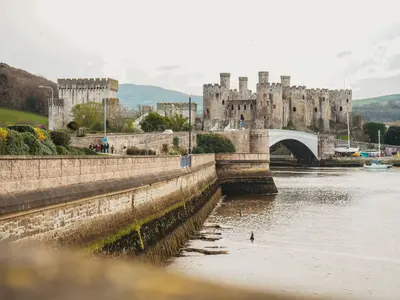
    The route crosses Wales from Conwy on the North Coast, via Eryri, the Pembrokeshire coast and the Bannau Brycheiniog, to Cardiff. Main roads run east-west, so the journey along the west coast takes longer than the mileage suggests. By train, you will travel sections through England.

    10 Days
    5 stops
    Open jaw

    Zoe Jackson·Pexels

    Nearby

    Fishguard

    Fishguard

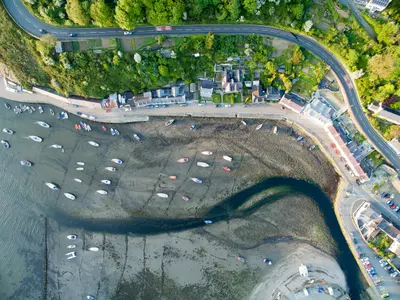
    Fishguard is a coastal town in Pembrokeshire, Southwest Wales, from whose harbour in Goodwick ferries depart for Ireland. Down in the valley lies the old harbour of Lower Town, with its fishing houses.In 1797, the last invasion force on British soil landed here, a tapestry in the town tells the story. The Pembrokeshire Coast National Park path runs directly past the town.

    Nick Russill·Unsplash

    Wales

    Wales

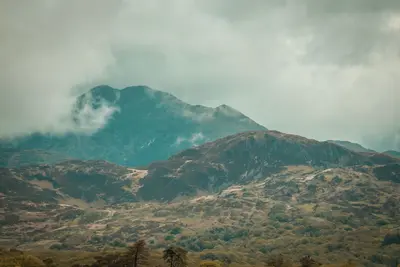
    Wales, just over 20,000 square kilometers, is smaller than Hesse, yet it packs in three national parks, five mountain ranges, and a continuously accessible coastline. The country was conquered by England in 1284 and formally incorporated in 1536, but has retained its language: About a fifth of the population speaks Welsh, significantly more in the northwest. All place signs are bilingual, and since 2022 and 2023, two of the three national parks, Eryri and Bannau Brycheiniog, primarily use their Welsh names.Mountains, Coast, CastlesThe north is dominated by Eryri, formerly Snowdonia, with the 1,085-meter-high Yr Wyddfa. To the south are the Bannau Brycheiniog, formerly Brecon Beacons, with their wide sandstone ridges. Between them lies sparsely populated Mid Wales. The Wales Coast Path, established in 2012, covers some 1,400 kilometers along the entire coast; together with the Offa's Dyke Path along the English border, it forms a circular route around the country. Wales also has one of Europe's highest castle densities: Around 600 structures, many from Edward I's campaign.Industry and SongThe valleys south of Merthyr Tydfil supplied a significant portion of the world's coal production in the 19th century. Mining rapidly declined after the 1984/85 strike; the last deep mine in the valleys, Tower Colliery, closed in 2008. Yet its culture endured: The male voice choirs, rugby enthusiasm, and the Eisteddfod festival trace their roots to this period and older bardic traditions. Today, the former industrial facilities of Blaenavon and the slate landscape of North Wales are UNESCO World Heritage Sites.When to VisitWales is among Britain's rainiest regions, with over 3,000 millimeters of rainfall annually on Eryri's western slopes. May to September are the most reliable months. In the mountains, the weather changes quickly, making waterproof clothing a year-round necessity, not a luxury.
    Boys in Bristol Photography·Pexels

    Bannau Brycheiniog (Brecon Beacons)

    Bannau Brycheiniog (Brecon Beacons)

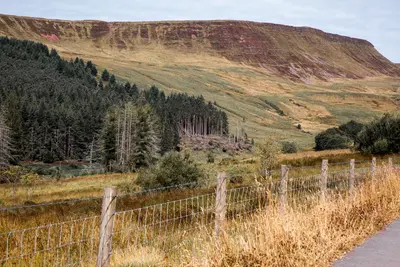
    Bannau Brycheiniog, known as Brecon Beacons until 2023, is located in South Wales and consists of four distinct mountain ranges of Old Red Sandstone. The characteristic shape is uniform throughout: gently sloping southern slopes and abruptly dropping northern faces, carved out by glaciers. The highest point is Pen y Fan at 886 metres.The reversion to the Welsh name was a deliberate decision by the park authorities: Beacon refers to signal fires and thus to fossil fuels, which no longer seemed appropriate given the park's climate goals. Bannau simply means peaks.To the south, Waterfall Country around Ystradfellte is a zone where limestone and sandstone meet; several waterfalls cascade over rock steps, and behind Sgwd yr Eira, one can walk through. Beneath these lie extensive cave systems. The entire park is designated as an International Dark Sky Reserve, where the Milky Way is visible to the naked eye on clear nights.

    Tony Zohari·Pexels

    Cardiff

    Cardiff

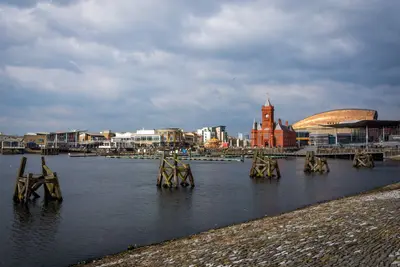
    Cardiff has only been the official capital of Wales since 1955, having been an insignificant coastal town until the 19th century. Coal from the valleys to its north then transformed the city into the world's largest coal port. The Bute family, controlling the docks and mines, was for a time considered Britain's richest family.This wealth is reflected in the opulently designed Cardiff Castle and the Coal Exchange in the Bay, where the first million-pound contract was allegedly signed in 1904. After coal exports ceased, the docks fell into disrepair; since the 1990s, Cardiff Bay has been transformed by a dam into a freshwater basin and revitalized with cultural buildings like the Wales Millennium Centre.The city centre is compact and easily walkable, crisscrossed by covered Victorian shopping arcades. On rugby match days at the Principality Stadium, located right in the city centre, Cardiff becomes a single human tide.

    Balazs Bezeczky·Pexels

    North Cornwall Coast

    North Cornwall Coast

    The North Coast of Cornwall, stretching between Newquay and Bude, faces the Atlantic side of the peninsula: high slate and granite cliffs, wide sandy beaches, and a surf that has made Newquay the surfing capital of Great Britain. Nestled in between are small harbours in narrow coves, often the only safe landing spots for many kilometres.The best-known places include Padstow at the mouth of the Camel, the fishing village of Port Isaac, Tintagel with its castle ruins, and Boscastle nestled in its gorge. The South West Coast Path connects them, leading along some of the most impressive stretches of the English coast.The sea here is rougher than on the south coast. Only swim at lifeguarded beaches between the red and yellow flags, and be aware of the tides, which can submerge entire coves.

    Unsplash

    Your next steps

    Pembrokeshire Coast National Park is in Great Britain. Ways to carry on from here.

    • More in Great Britain

      Highlights, areas, routes and the best time to travel for all of Great Britain.

      Great Britain travel guide
    • Round trips with Pembrokeshire Coast National Park

      One route passes through Pembrokeshire Coast National Park, with stops, nights and a map.

      See the round trip
    • Plan a trip with Pembrokeshire Coast National Park

      The Guide asks about season, length and who is coming, and suggests a trip with Pembrokeshire Coast National Park.

      Plan the trip

    Sources & method

    • Photos: Wikimedia Commons, Pexels. Each photo carries its credit.
    • Place data such as addresses and ratings comes from Google Maps.
    • The content is based on web research from public, traceable sources. How the content is made · The role of AI