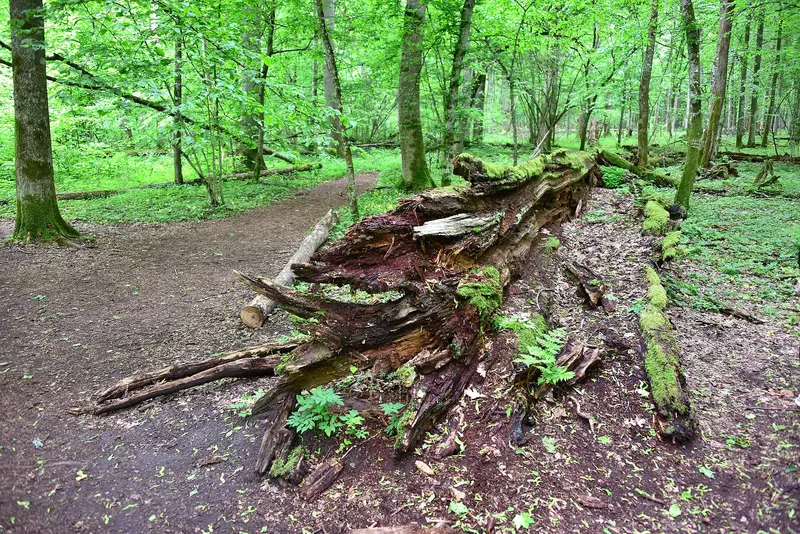
Białowieża National Park (Białowieski Park Narodowy) protects the Polish core of the Białowieża Forest on the border with Belarus. Established in 1932, it is Poland's second-oldest national park after Pieniny National Park, and today covers approximately 105 square kilometers. The forest is considered Europe's last primeval lowland forest, dominated by pedunculate oak, small-leaved lime, and hornbeam. It has been on the UNESCO World Heritage List since 1979, with the Belarusian part added in 1992.
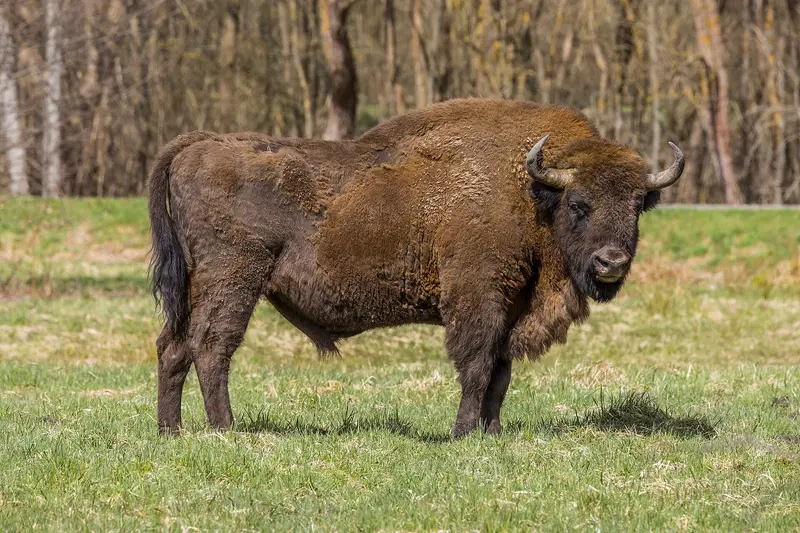
The symbol of the park is the European bison (Wisent). The species was extinct in the wild, but in 1952, the first animals bred in captivity were reintroduced here. The village of Białowieża serves as a starting point for visits, featuring the Palace Park, the Museum of Natural History and Forestry, and the park administration. The most valuable part, the former strict protection zone, may only be entered with a licensed guide; other sections are accessible via marked hiking and cycling trails.
According to the National Park administration, all hiking trails in the park are open (as of October 2026). Along the border with Belarus, a ban on staying in a border strip has been in effect since June 2024, extended by the Ministry of Interior every 90 days. According to reports on the Polish Ministry of Interior's regulation, this strip generally exempts villages and hiking trails and is approximately two kilometers wide in protected areas. For current travel and security information, including regarding the border area, see the UK Foreign, Commonwealth & Development Office (FCDO).
Sights in Białowieża National Park
Discover the most important sights and attractions
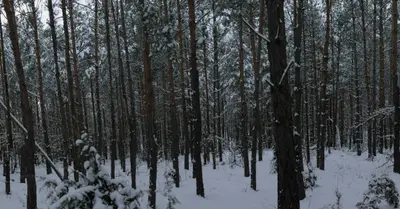
The park's most valuable part, with primeval forest, is only accessible on the unmarked route to Jagiełło Oak (Dąb Jagiełły) and a park-licensed guide. Groups are limited to ten, and paths must not be left.
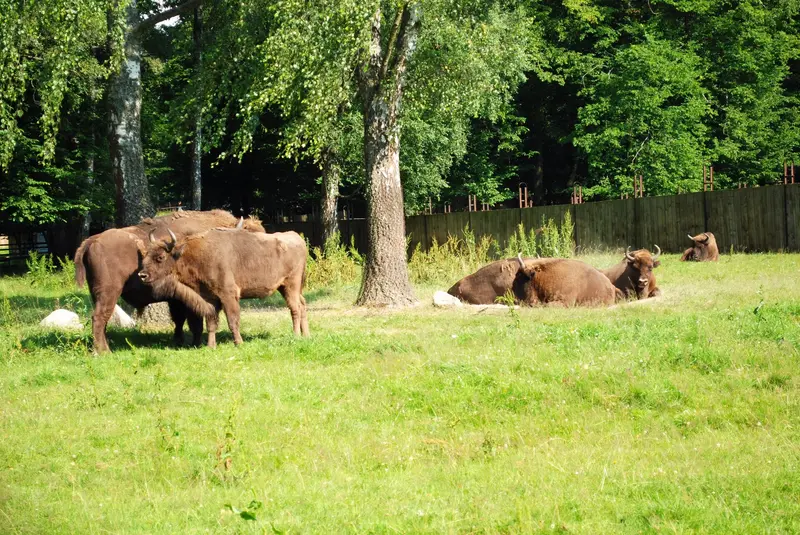
The exhibition enclosure is on the Hajnówka road, roughly 3 km before Białowieża. Across some 27 hectares, natural enclosures house European bison, Żubroń (bison-cattle hybrids), Tarpan-like horses, wolves, lynxes, deer, elk, roe deer, and wild boars. Visits begin in the education pavilion, opened in 2018.
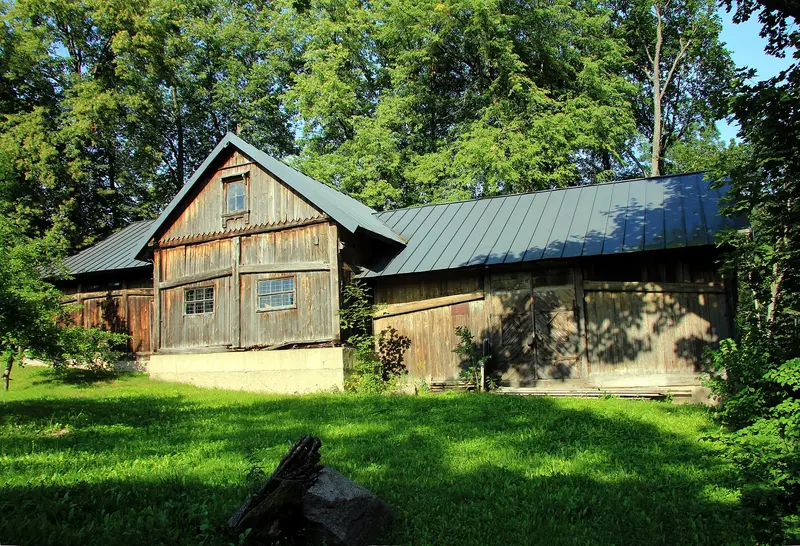
The approximately 50-hectare park developed around the Czars' hunting residence from 1889 to 1894, which burned down in 1944. Remaining are the Kitchen Gate, Czarist-era outbuildings, a wooden manor house from 1845, and Augustus III's hunting obelisk (1752). The palace site now houses the park administration and a museum with an observation tower. The park is open to the public.
Restaurant in the restored Białowieża Towarowa railway station building from 1903, whose construction dates back to the Czars. The cuisine combines Polish and Russian dishes; in the 1980s, Andrzej Wajda filmed scenes here for his Dostoevsky adaptation, The Possessed.
Restaurant of the Żubrówka Hotel in the village of Białowieża. The cuisine is Polish and game-focused, and according to the establishment, follows regional recipes, with game regularly featured on the menu.
Hunting Ground of Kings and Tsars
For centuries, the forest was a hunting ground for rulers. On the dam between the ponds in the palace park, an obelisk, Białowieża's oldest monument, commemorates a hunt by King August III in 1752. From 1889 to 1894, the Russian Tsars had a hunting residence built here, which burned down in 1944. The Kitchen Gate and several outbuildings from the Tsarist era remain, including the Marshal's House and the Hunter's House.
The Return of the Wisent
After World War I, the Wisent was extinct in the wild; the last free-ranging animal in the Białowieża Forest was killed in 1919. With animals bred in captivity, the species was reintroduced into the wild in Białowieża starting in 1952. Today, approximately 950 Wisents once again live in the entire Białowieża Forest, about 510 of them on the Polish side. Those who wish to reliably spot Wisents can visit the show enclosure.
Arrival, Opening hours and Tickets
Getting There
Białowieża is in southeastern Podlachia, accessed via Hajnówka, with Białystok and Warsaw (Warszawa) as major departure points. National Park administration parking is at the building next to the post office, approximately 350 meters from the park administration. The bus stop is on ul. Stoczek next to the school. Connections can be found via e-podroznik.pl.
Opening Hours and Tickets
Former Strict Nature Reserve (Route to the Jagiełło Oak): daily from half an hour before sunrise until half an hour after sunset, only with a licensed guide, maximum 10 people per group. Admission 10 zł, reduced 5 zł, plus guide fee.
Bison Show Reserve: April 16 to October 15 daily 9 AM–5 PM, October 16 to April 15 Tuesday to Sunday 9 AM–4 PM. Admission 25 zł, reduced 15 zł.
Natural History and Forest Museum: during winter half-year Tuesday to Sunday 9 AM–4 PM, daily in summer, last admission one hour before closing. Admission 16 zł, reduced 10 zł.
Palace Park: freely accessible and without a guide, admission free.
At night, i.e., from half an hour after sunset until half an hour before sunrise, as well as during storms, staying in the forest is not permitted, and paths must not be left. Current times, prices, and information are available on bpn.gov.pl (as of October 2026).