Fernweh: Home
    ExploreTravel GuidesPlan a tripMy tripLast visited
    de|en
    All Places & RegionsAll highlightsAbout FernwehFAQPrivacy PolicyImprint
    ExploreTravel GuidesPlan a tripMy tripLast visited
    • Neighborhoods & highlights
    • Walking tours
    • Eat & drink
    • Food culture
    • Culture
    • Getting around
    • Accommodation
    • Plan trip
    • Nearby
    Cefalù

    Italy

    Cefalù

    CityCulture

    Cefalù is located on Sicily's north coast, about 70 kilometers east of Palermo, nestled between a sandy beach and the steep Rocca cliff.

    by Felix Gillen

    1. Home
    2. Destinations
    3. Italy
    4. Sicily
    5. Cefalù
    Cefalù is located on Sicily's north coast, about 70 kilometers east of Palermo, nestled between a sandy beach and the steep Rocca cliff. The small old town is dominated by the Norman Cathedral, commissioned by King Roger II in 1131 and a UNESCO World Heritage site since 2015. Its narrow streets house the medieval washhouse and the Mandralisca Museum, featuring a portrait by Antonello da Messina. The climb up the Rocca leads to the remains of a castle and offers sweeping views over the town and coast. In summer, Cefalù is crowded and parking is scarce; it's quieter in spring and autumn.

    Sights in Cefalù

    Discover the most important sights and attractions

    Church

    1Cefalù's Duomo

    Norman Cathedral, begun 1131 under King Roger II. Its facade framed by two massive towers. Its apse holds a Byzantine gold mosaic of Christ Pantokrator, dated 1148 by inscription. Adjacent cloister has figured capitals. Since 2015, part of UNESCO World Heritage with Monreale and Arab-Norman Palermo.
    Open in Google Maps
    Attraction

    2The Beach of Cefalù

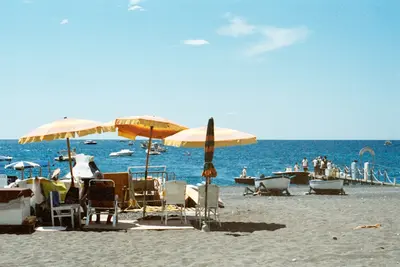
    Sandy city beach near the old town, bordered by the promenade. There are free sections and beach clubs with sun loungers and parasols; it is ideal for children.
    Open in Google Maps
    Castle

    3Rocca di Cefalù

    A rock around 270 meters high above the Old Town. A stepped path leads up in about half an hour, past the so-called Temple of Diana, a megalithic structure from the pre-Roman era, to the remains of the medieval castle. The ascent is steep; in summer, it's best to set off early in the morning.
    Open in Google Maps
    Attraction

    4Medieval Wash House

    Historic washhouse on Via Vittorio Emanuele. A staircase leads down to stone basins, fed by 22 cast-iron spouts, 15 of them with lion heads; the water flows on into the sea.
    Open in Google Maps
    Museum

    5Museo Mandralisca

    Museum houses the 19th-century collection of Baron Enrico Pirajno di Mandralisca: Sicilian paintings, ancient vases, over 2,500 coins, and a shell collection. Its main work is the 'Portrait of an Unknown Sailor' by Antonello da Messina.
    Open in Google Maps
    Attraction

    6Bastion of Capo Marchiafava

    Bastion of the old city walls on the seaside of the old town, today home to a digital museum on Sicily's Arab-Norman history. From here, you look out at the rocky coast and the lighthouse.
    Open in Google Maps

    City walks in Cefalù

    Curated walking tours through the city's highlights, handpicked by experienced travel journalists.

    Cefalù's Charm: A Walk Through History and Sea Views

    Discover Cefalù's timeless beauty on this 2-hour walk. From the majestic cathedral to the picturesque lanes and the azure sea, immerse yourself in the rich history and authentic Sicilian flair of this enchanting town.

    ~2 Std.
    Open in Google Maps
    Stops (6)

    Food and Drink

    1

    La Brace

    Restaurant with Mediterranean cuisine in an Old Town alley, not far from the Cathedral.
    Show on Google Maps
    2

    Cala Luna Restaurant

    Restaurant on Via Angela di Francesca east of the Rocca, outside the Old Town on the coast towards Caldura.
    Show on Google Maps
    3

    Da Sasà

    Restaurant and pizzeria on Via Giudecca on the eastern edge of the Old Town. The menu features pizza, as well as fish and seafood.
    Show on Google Maps

    Dining and Drinks

    Cefalù's cuisine is shaped by the sea and the nearby Madonie Mountains. Restaurants line the old town, many with waterfront terraces, and along the promenade.

    Pasta a taianu

    Local dish: Pasta with meat ragout, fried eggplant and Pecorino, prepared in a clay pot and traditionally cooked for the Feast of Santissimo Salvatore in summer.

    Fish and Seafood Selection

    Sardines, swordfish, squid and anchovies feature on menus, grilled, marinated or as a pasta sauce.

    Manna from the Madonie

    Between Pollina and Castelbuono, manna is harvested, the dried sap of the Manna Ash.

    Granita and Cannoli

    You can get granita with brioche for breakfast and cannoli with ricotta in the city's bars and pasticcerie.

    History and Culture

    From Kephaloidion to the Norman CityThe ancient name Kephaloidion derives from the Greek word for head, likely referring to the shape of the promontory. On the Rocca stands the so-called Temple of Diana, a structure of large stone blocks dating from pre-Roman times. Later came the Romans, Byzantines, Arabs, and Normans. Roger II had the Cathedral built from 1131; the apse mosaic with Christ Pantocrator is dated 1148 by an inscription.World HeritageSince 2015, the Cathedral has been part of the UNESCO World Heritage site “Arab-Norman Palermo and the Cathedrals of Cefalù and Monreale”. Besides the Cathedral, a cloister with figured capitals belongs to the complex.FestivalsThe patron saint is Santissimo Salvatore. The patronal festival from August 2nd to 6th combines processions with the 'Ntinna a mari on the afternoon of the last day, where participants balance across a greased pole.Excursions into the SurroundingsIn the hinterland lies the Madonie Mountains, whose highest peak, Pizzo Carbonara, reaches 1,979 meters. Castelbuono boasts a Ventimiglia castle from 1317; above Cefalù lies the Sanctuary of Gibilmanna. Further east, along the Tusa River, spreads the Fiumara d'Arte, an open-air sculpture park.

    Exploring locally

    On FootIn the old town, you won't need transport. It's closed to cars at certain times, longer in summer. The ascent to the Rocca involves steps and is steep; in summer, it's best to start early in the morning.Train and BusCefalù is on the Palermo–Messina rail line. From the station, intercity buses go to the surrounding towns and the Madonie.CarAlmost all parking spaces are paid; larger areas can be found on the waterfront road and near the station. Parking is difficult in summer. A car is useful for excursions into the Madonie.

    Accommodations in Cefalù

    Find perfect stay in Cefalù

    Booking.com* (Affiliate link)
    Search Hotels
    Agoda* (Affiliate link)
    Search Hotels
    Airbnb
    Vacation Rentals

    * Affiliate link: if you book through it, we earn a small commission. The price stays the same for you.

    Campgrounds in Cefalù

    Find perfect campground in Cefalù

    Search via Google Maps
    Campgrounds nearby (15km)
    Camping.info
    Find Campgrounds
    Park4Night
    RV Parks & Camping

    Plan your trip to Cefalù

    Save places, build a route and plan your city trip, all in one place.

    1. 1
      Sunrise over alpine peaks and a sea of clouds
      1234

      Round trip

      12 days · 4 stops

      Saved

      Pick a route

      Pick a ready-made one or save places and plan your own.

      Open bookmarks
    2. 2

      Trip to Cefalù

      Live
      • 1Cefalù's Duomo3 days
      • 2The Beach of Cefalù4 days
      • 3Rocca di Cefalù5 days
      Budget

      Plan your trip

      The planner sorts stops, days and budget. Plan together in real time.

      Start trip planning
    3. 3
      9:41 No signal
      Cefalù
      Available offline

      Use it on the road

      Download the guide to your phone and use it on site, even offline.

    Nearby

    Sicily

    Sicily

    Sicily is the largest island in the Mediterranean and separated from the Italian mainland by the Strait of Messina. Greeks, Romans, Arabs, Normans, and Spaniards have left behind temples, mosaics, cathedrals, and Baroque cities here. In the east rises Mount Etna, the highest mountain on a Mediterranean island and one of the world's most active volcanoes.
    Palermo

    Palermo

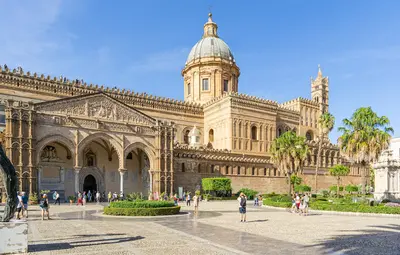
    Palermo, the capital of Sicily, is located on the north coast in the plain of the Conca d'Oro beneath Monte Pellegrino. Phoenicians, Arabs, Normans, Hohenstaufen, and Spaniards have shaped the city, a legacy still visible in its urban landscape today: churches with red domes, Byzantine gold mosaics, Baroque churches, and fountains. Since 2015, nine sites in Palermo, Cefalù, and Monreale have been part of the UNESCO World Heritage Site "Arab-Norman Palermo", seven of which are in Palermo itself. Equally renowned are its markets and street food. With the Cathedral, Norman Palace, and Quattro Canti, most sights are within walking distance.
    Agrigento

    Agrigento

    Agrigento lies on a hill on Sicily's south coast, about four kilometers from the sea. Beneath the city lies the Valley of the Temples, the ruins of the Greek city Akragas, a UNESCO World Heritage site since 1997. The Doric temples from the 5th century BC, especially the Temple of Concordia, are among the best preserved in the Greek world. The Archaeological Museum and the Garden of Kolymbethra complement the visit. The Old Town up on the slope is medieval: its main street is Via Atenea; at the hill's highest point stands San Gerlando Cathedral; the Church of Santa Maria dei Greci is also in the Old Town. The Temple Valley has little shade; in summer, you should avoid the hottest hours.
    Etna

    Etna

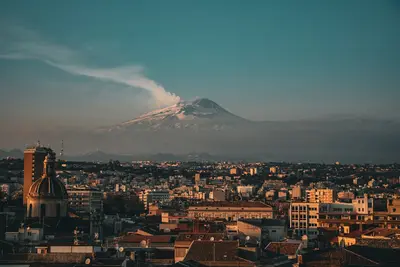
    Mount Etna, on the eastern coast of Sicily, is Europe's highest active volcano, standing over 3,300 meters tall; its exact height changes by several dozen meters with each eruption. Since 2013, it has been a UNESCO World Heritage site. On the south side, a road leads up to nearly 2,000 meters and a cable car to around 2,500 meters. You hike over cooled lava flows, past secondary craters, and gaze out from the upper slopes over the Ionian Coast. On the lower slopes, wine, pistachios, and fruit grow in fertile volcanic soil.
    Catania

    Catania

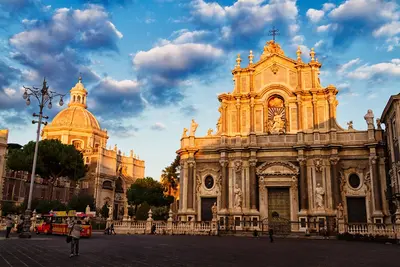
    Catania is Sicily's second-largest city, located on the east coast at the foot of Mount Etna. Following the major eruption of 1669 and the earthquake of 1693, the old town was rebuilt in Baroque style, often using dark lava rock. Since 2002, it has been part of the UNESCO World Heritage site of the Baroque Towns of Val di Noto. Its focal point is the Piazza del Duomo, featuring the Elephant Fountain and the Cathedral; just next to it is the fish market. In the evenings, many gather in the old town around Via Crociferi. The city's airport serves as a starting point for many travelers exploring Eastern Sicily and Mount Etna.

    Sources & method

    • Photos: Unsplash. Each photo carries its credit.
    • Place data such as addresses and ratings comes from Google Maps.
    • The content is based on web research from public, traceable sources. How the content is made · The role of AI