Fernweh: Home
    ExploreTravel GuidesPlan a tripMy tripLast visited
    de|en
    All Places & RegionsAll highlightsAbout FernwehFAQPrivacy PolicyImprint
    ExploreTravel GuidesPlan a tripMy tripLast visited
    • Overview
    • Places in the region
    • Food culture
    • Culture
    • Getting around
    • Round trips
    • Nearby
    Sicily

    Italy

    Sicily

    Region

    Sicily is the largest island in the Mediterranean and separated from the Italian mainland by the Strait of Messina. Greeks, Romans, Arabs, Normans, and Spaniards have left behind temples, mosaics, cathedrals, and Baroque cities here.

    by Felix Gillen

    1. Home
    2. Destinations
    3. Italy
    4. Sicily
    Sicily is the largest island in the Mediterranean and separated from the Italian mainland by the Strait of Messina. Greeks, Romans, Arabs, Normans, and Spaniards have left behind temples, mosaics, cathedrals, and Baroque cities here. In the east rises Mount Etna, the highest mountain on a Mediterranean island and one of the world's most active volcanoes.
    The island spans approximately 25,400 square kilometers and has just under five million inhabitants. In the northwest are the capital Palermo, Monreale, and Trapani, with Cefalù on the north coast. The east coast, with Taormina, Catania, and Syracuse, is dominated by Mount Etna. To the southeast are the Baroque towns of Val di Noto like Noto, Ragusa, and Modica; on the south coast lies Agrigento with the Valley of the Temples. The hilly island interior is sparsely populated. Distances are greater than the map suggests: for a round trip, you should plan at least ten days. Spring and autumn are more pleasant for sightseeing than the hot high summer.
    Etna

    Place 1 of 4

    Etna

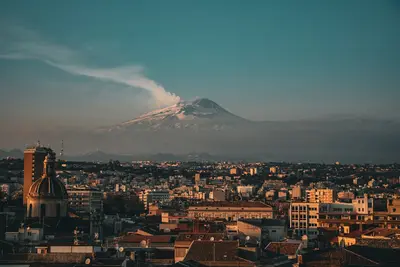
    Mount Etna, on the eastern coast of Sicily, is Europe's highest active volcano, standing over 3,300 meters tall; its exact height changes by several dozen meters with each eruption. Since 2013, it has been a UNESCO World Heritage site.

    Discover
    Syracuse

    Place 2 of 4

    Syracuse

    Syracuse on the southeast coast of Sicily was in antiquity one of the most powerful cities in the Greek world. The old town is located on the small island of Ortigia: alleys, Baroque palaces and the Cathedral, which was built into a Greek temple of Athena.

    Discover
    Agrigento

    Place 3 of 4

    Agrigento

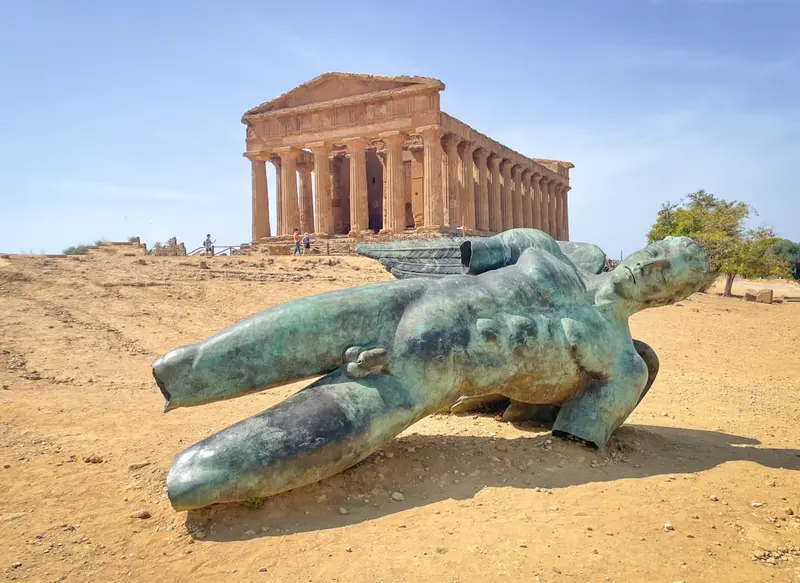
    Agrigento lies on a hill on Sicily's south coast, about four kilometers from the sea. Beneath the city lies the Valley of the Temples, the ruins of the Greek city Akragas, a UNESCO World Heritage site since 1997.

    Discover
    Catania

    Place 4 of 4

    Catania

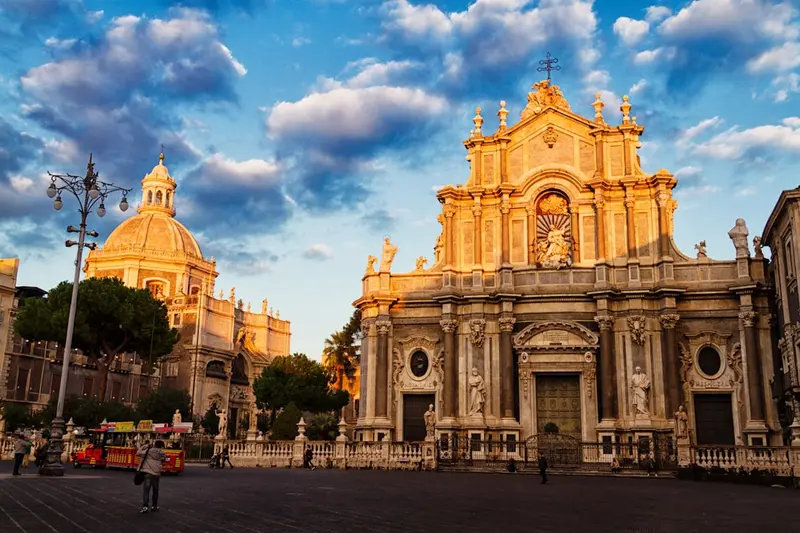
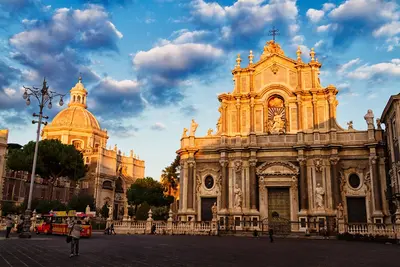
    Catania is Sicily's second-largest city, located on the east coast at the foot of Mount Etna. Following the major eruption of 1669 and the earthquake of 1693, the old town was rebuilt in Baroque style, often using dark lava rock.

    Discover

    More places in Sicily

    Cefalù

    Cefalù

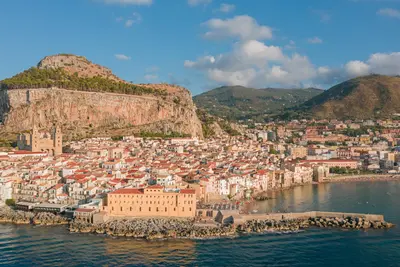
    Cefalù is located on Sicily's north coast, about 70 kilometers east of Palermo, nestled between a sandy beach and the steep Rocca cliff. The small old town is dominated by the Norman Cathedral, commissioned by King Roger II in 1131 and a UNESCO World Heritage site since 2015. Its narrow streets house the medieval washhouse and the Mandralisca Museum, featuring a portrait by Antonello da Messina. The climb up the Rocca leads to the remains of a castle and offers sweeping views over the town and coast. In summer, Cefalù is crowded and parking is scarce; it's quieter in spring and autumn.
    Noto

    Noto

    Noto, in southeastern Sicily, 30 km from Syracuse, is considered a prime example of Sicilian Baroque. After the 1693 earthquake, the city was rebuilt 8 km from its old site, with squares, staircases, and light stone palaces. Since 2002, it and other Val di Noto Baroque towns are UNESCO World Heritage sites. Along Corso Vittorio Emanuele are the Cathedral, palaces, and churches. Nearby are the Vendicari Nature Reserve and the ruins of Noto Antica.
    Palermo

    Palermo

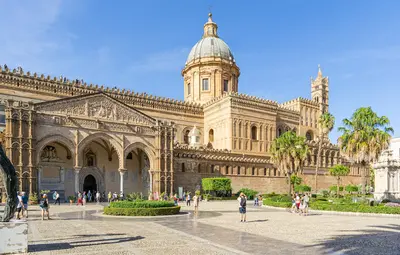
    Palermo, the capital of Sicily, is located on the north coast in the plain of the Conca d'Oro beneath Monte Pellegrino. Phoenicians, Arabs, Normans, Hohenstaufen, and Spaniards have shaped the city, a legacy still visible in its urban landscape today: churches with red domes, Byzantine gold mosaics, Baroque churches, and fountains. Since 2015, nine sites in Palermo, Cefalù, and Monreale have been part of the UNESCO World Heritage Site "Arab-Norman Palermo", seven of which are in Palermo itself. Equally renowned are its markets and street food. With the Cathedral, Norman Palace, and Quattro Canti, most sights are within walking distance.
    Ragusa Ibla

    Ragusa Ibla

    Ragusa Ibla is one of the two parts of Ragusa's old town in southeastern Sicily. It lies on a hill east of the city and was rebuilt on its ancient site after the 1693 earthquake, while a new upper town arose on the higher ground above. Narrow streets, staircases, and alleys still follow its medieval layout. Together with the upper town, Ibla is one of the late Baroque towns of the Val di Noto, which have been a UNESCO World Heritage site since 2002.
    Taormina

    Taormina

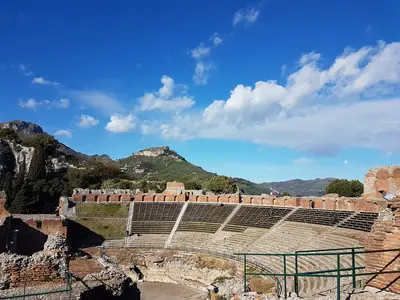
    Taormina is located on the east coast of Sicily, about 200 meters above the Ionian Sea, between Messina and Catania. From here, views stretch along the coast to Mount Etna. Its main attraction is the ancient theatre, originally built by the Greeks and later modified by the Romans. The Corso Umberto runs through the old town, passing palaces, churches, and Piazza IX Aprile. Below the town are Mazzarò and the bay of Isola Bella. Since the 19th century, Taormina has been an international resort; it is accordingly crowded in summer.
    Trapani

    Trapani

    Trapani is located in the far west of Sicily on a narrow, sickle-shaped peninsula that juts out into the sea. Its old town, with its churches and palaces, stretches to the Torre di Ligny at its very tip. To the south of the city lie the salt pans with their windmills; above the city, on a mountain, is medieval Erice, which you reach by cable car. From the port, hydrofoils and ferries depart for the Egadi Islands. Trapani is also known for its Good Friday procession of the Misteri and for couscous with fish.

    Sights in Sicily

    Discover the most important sights and attractions

    Villa Romana del Casale
    Museum

    Villa Romana del Casale

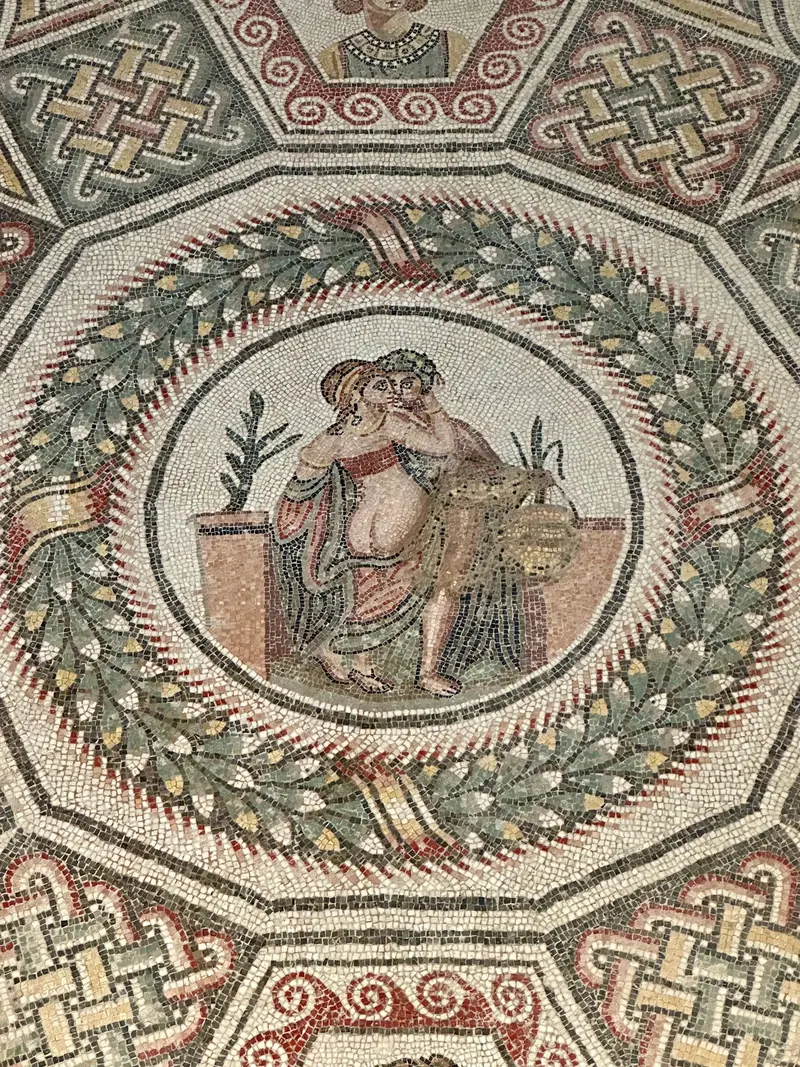
    A 4th-century Roman villa near Piazza Armerina in the island's interior, a UNESCO World Heritage Site since 1997. Approximately 3500 square meters of floor mosaics are preserved, including the Great Hunt and the depiction of young women exercising, known as the "Bikini Girls."
    Open in Google Maps
    Archaeological Park Selinunt
    Museum

    Archaeological Park Selinunt

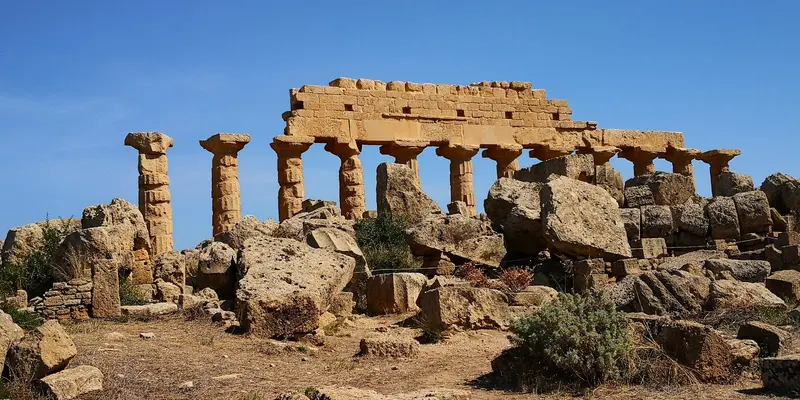
    Ruins of the Greek city of Selinus, founded in the 7th century BC on the southwest coast near Castelvetrano, destroyed by the Carthaginians in 409 BC. On the vast coastal site are the Acropolis and several Doric temples, some restored like Temple E, others as fields of ruins.
    Open in Google Maps
    Monreale Cathedral
    Church

    Monreale Cathedral

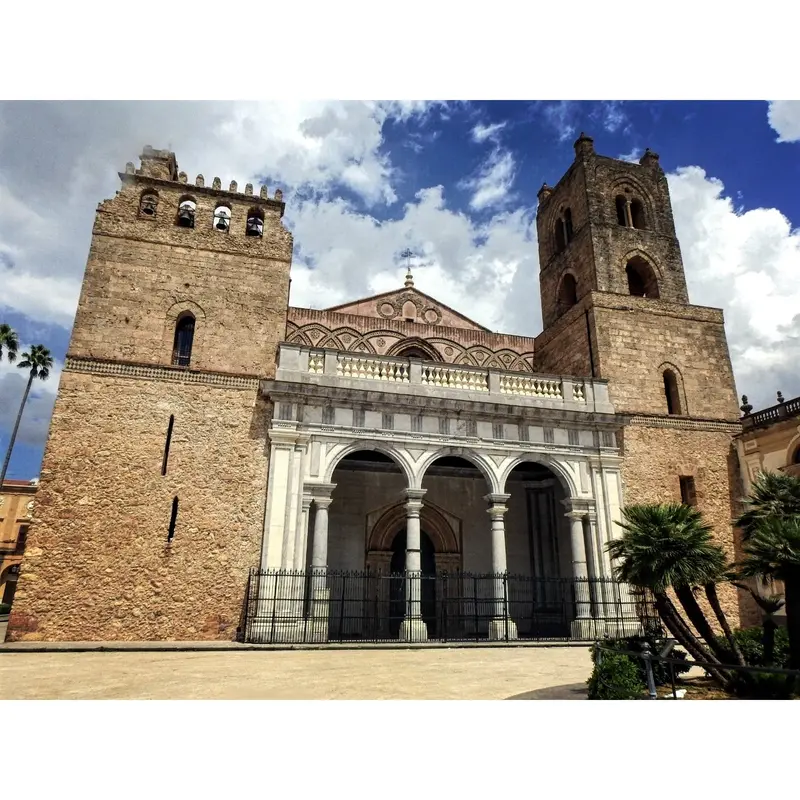
    Norman Cathedral overlooking Palermo, built under King William II from the 1170s. More than 6000 square meters of gold mosaics cover the walls; adjacent lies a cloister with double columns and sculpted capitals. The cathedral has been a UNESCO World Heritage site of Arab-Norman Palermo since 2015.
    Open in Google Maps
    Scala dei Turchi
    Attraction

    Scala dei Turchi

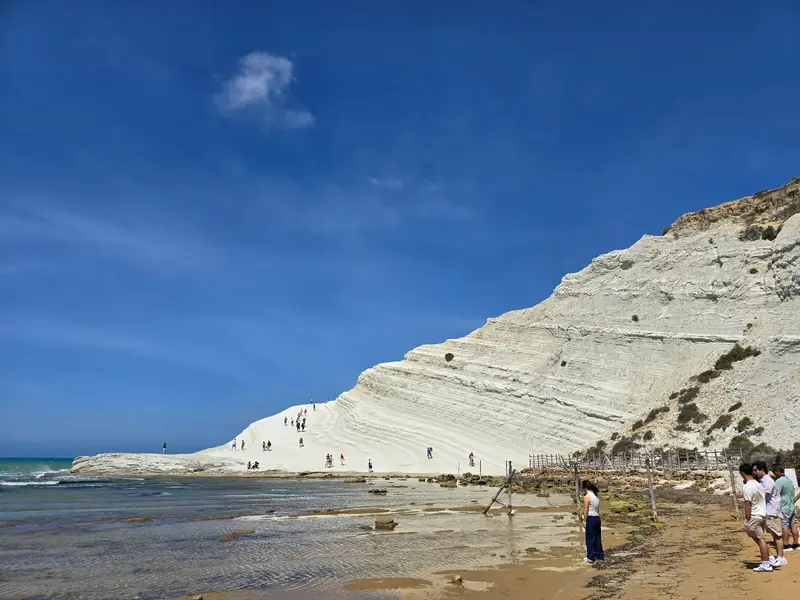
    White marl cliff near Realmonte west of Agrigento, descending in natural steps to the sea. Access is regulated to protect the soft rock; enquire with the Municipality of Realmonte before your visit. The cliff is clearly visible from the adjacent beaches.
    Open in Google Maps

    Food and Drink

    Sicilian cuisine is shaped by Arab, Spanish, and Greek influences. Aubergines, fish, citrus fruits, almonds, and pistachios play a major role.

    Arancini

    Fried rice balls with filling, such as Ragù or ham and cheese. In Palermo, they are called Arancine and are round; in Catania, they are called Arancini and are often pointed.

    Pasta alla Norma

    Pasta with tomato sauce, fried aubergines and salted ricotta, named after the opera by composer Vincenzo Bellini.

    Caponata

    Sweet and sour vegetable dish with aubergines, celery, olives, and capers, often cold as a starter.

    Pasta con le sarde

    Pasta with sardines, wild fennel, raisins and pine nuts.

    Cannoli

    Deep-fried dough rolls with a filling of sweetened sheep's ricotta.

    Granita

    Semi-frozen mix of water, sugar, fruit juice, almonds, pistachios or coffee, traditionally had for breakfast with brioche.

    Nero d'Avola and Marsala

    The red grape variety from the southeast around Avola and wine from its namesake western town.

    History and Culture

    In antiquity, Greeks founded cities like Syracuse, Agrigento, and Selinunte, some of whose temples still stand today. After the Romans and Byzantines, the Arabs conquered the island from 827 onwards, leaving traces in language, place names, and cuisine. The Normans took Sicily in the 11th century; the Kingdom of Sicily was established in 1130. In Norman Palermo, Latin, Greek, and Arabic cultures converged; the buildings, now protected as Arab-Norman World Heritage, bear witness to this.Centuries followed under Aragonese, Spanish, and Bourbon rule. After the earthquake of 1693, the cities in the southeast were rebuilt in the Baroque style. In 1860, Garibaldi's Expedition of the Thousand began in Sicily, and in 1861, the island joined the Kingdom of Italy. Since 1946, Sicily has been an autonomous region. Seven sites on the island are on the UNESCO World Heritage List, and the Sicilian puppet theater Opera dei Pupi is intangible cultural heritage.

    Exploring the Region

    The largest airports are Palermo and Catania, with smaller ones near Trapani and Comiso. Ferries connect Messina with Villa San Giovanni on the mainland, and Palermo with Naples, Civitavecchia, Livorno, and Genoa; crossings from the north usually take one night.Trains run along the north and east coasts, but are slow on many routes. Intercity buses often connect larger cities faster than the train. For the island's interior, nature reserves, and smaller towns, a rental car is most practical. In old town centers, access restrictions (ZTL) often apply, and parking spaces are scarce.

    Round trips through this region

    Sicily East-West

    Sicily East-West

    The route starts in Catania, leads to Taormina and Mount Etna, then south via Syracuse and Noto to Agrigento, and along the north coast via Cefalù to Palermo. For a good two weeks, you'll need a rental car. The longest leg from Noto to Agrigento takes approximately three hours.

    17 Days
    8 stops

    Nearby

    Cefalù

    Cefalù

    Cefalù is located on Sicily's north coast, about 70 kilometers east of Palermo, nestled between a sandy beach and the steep Rocca cliff. The small old town is dominated by the Norman Cathedral, commissioned by King Roger II in 1131 and a UNESCO World Heritage site since 2015. Its narrow streets house the medieval washhouse and the Mandralisca Museum, featuring a portrait by Antonello da Messina. The climb up the Rocca leads to the remains of a castle and offers sweeping views over the town and coast. In summer, Cefalù is crowded and parking is scarce; it's quieter in spring and autumn.
    Agrigento

    Agrigento

    Agrigento lies on a hill on Sicily's south coast, about four kilometers from the sea. Beneath the city lies the Valley of the Temples, the ruins of the Greek city Akragas, a UNESCO World Heritage site since 1997. The Doric temples from the 5th century BC, especially the Temple of Concordia, are among the best preserved in the Greek world. The Archaeological Museum and the Garden of Kolymbethra complement the visit. The Old Town up on the slope is medieval: its main street is Via Atenea; at the hill's highest point stands San Gerlando Cathedral; the Church of Santa Maria dei Greci is also in the Old Town. The Temple Valley has little shade; in summer, you should avoid the hottest hours.
    Palermo

    Palermo

    Palermo, the capital of Sicily, is located on the north coast in the plain of the Conca d'Oro beneath Monte Pellegrino. Phoenicians, Arabs, Normans, Hohenstaufen, and Spaniards have shaped the city, a legacy still visible in its urban landscape today: churches with red domes, Byzantine gold mosaics, Baroque churches, and fountains. Since 2015, nine sites in Palermo, Cefalù, and Monreale have been part of the UNESCO World Heritage Site "Arab-Norman Palermo", seven of which are in Palermo itself. Equally renowned are its markets and street food. With the Cathedral, Norman Palace, and Quattro Canti, most sights are within walking distance.
    Etna

    Etna

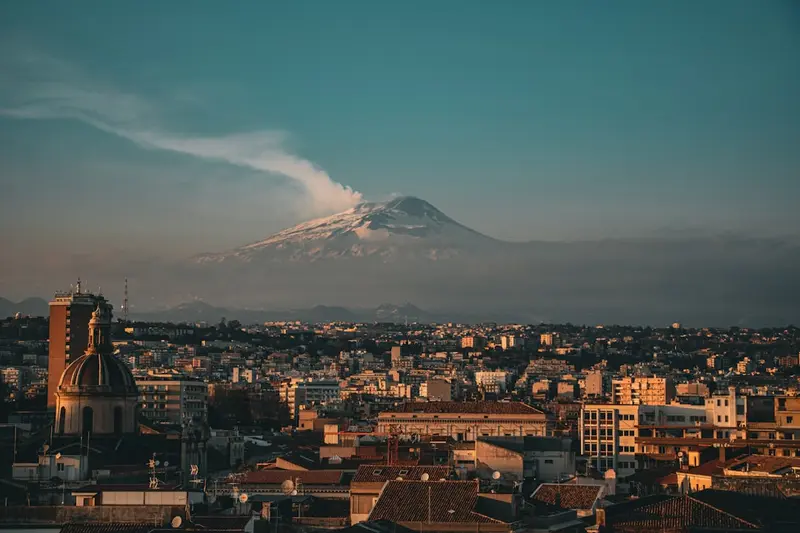
    Mount Etna, on the eastern coast of Sicily, is Europe's highest active volcano, standing over 3,300 meters tall; its exact height changes by several dozen meters with each eruption. Since 2013, it has been a UNESCO World Heritage site. On the south side, a road leads up to nearly 2,000 meters and a cable car to around 2,500 meters. You hike over cooled lava flows, past secondary craters, and gaze out from the upper slopes over the Ionian Coast. On the lower slopes, wine, pistachios, and fruit grow in fertile volcanic soil.
    Catania

    Catania

    Catania is Sicily's second-largest city, located on the east coast at the foot of Mount Etna. Following the major eruption of 1669 and the earthquake of 1693, the old town was rebuilt in Baroque style, often using dark lava rock. Since 2002, it has been part of the UNESCO World Heritage site of the Baroque Towns of Val di Noto. Its focal point is the Piazza del Duomo, featuring the Elephant Fountain and the Cathedral; just next to it is the fish market. In the evenings, many gather in the old town around Via Crociferi. The city's airport serves as a starting point for many travelers exploring Eastern Sicily and Mount Etna.

    Sources & method

    • Photos: Unsplash, Google Maps. Each photo carries its credit.
    • Place data such as addresses and ratings comes from Google Maps.
    • The content is based on web research from public, traceable sources. How the content is made · The role of AI