Fernweh: Home
    ExploreTravel GuidesPlan a tripMy tripLast visited
    de|en
    All Places & RegionsAll highlightsAbout FernwehFAQPrivacy PolicyImprint
    ExploreTravel GuidesPlan a tripMy tripLast visited
    • Overview
    • Places in the region
    • Food culture
    • Culture
    • Getting around
    • Round trips
    • Nearby
    Dolomites

    Italy

    Dolomites

    RegionMountainsNatureCultureFor FamiliesCulinary

    The Dolomites are a mountain range of the Southern Alps in northeastern Italy, spread across South Tyrol, Trentino, Veneto, and Friuli-Venezia Giulia.

    by Felix Gillen

    1. Home
    2. Destinations
    3. Italy
    4. Veneto
    5. Dolomites
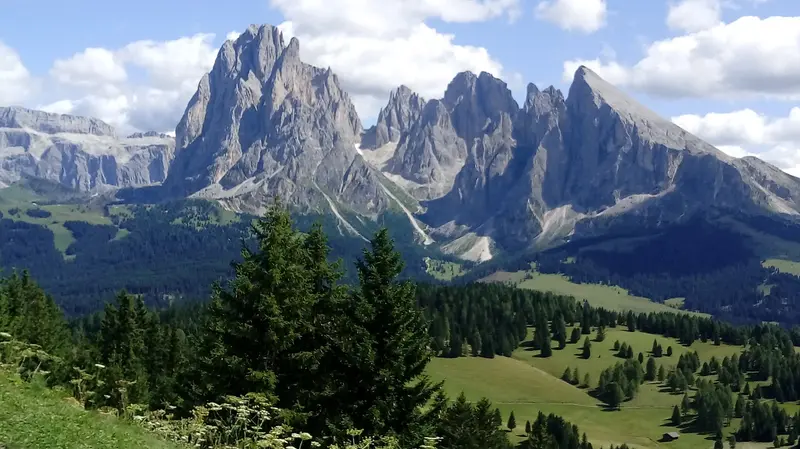
    The Dolomites are a mountain range of the Southern Alps in northeastern Italy, spread across South Tyrol, Trentino, Veneto, and Friuli-Venezia Giulia. Their light limestone and dolomite rocks rise as towers and walls from green alpine meadows; since 2009, they have been a UNESCO World Natural Heritage site. The highest peak is the Marmolada at 3,343 meters, and among the most famous formations are the Three Peaks, the Sella, and the Rosengarten. In summer, hiking trails, via ferratas, and mountain huts attract visitors, while in winter, the ski resorts around the Sella do. In valleys like Val Gardena and Alta Badia, Ladin is spoken alongside German and Italian.
    The Dolomites stretch across parts of Südtirol, Trentino, Venetien, and Friaul. Key starting points are Cortina d'Ampezzo in the east, Gröden and the Gadertal in the center, and the Fassatal in the southwest. Between the valleys, mountain passes like Sella, Grödner Joch, Pordoi, and Falzarego connect the mountain groups. Only the fringes of the area have train connections, such as Bozen, Brixen, Bruneck, or Innichen; from there, you continue by bus. Most mountain huts are open from about June to September, some until early October. In July and August, popular destinations like Pragser Wildsee, Seiser Alm, or Drei Zinnen are heavily visited, with some access restrictions and mandatory reservations.

    More places in Dolomites

    Three Peaks

    Three Peaks

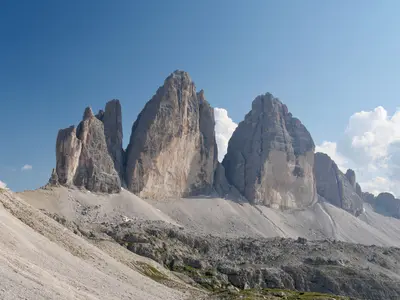
    The Drei Zinnen are three freestanding rock towers in the Sesto Dolomites, on the border between South Tyrol and the Province of Belluno. The Große Zinne reaches 2,999 meters. Their north faces are among the most famous climbing destinations in the Alps; for hikers, the circular trail around the towers is the main objective.HistoryDuring the First World War, the front line between Austria-Hungary and Italy ran through here. Remains of fortifications, tunnels, and paths can be found on Paternkofel and Monte Piana.VisitingMost visitors start at the Auronzo Hut, which is accessible via a toll road from Misurina; an online reservation is required for car access. The huts along the circular trail are generally open from June to September; outside this period, snow may be present on the paths. Check the weather and trail conditions before your tour; current safety and health advisories for Italy can be found via the link to the Federal Foreign Office on the country page.

    Sights in Dolomites

    Discover the most important sights and attractions

    Gardena Valley (Val Gardena)

    Gardena Valley (Val Gardena)

    Ladin valley in South Tyrol with St. Ulrich, St. Christina & Wolkenstein. Known for 400+ years of woodcarving; St. Christina has a large hand-carved nativity scene. Next door lies Seiser Alm, Europe's largest Hochalm, with winter Sellaronda access from Wolkenstein. Langkofel and Sellagruppe stand in the background.
    Open in Google Maps

    Cortina d’Ampezzo , 32043

    Cortina d'Ampezzo, an alpine hub in the Italian Dolomites, is surrounded by UNESCO-protected peaks like Tofane and Monte Cristallo. The town established itself as a sports and tourism center thanks to the 1956 Winter Olympics. Along the Corso Italia, you'll find architecture and shops. The Parish Church of Santi Filippo e Giacomo features a striking bell tower. Cortina serves as a base for hikes in summer and a vast ski area in winter. Our Tip: For panoramic views, take the Faloria cable car. Visit outside peak season (July/August and February/March) for fewer crowds and better morning photos.
    Open in Google Maps

    Laghi ghedina

    The Laghi Ghedina, nestled in the majestic landscape of the Dolomites near Cortina d'Ampezzo, offer an authentic nature experience. This small mountain lake is renowned for its clear, emerald-green water, impressively reflecting the surrounding peaks and dense forests. Historically, the region around the lake was an important site for the local timber industry and offered valley residents a source of recreation. Today, you'll find an oasis of tranquility here, ideal for walks and picnics away from the busier tourist trails. On the shore, there's a small hut offering simple, regional specialties and inviting you to linger. Our Tip: Visit the Laghi Ghedina in the early morning to capture the lake's mirror-smooth surface and the soft morning light for unforgettable photos. To avoid the crowds, a visit outside of peak season is recommended.
    Open in Google Maps

    Food & Drinks

    The cuisine of the Dolomites blends Tyrolean, Ladin, and Italian traditions. At the huts, simple and hearty dishes are cooked for lunch.

    Schlutzkrapfen

    Dumplings with spinach and Topfen, with brown butter and Parmesan.

    Knödel (Canederli)

    Bread dumplings with bacon, cheese or spinach, in broth or as a side dish.

    Casunziei

    Ampezzaner dumplings with beetroot filling, butter and poppy seeds.

    Tirtlen

    Ladin fried dough fritters, filled with sauerkraut or spinach and curd cheese.

    Kaiserschmarrn

    Shredded pancake with lingonberries or applesauce, a staple on many huts.

    Bacon and mountain cheese

    Air-dried ham and cheese from the Alps, often served as a Brettljause.

    Spirit

    In the Dolomites, three language groups meet: Italian, German, and Ladin. Ladin is primarily spoken in Val Gardena, Val Badia, Val di Fassa, Livinallongo, and Cortina. Until 1918, large parts of the area belonged to Austria-Hungary.During the First World War, the front between Austria-Hungary and Italy ran through the mountains. Trenches, tunnels, and via ferratas from the war are preserved in many places, such as at Lagazuoi, Cinque Torri, and Monte Piana.Val Gardena is known for its wood carving. Since 2009, nine Dolomite sub-areas belong to the UNESCO World Natural Heritage.

    Traveling

    Bozen has a small airport for scheduled and charter flights, with larger airports in neighboring regions. You can reach Bozen and Brixen by train via the Brenner line, and Bruneck and Innichen via the Pustertalbahn, which branches off at Franzensfeste. From there, buses run into the valleys.Within the Dolomites, a car offers the most flexibility, but in summer, passes are heavily trafficked and parking at popular destinations is often subject to fees or limited. At Pragser Wildsee, for example, access during peak summer daytime hours is only possible with a reserved parking space, and the toll road to the Drei Zinnen requires an online reservation. In South Tyrol, guests of many accommodations receive a Guest Pass, allowing them to use almost all public transport throughout South Tyrol. Cable cars open up hiking areas and shorten ascents.Weather, rockfall, and snowfields can make tours challenging even in summer. Current safety and health information for Italy can be found via the link to the German Federal Foreign Office on the country page.

    Round trips through this region

    Dolomites Tour

    Dolomites Tour

    From Bozen, the route leads to the Seiser Alm, via the Pustertal to the Pragser Wildsee, then to Cortina d'Ampezzo and the Drei Zinnen. The Seiser Alm is closed to private cars during the day; take the cable car up from Seis. For parking at Pragser Wildsee and the Drei Zinnen toll road, online reservation is recommended in summer.

    12 Days
    5 stops

    Nearby

    Cortina d’Ampezzo

    Cortina d’Ampezzo

    Cortina d'Ampezzo is situated at around 1,200 meters in a wide valley basin of the Ampezzo Dolomites, surrounded by Tofane, Pomagagnon, Cristallo, Faloria, and Sorapiss.Winter and OlympicsThe Olympic Winter Games were held here in 1956, and in 2026, Cortina, together with Milan, will again host the Olympic and Paralympic Winter Games. The ski area is part of the Dolomiti Superski network.Summer in the MountainsCable cars ascend Faloria and Tofana, and from Passo Falzarego, to Lagazuoi. Popular destinations in the vicinity include the Cinque Torri, Lake Misurina, and the Drei Zinnen. During World War I, the front line ran along Lagazuoi, and tunnels and emplacements are preserved to this day.Mountain SafetyWeather and trail conditions in the high mountains change rapidly. Before tours, inquire with local sources; current safety and health advice for Italy can be found via the link to the Auswärtiges Amt on the country page.
    Three Peaks

    Three Peaks

    The Drei Zinnen are three freestanding rock towers in the Sesto Dolomites, on the border between South Tyrol and the Province of Belluno. The Große Zinne reaches 2,999 meters. Their north faces are among the most famous climbing destinations in the Alps; for hikers, the circular trail around the towers is the main objective.HistoryDuring the First World War, the front line between Austria-Hungary and Italy ran through here. Remains of fortifications, tunnels, and paths can be found on Paternkofel and Monte Piana.VisitingMost visitors start at the Auronzo Hut, which is accessible via a toll road from Misurina; an online reservation is required for car access. The huts along the circular trail are generally open from June to September; outside this period, snow may be present on the paths. Check the weather and trail conditions before your tour; current safety and health advisories for Italy can be found via the link to the Federal Foreign Office on the country page.
    Pragser Wildsee

    Pragser Wildsee

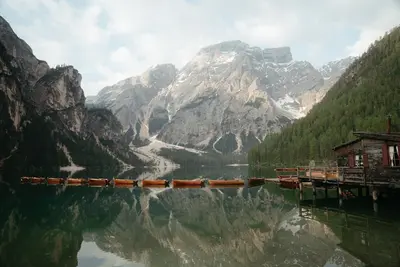
    Pragser Wildsee is situated at 1494 meters in the Pragser Tal, a few kilometers south of the Pustertal between Bruneck and Toblach. It belongs to the Fanes-Sennes-Prags Nature Park and is overlooked by the 2810-meter-high Seekofel. It also became known as a filming location for the TV series “Die Bergpolizei”.VisitA circular path of just under four kilometers leads around the lake in just over an hour. In summer, you can rent rowing boats at the boathouse. The Dolomite High Path No. 1 starts at the lake.Access in High SeasonIn 2026, a traffic regulation was in effect from July 1st to September 15th, between 9 AM and 4 PM: You could only enter the Pragser Tal with a parking space booked online in advance, with a scheduled bus service (also to be booked in advance), on foot, or by bike. The regulation is expected to return in summer 2027; details will be published in spring. Check them on the official website prags.bz before your arrival.
    Seiser Alm

    Seiser Alm

    The Seiser Alm (Alpe di Siusi) is a wide high plateau at roughly 1,680 to 2,350 meters with an area of about 56 square kilometers, and is considered the largest high alpine meadow in Europe. Administratively it is a fraction of the municipality of Kastelruth. Its southern parts belong to the Schlern-Rosengarten Nature Park.SummerA dense network of trails, alpine pastures and huts makes the Alm a destination for families and leisurely hikers. The tours up the Schlern are more demanding.WinterIn winter the Seiser Alm is a ski area with about 60 kilometers of slopes, part of Dolomiti Superski and connected to St. Ulrich in Gröden by a gondola lift.AccessThe road from Seis to Compatsch is closed to private traffic uphill between 9 a.m. and 5 p.m., while you may drive downhill at any time. Since the end of June 2026, an online reservation is mandatory for the parking lots P1 Spitzbühl and P2 Compatsch. The easiest way is to take the cable car from Seis to Compatsch. Guests of accommodations on the Alm receive an access permit from their host. You can find the current rules at Seiser Alm Marketing.
    Bozen

    Bozen

    Nestled in a valley basin at the confluence of the Talfer and Eisack, Bolzano is the capital of South Tyrol. The city is bilingual; unlike the rest of South Tyrol, the Italian language group is in the majority here: In the 2024 language census, about three-quarters of the inhabitants declared themselves part of the Italian language group and about one-quarter part of the German language group.Old TownThe heart of the Old Town features the over 300-meter-long Lauben (arcades) with their merchant houses, the Obstplatz (Fruit Square) with its market, and the Waltherplatz with the Gothic cathedral. Gothic frescoes are preserved in the Dominican Church, while the Franciscan Church boasts a winged altar and a cloister.MuseumsThe South Tyrol Museum of Archaeology exhibits the glacier mummy Ötzi. Additionally, there is the Museion for modern and contemporary art and the Messner Mountain Museum Firmian at Sigmundskron Castle.SurroundingsCable cars lead up to Ritten and Kohlern.

    Sources & method

    • Photos: Unsplash, Google Maps. Each photo carries its credit.
    • Place data such as addresses and ratings comes from Google Maps.
    • The content is based on web research from public, traceable sources. How the content is made · The role of AI