RV Infrastructure
Good facilities for RVs (parking, hookups, etc.)
Campgrounds & RV Parks
Many campgrounds and RV parks available for motorhomes.
RV Routes
Routes and round trips specifically suitable for RVs.
Planning an RV trip to Italy? Here are valuable tips, the best routes, campgrounds, and everything you need for an unforgettable motorhome journey.
Recommended RV Routes
Discover the best round trips and routes in Italy that are perfect for RVs.
Sicily East-West
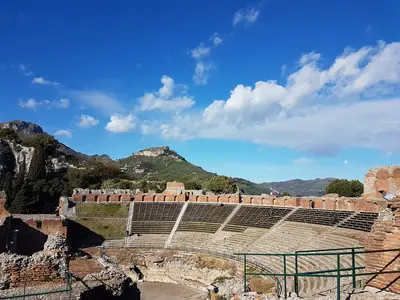
The route starts in Catania, leads to Taormina and Mount Etna, then south via Syracuse and Noto to Agrigento, and along the north coast via Cefalù to Palermo. For a good two weeks, you'll need a rental car. The longest leg from Noto to Agrigento takes approximately three hours.
Tuscany & Umbria Classic
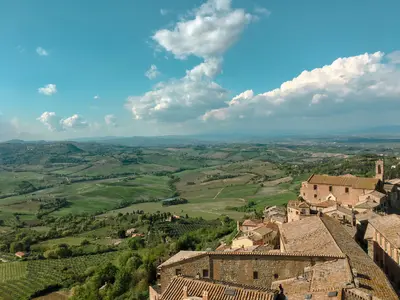
From Florence, via Siena and Montepulciano on the edge of Val d'Orcia, to Umbria and the old towns of Perugia and Assisi. Stages rarely exceed an hour's drive. In the old towns, ZTLs apply; park outside.
Puglia & Salento
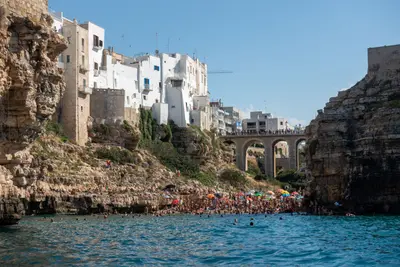
The route leads from Bari via Polignano a Mare, Alberobello and Ostuni into the Salento region to Lecce, Otranto and Gallipoli. The stages are short and rarely last more than an hour's drive. In August, beaches and accommodations are heavily booked.
Places & Regions for RVs
These places and regions in Italy are particularly well-suited for RV travel.

Tuscany
Tuscany is located in central Italy between the Apennine Mountains and the coast of the Ligurian and Tyrrhenian Seas. The region has almost 3.7 million inhabitants, and its capital is Florence. It is home to eight UNESCO World Heritage Sites: the historic centres of Florence, Siena, San Gimignano and Pienza, the Piazza del Duomo in Pisa, the Val d'Orcia, the Medici Villas and Gardens, and Montecatini Terme as part of the Great Spa Towns of Europe.Besides the art cities, wine regions like Chianti Classico, Montalcino, and Montepulciano shape the area, and in the south, the Maremma with its coast, thermal springs, and tufa towns. For the rural areas, you usually need a car.

Dolomites
The Dolomites are a mountain range of the Southern Alps in northeastern Italy, spread across South Tyrol, Trentino, Veneto, and Friuli-Venezia Giulia. Their light limestone and dolomite rocks rise as towers and walls from green alpine meadows; since 2009, they have been a UNESCO World Natural Heritage site. The highest peak is the Marmolada at 3,343 meters, and among the most famous formations are the Three Peaks, the Sella, and the Rosengarten. In summer, hiking trails, via ferratas, and mountain huts attract visitors, while in winter, the ski resorts around the Sella do. In valleys like Val Gardena and Alta Badia, Ladin is spoken alongside German and Italian.

Sardinia
Sardinia is, after Sicily, the second-largest island in the Mediterranean Sea and lies west of the Italian mainland. It is known for its coast with sandy beaches and clear waters, from the Costa Smeralda in the northeast to the bays of the Golfo di Orosei in the east. The island's interior is mountainous and sparsely populated; here stand many Nuraghe, stone tower-structures from the Bronze Age, among which the Su Nuraxi complex near Barumini is a UNESCO World Heritage site. Sardinia has its own language, Sardinian, and in Alghero, an old form of Catalan is still spoken today. Ferries connect the island to Genoa, Livorno, and Civitavecchia, among other places, and airports are located in Cagliari, Olbia, and Alghero.
Travel Climate for RV Trips
Important information about climate, weather, and the best travel time for your RV trip in Italy.
14–21°C·55–85 mm(moderate rain)
Diese Monate bieten meist angenehme Temperaturen, weniger Touristenmassen und ideale Bedingungen für Sightseeing, Outdoor-Aktivitäten sowie Badeurlaub an den Küsten im späten Frühjahr und frühen Herbst.
Italien, ein Land von beeindruckender geografischer Länge und Vielfalt, weist deutliche regionale Klimaunterschiede auf. Die oben genannten Durchschnittswerte stellen eine Annäherung für zentrale und südliche Regionen dar, die bei Reisenden besonders beliebt sind.Norditalien (Alpen, Po-Ebene): Hier herrscht ein kontinentales Klima. Die Winter sind kalt mit Schneefall, besonders in den Alpen, und die Sommer heiß und feucht. Niederschläge sind das ganze Jahr über verteilt, mit Höhepunkten im Frühjahr und Herbst.Zentralitalien (Toskana, Rom): Mediterranes Klima mit milden Wintern und heißen, trockenen Sommern. Die Übergangszeiten sind angenehm warm. Dies ist die Region, auf deren Klimawartungen sich die obigen Monatsdaten am stärksten beziehen.Süditalien (Neapel, Sizilien) & Inseln: Typisch mediterran mit sehr milden, kurzen Wintern und sehr heißen, trockenen und sonnigen Sommern. Die Hitze kann im Hochsommer (Juli/August) intensiv sein, oft über 35°C. Die Wassertemperaturen sind hier am höchsten.Niederschlag: Generell sind die Sommermonate im Süden am trockensten. Im Norden und in den Alpen kann es auch im Sommer zu Gewittern kommen. Herbst und Frühling sind landesweit die regenreichsten Perioden.Windphänomene: Der Sirocco, ein heißer, trockener Wind aus Afrika, kann besonders den Süden und die Inseln im Sommer beeinflussen, wodurch die Temperaturen stark ansteigen und die Luftfeuchtigkeit sinkt. In den Alpen gibt es den Föhn, der zu Temperaturanstiegen führen kann.Für die genaue Reiseplanung ist es ratsam, die Klimadaten für die spezifische Region innerhalb Italiens zu prüfen, die Sie besuchen möchten.
Seasons
Jan
Feb
Mar
Apr
May
Jun
Jul
Aug
Sep
Oct
Nov
Dec
Hauptsaison
Übergangssaison
Nebensaison
Best Time to Visit
▶Show detailed monthly data
| Month | Temp (°C) | Rain (mm) | Sun (h) |
|---|---|---|---|
| January | 7.0 | 65 | 3.5 |
| February | 8.0 | 60 | 4.5 |
| March | 11.0 | 60 | 5.5 |
| April | 14.0 | 65 | 6.5 |
| May | 19.0 | 55 | 8.5 |
| June | 23.0 | 35 | 9.5 |
| July | 26.0 | 25 | 10.5 |
| August | 26.0 | 30 | 9.5 |
| September | 21.0 | 65 | 7.5 |
| October | 16.0 | 85 | 5.5 |
| November | 11.0 | 95 | 4.0 |
| December | 8.0 | 75 | 3.5 |
RV Tips for Italy
Suitability and InfrastructureItaly is well-suited for RV travel. Throughout the country, there are places for overnight stays and services, from simple pitches to well-equipped campsites.Suitability: Especially the coastal regions, the pre-Alps, and the large lakes are suitable for tours with your own or a rented vehicle.Infrastructure: Besides a dense network of campsites, there are Agricampeggi (farm campsites) and designated Aree di Sosta (motorhome parking areas), which are often cheaper and offer supply and disposal (carico/scarico) as well as sometimes electricity.Supply and Disposal: Fresh water and the disposal of grey and black water are available at most campsites and many parking areas. You may only discharge wastewater at designated disposal stations; it is forbidden on public roads and squares. Pay attention to signage or use parking area apps.Regulations, Roads, and CostsOvernight Stays and Parking: Wild camping is prohibited almost everywhere, especially strictly in national parks, nature reserves, and on beaches. According to traffic regulations, an RV may park in regular parking spaces like other vehicles, as long as it rests only on its wheels (no stabilizers), occupies no more area than the vehicle itself (no chairs, no extended awning), and nothing besides engine exhaust is emitted. On paid parking lots, a surcharge for RVs compared to cars may apply. Local prohibitions and restrictions indicated by signs also apply to RVs; adhere to local signage. According to the German Federal Foreign Office, RVs and their contents are repeatedly stolen, especially in unguarded parking lots.ZTL: In many old towns, Zone a Traffico Limitato (ZTL) apply. Accesses are camera-monitored; unauthorized entry leads to fines. Check access rules before entering any city.Roads and Tolls: The Autostrade are well-developed and mostly subject to tolls. For two-axle vehicles, the toll class depends on the height at the front axle: From 1.30 meters, you pay Class B instead of Class A, like a normal car, which includes most RVs. Country roads in the mountains and rural areas are often narrow and winding; historic centers are usually unsuitable for larger vehicles. For RVs over 3.5 tons, lower speed limits apply (100 km/h on motorways, 80 km/h on expressways and outside urban areas).Bicycle Racks: If cargo, such as a bicycle rack with bikes, extends beyond the rear of the vehicle, a red-and-white striped, reflective warning sign (50 × 50 cm) is mandatory, even for racks with their own lighting.Typical Costs: Simple pitches are usually cheaper than well-equipped campsites. During high season, especially in August, prices increase. Check current prices directly with the sites or in parking area apps.Recommended RegionsTuscany: Rolling hills, cypress avenues, and cities like Siena and Florence. There are many Agricampeggi and wineries that welcome RV guests.Dolomites (South Tyrol, Trentino, Veneto): Alpine landscapes and numerous hiking trails, plus well-equipped campsites. Plan ample time for the steep and winding mountain passes.Lake Region (Lake Garda, Lake Como): The major North Italian lakes are very popular and well-prepared for RVs, offering water sports and lakeside towns. However, the lakeside roads around Lake Como are narrow.Apulia: In the “heel of the boot,” you'll find long coastlines, Trulli, and small towns, as well as a good mix of pitches and campsites near the coast.
General RV Travel Tips
Planning Routes
Choose routes that are suitable for RVs. Pay attention to road width, height restrictions, and parking options.
Booking Campgrounds
Especially during peak season, you should book campgrounds in advance. Many RV parks are also available spontaneously.