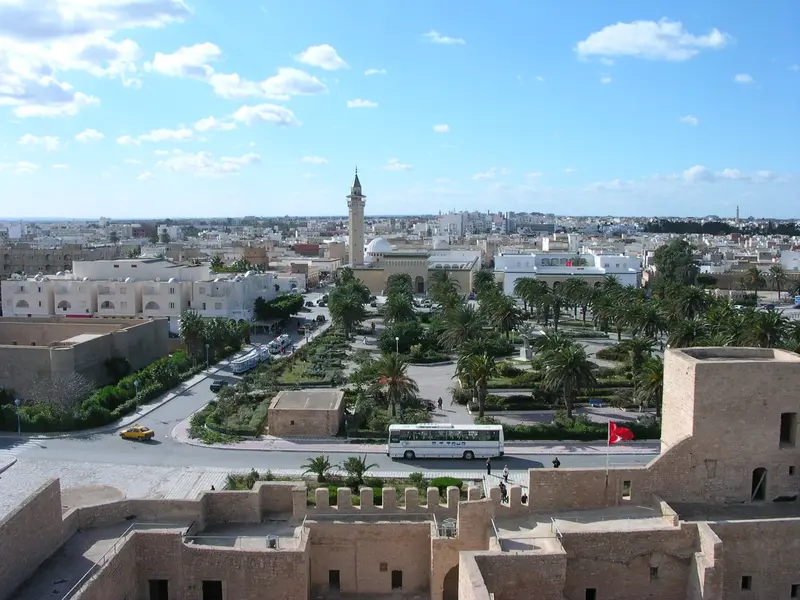
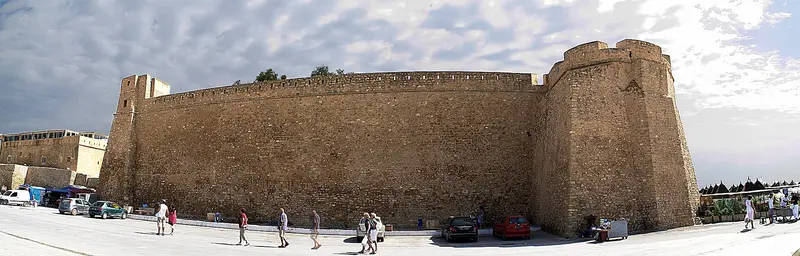
Twelve days through the north and the Sahel: from the medina of Tunis via the ruins of Carthage and Dougga to Kairouan, on to the amphitheatre of El Djem and down to the coast at Sousse, Monastir and Hammamet. The medina of Tunis, Carthage, Dougga, Kairouan, El Djem and the medina of Sousse are UNESCO World Heritage Sites.
12 Days / 11 Nights
April to June, September to October
9 stops
Why This Route?
The route links Tunisia's key cultural sites with a few days on the beach. Stages are short, all driving is done in daylight, and there is accommodation in every price range.
Hidden Gems
Take the TGM train rather than the car to Carthage and Sidi Bou Saïd
Try makroudh in Kairouan, the date pastry is the city's speciality
Visit El Djem early in the morning, before the coaches from the resorts arrive
Getting there and back
Round trip, returning to where you started
Arrival
Flight · Tunis-Carthage (TUN)Tunis-Carthage airport is on the edge of Tunis; a taxi takes you into the centre. Pick up the hire car only when you leave Tunis.
Departure
Flight · Tunis-Carthage (TUN)
Itinerary
Stop 1 • 3 Nights
Tunis
City
Route highlight
Tunis, Tunisia's capital, lies on the Gulf of Tunis on the country's north coast. Its 698-founded Medina, with souks, mosques, and palaces, became a UNESCO World Heritage site in 1979. East of it, the colonial New Town with Avenue Habib Bourguiba adjoins; 4 km northwest is the Bardo National Museum with Roman mosaics. Tunis-Carthage International Airport is 8 km northeast; the TGM suburban train reaches Carthage and Sidi Bou Saïd in just over half an hour.
Medina and souks, Bardo Museum; base for day trips to Carthage and Sidi Bou Saïd
13 Sights
4 Restaurants
Culture
The Medina
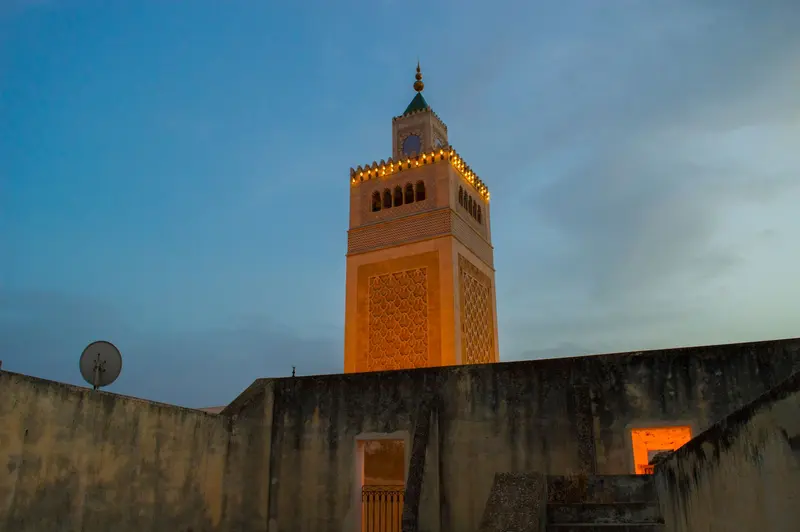
The old city grew from 698 around the Zitouna Mosque and covers approximately 270 hectares. Its alleys do not follow a grid, and the residential buildings are constructed around courtyards. The Medina boasts around 700 historical monuments, including palaces, mosques, mausoleums, madrasas, and fountains.
Guilds and Souks
Souk El Attarine: Perfumers, established around 1240 under the Hafsids on the north side of the Zitouna Mosque
Souk Ech-Chaouachine: Makers of the red Chechia hats, a guild of Andalusian origin
Souk El Berka: Jewelers, established in 1612 as a slave market
Souk El Leffa: Fabrics, woolens, and clothing
Visiting Mosques
Mosques in Tunis are generally not accessible to non-Muslims, including the prayer hall of the Zitouna Mosque. However, structures such as the Tourbet el Bey Mausoleum are open to visitors.
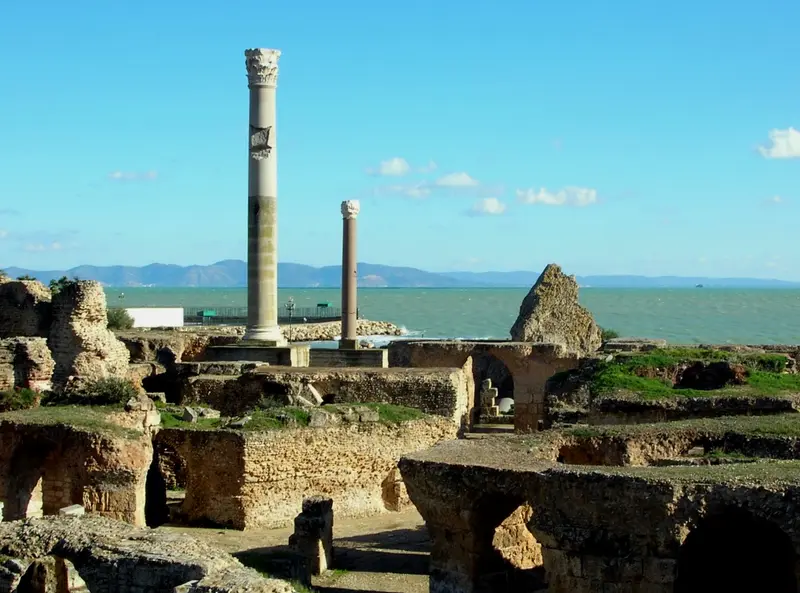
The ruins of Carthage are scattered among residential areas on the coast northeast of Tunis and are directly accessible by the TGM suburban train. Traditionally founded by Phoenicians in 814 BC, the city was destroyed by Rome in 146 BC and later rebuilt as a Roman colony. Since 1979, the archaeological site has been a UNESCO World Heritage site. Visible attractions include the Antonine Baths by the sea, the Punic Ports, the Tophet, and the Amphitheater.
Day trip by TGM train from Tunis
8 Sights
History & Museums
Punic and Roman Carthage
According to legend, the Phoenician princess Dido (Elyssa) founded the city in 814 BC. After the Third Punic War, the Romans completely destroyed it in 146 BC. Augustus refounded it as a Roman colony in 29 BC.
Museums: What's Open
National Museum on Byrsa Hill: closed since 2018; renovation of the museum and Byrsa Hill was put out to tender in summer 2026. No reopening date has been set.
Former Saint-Louis Cathedral (Acropolium): provisionally and partially accessible since March 2024; due to planned works on Byrsa Hill, inquire on site.
Musée Paléochrétien in Dermech: reopened in December 2025 after renovation, featuring finds from late Roman and early Christian times.
Theater and Festival
The 2nd-century Roman theater was largely reconstructed in the 20th century. Today, it hosts the annual Festival International de Carthage, which took place for the 60th time in summer 2026.
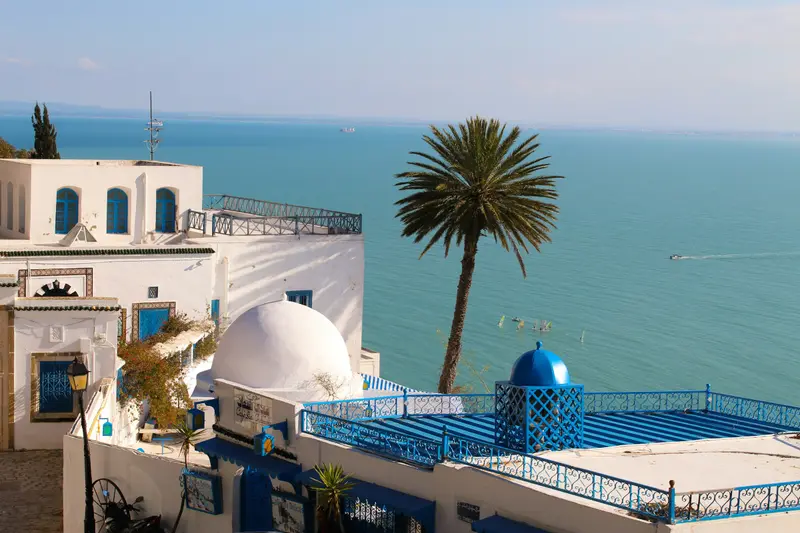
Sidi Bou Saïd is a village on a cliff above the Gulf of Tunis, about 20 kilometers northeast of the capital and directly above Carthage. Its white houses with blue doors have been protected by a 1915 decree, and in July 2026, UNESCO added the village to its World Heritage List. Its alleys host traditional cafes overlooking the bay, and the palace of Baron d'Erlanger. The TGM suburban train takes about 35 minutes from Tunis Marine.
Combine with Carthage, the TGM train stops at both
5 Sights
4 Restaurants
Culture
Blue and WhiteA 1915 decree placed the village under protection, mandated the colors blue and white, and prohibited unregulated construction. This includes courtyards, studded wooden doors, and bougainvillea.Saint, Artists, and World HeritageThe name derives from the scholar Abou Saïd el-Béji (1156 to 1231), who taught on the hill and is buried here. Since the 19th century, artists and writers like Paul Klee, August Macke, Gustave Flaubert, and André Gide have visited. In July 2026, the village was designated as Tunisia's tenth World Heritage site, recognized as a center of cultural and spiritual inspiration in the Mediterranean region.Festivals and Current SituationKharja: In mid-August, religious brotherhoods process through the village.Storm Damage: Following heavy rains in January 2026, parts of the hillside slid, some buildings were temporarily evacuated, and roads were closed. Protective work on the hill was announced from August 2026.
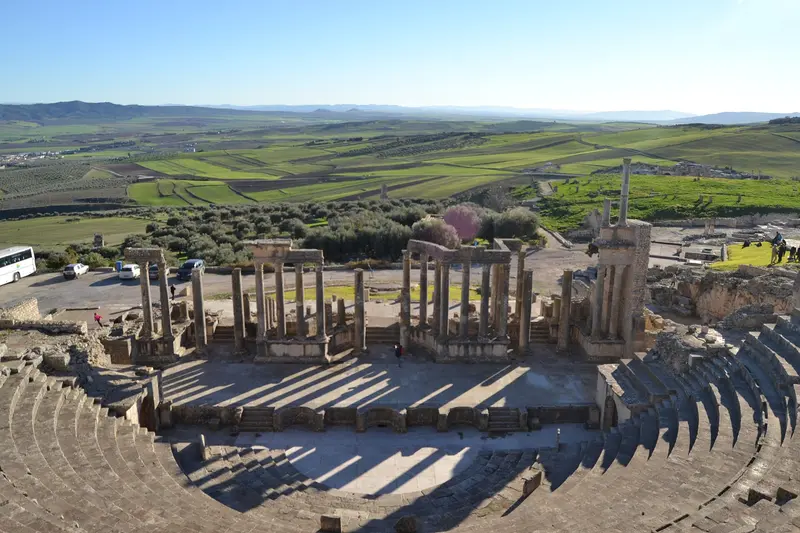
Dougga, ancient Thugga, has been a UNESCO World Heritage Site since 1997 and is considered the best-preserved small Roman town in North Africa. The 75-hectare excavation lies about 110 km west of Tunis, with a Capitol, a theatre and a Numidian mausoleum from the 2nd century BC. Allow at least 2.5 to 3 hours for a walk around the site.
Roman town in the hinterland, on the drive from Tunis to Kairouan
6 Sights
History & Guided Tour
Numidians, Punics, Romans
Long before the Romans, Thugga was a Numidian city. Testament to this is the approximately 21-meter-high Libyco-Punic Mausoleum of Ateban from the 2nd century BC. Its bilingual inscription was broken out by the British consul Thomas Reade in 1842, severely damaging the tomb; the inscription is now in the British Museum.
Tour
Theatre: Built 168/169 AD, approx. 3,500 seats; usually the first stop after the entrance
Capitol and Forum: The temple for Jupiter, Juno, and Minerva from 166/167 AD, next to it the Square of the Compass Rose
Temple of Juno Caelestis: On the outskirts of the city, via a path through an olive grove
Baths: The Licinian Baths from the 3rd century and the Antonine Baths with supply tunnels
Trifolium House: The largest private house of the city excavated to date, named after a clover-shaped room
Practical
Admission: 8 TND for visitors not residing in Tunisia
Opening Hours: Winter 8:30 AM to 5:30 PM, Summer 8 AM to 7 PM, Ramadan 8 AM to 5 PM
Footwear: Paths are paved and sometimes steep; sturdy shoes are better than sandals
Mosaics: The Cyclops Mosaic from the Baths of the Cyclops is now in the Bardo Museum in Tunis
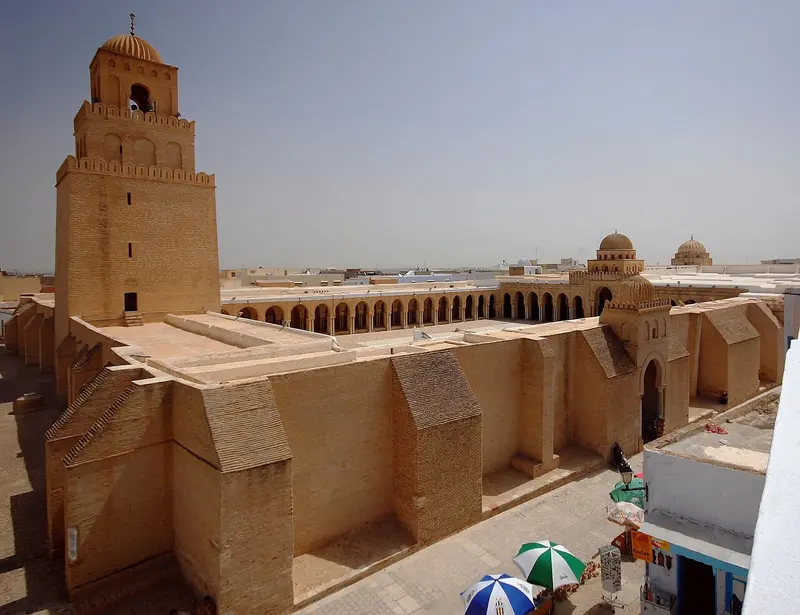
Kairouan is located inland, about one and a half bus hours west of Sousse, and was founded around 670 by Uqba ibn Nafi. Its walled Medina, with the Great Mosque, has been a UNESCO World Heritage site since 1988. The city, with around 173,000 inhabitants (2024 Census), is also known for carpets and the date pastry Makroudh. Kairouan has no train station; buses and louages stop northwest of the Medina.
Great Mosque and medina, UNESCO World Heritage Site since 1988
8 Sights
4 Restaurants
History and Culture
Visiting the Great MosqueAccess: The courtyard is open to all, the prayer hall only to Muslims; you can look inside through the open doorsHours: generally daily for non-Muslims until about 2 PM, shorter on Fridays; please check locallyDress: Shoulders and knees coveredCombined TicketA combined ticket is available for the Great Mosque, the Aghlabid Basins, and other monuments. Price information varies; current prices can be found at the ticket offices.CarpetsKairouan carpets are classified by knots per square meter, from simple quality with 10,000 to 40,000 knots up to extra-fine carpets with up to 490,000. Some shops are located in old townhouses, for example, in the former governor's mansion. A purchase is not obligatory.
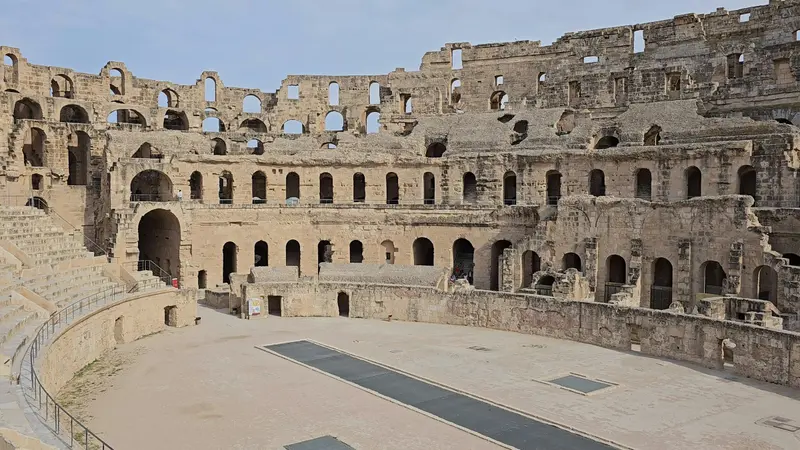
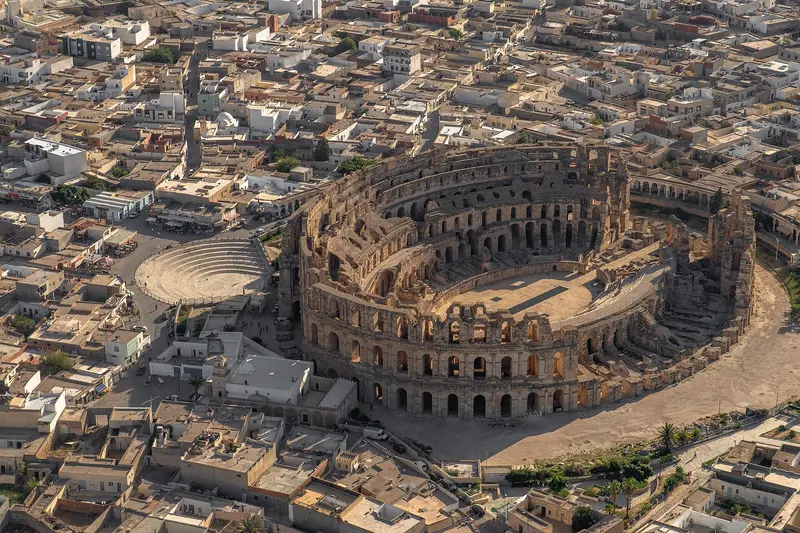
The Amphitheatre of El Djem is one of the largest in the Roman world, situated in a small town in the Sahel, about an hour by train south of Sousse. It was built in the first half of the 3rd century in ancient Thysdrus and has been a UNESCO World Heritage site since 1979. With the same ticket, you can visit the Archaeological Museum with its mosaics and a reconstructed Roman villa.
Roman amphitheatre, on the way to the coast
2 Sights
2 Restaurants
History and Culture
The AmphitheaterDimensions: 148 x 122 meters (external dimensions), Arena 65 x 39 meters, approximately 36 meters highCapacity: Estimates range from 27,000 to 45,000 spectatorsConstruction Period: first half of the 3rd century, the year 238 is frequently citedPredecessors: It is the city's third amphitheater; the two older ones held approximately 6,000 and 7,000 spectatorsLater UseDuring the Middle Ages, the structure served as a fortress. In 1695, Mohamed Bey had a breach made in one of the walls; by 1850, it had been extended to approximately 30 meters. Later, its interior was used for a saltpeter factory, shops, dwellings, and as a grain store.Festival in the AmphitheaterSince 1985, summer concerts of the Festival international de musique symphonique d'El Jem have taken place. The 39th edition ran from July 11 to August 15, 2026; the program appears each June.
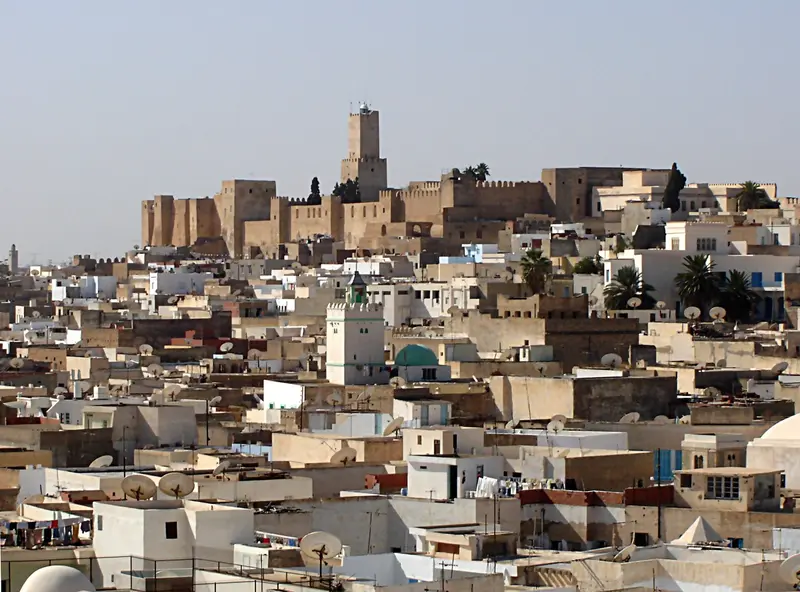
Sousse, with around 240,000 inhabitants (2024 census), is the largest city in the Sahel, on the east coast, a good two-hour train ride south of Tunis. Its walled Medina, with its Ribat and Great Mosque, has been a UNESCO World Heritage site since 1988; the Archaeological Museum in the Kasbah displays mosaics from Roman villas. To its north are the hotel zone and Port El Kantaoui marina. Medina, museum, and port are reachable by foot; the Metro du Sahel runs from Bab Jedid to Monastir and Mahdia.
Medina, UNESCO World Heritage Site since 1988; trip to Monastir
7 Sights
5 Restaurants
History and Culture
Aghlabid MedinaThe Ribat, Kasbah, and Great Mosque largely originate from the 9th century, the era of the Aghlabid dynasty. The Ribat attained its present form in 821 under Emir Ziyadat Allah I, and the Great Mosque was built in 850/851.Ancient HadrumetumBeneath the modern city lies Roman Hadrumetum. The mosaics in the Archaeological Museum, which come from its villas, constitute the country's largest collection after the Bardo in Tunis.Good to KnowAttire: In the Great Mosque, shoulders and knees must be covered; wraps are available at the entrance.Opening Hours: Mosque open mornings only; Ribat and museum open into the afternoon, longer in summer; check current times locally.Nickname: In Tunisia, Sousse is known as the Pearl of the Sahel.
Monastir, located on the east coast between Sousse and Mahdia, has an international airport offering connections to many Western European countries. The city is the birthplace of Tunisia's first president, Habib Bourguiba; his golden-domed mausoleum and the Ribat, dating from 796, define its cityscape. The Medina, Ribat, and Marina are close together and easily reachable on foot, while Sousse is about 20 minutes away by louage.
Half-day trip from Sousse
5 Sights
3 Restaurants
History and Culture
The RibatThe Abbasid governor Harthama ibn A'yan had the coastal fortress built in 796. Since 1958, it has housed a museum of Islamic art.The Ribat served as a film set, including for Monty Python's “Life of Brian” (1979) and the TV series “Jesus of Nazareth”.The City of BourguibaHabib Bourguiba was born in Monastir and was Tunisia's first president. His mausoleum was built starting in 1963 during his lifetime; he has been interred here since his death in 2000.Good to knowClothing: For the mausoleum, cover shoulders and kneesCash: Credit cards are not accepted everywhere outside of hotelsRamadan: Many eateries not geared towards tourists do not open during the day
Hammamet is located approximately 60 kilometers south of Tunis and is the most important seaside resort in the Cap Bon region. Its small, walled medina with the kasbah is right on the beach, and in summer, visitors also come for the festival at Villa Dar Sébastien.The city, with around 91,000 inhabitants, stretches along the coast as a hotel belt: Hammamet Nord, the center around the medina, and Hammamet Sud, with Yasmine Hammamet and its marina about six kilometers southwest of the old town.
Medina by the sea and beach days to finish
6 Sights
5 Restaurants
History and Culture
Medina and Kasbah
The Medina is the historic core of the city; its walls were completed around the mid-13th century. The Kasbah dates back to an 893 fortress and was significantly expanded under the Hafsids around 1463. Its bastions and walls predominantly originate from the 16th and 17th centuries.
Tour: From the Kasbah walls, you can overlook the Medina, beach, and fishing boats.
Dar Khadija: This three-story museum recounts approximately 2,000 years of city history and features a rooftop terrace.
Dar Sébastien and the Festival
The Romanian George Sebastian had a villa built in Hammamet after the 1929 stock market crash. In 1962, he sold it to the Tunisian state, and an open-air theatre was added to the garden in 1964.
Today: The villa houses the Centre culturel international de Hammamet, featuring exhibitions.
Festival international de Hammamet: Held every summer in the open-air theatre, the 60th edition in 2026 ran from July 11 to August 13, featuring 32 performances from 12 countries.
The Roman Pupput
Emperor Commodus elevated the site to a Roman colony between 185 and 192. A large part of the ancient city disappeared under hotel constructions in the 1960s.