Fernweh: Home
    ExploreTravel GuidesPlan a tripMy tripLast visited
    de|en
    All Places & RegionsAll highlightsAbout FernwehFAQPrivacy PolicyImprint
    ExploreTravel GuidesPlan a tripMy tripLast visited
    Canal du Midi

    France

    Canal du Midi

    Point of InterestCultureFor Families

    The Canal du Midi is an approximately 240-kilometer-long 17th-century waterway between Toulouse and the Étang de Thau, and has been a UNESCO World Heritage site since 1996.

    by Felix Gillen

    1. Home
    2. Destinations
    3. France
    4. Occitania (Occitanie)
    5. Canal du Midi
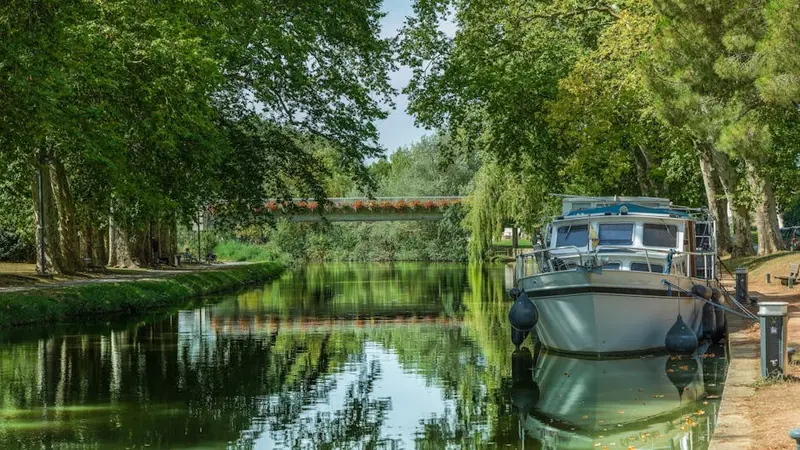
    The Canal du Midi is an approximately 240-kilometer-long 17th-century waterway between Toulouse and the Étang de Thau, and has been a UNESCO World Heritage site since 1996. Locks, bridges, and aqueducts line the way, which you can explore by houseboat or bicycle along its towpaths.

    Places of Interest

    Discover the most important sights and attractions

    Fresque La révolte vigneronne de 1907

    The Fresque La révolte vigneronne de 1907 is one of the murals on the Béziers fresco tour. It commemorates the 1907 Languedoc winegrowers' revolt against wine adulteration and declining wine prices, an event that profoundly shaped the region. Our tip: The mural can be easily combined with the other frescoes on the Béziers tour; a map is available at the tourist office.
    Open in Google Maps

    Fresque le Chemin de Compostelle

    The Fresque Les Chemins de Compostelle is part of the fresco tour in Béziers. The mural highlights a branch of the Camino de Santiago, the Via Tolosana, passing through the region, and depicts pilgrims and symbols like the scallop shell. Our Tip: Combine the mural with the other frescoes on the tour through Béziers.
    Open in Google Maps

    Fresque les 9 Écluses

    The Fresque les 9 Écluses is a mural from Béziers' fresco trail, depicting the Fonserannes Lock Staircase on the Canal du Midi. This 17th-century structure, planned by Pierre-Paul Riquet, overcomes an approximately 21-meter height difference with eight chambers. Our Tip: After viewing the mural, a visit to the real lock staircase on the western outskirts of the city is worthwhile.
    Open in Google Maps

    Fresque Personnalités de Béziers

    The Fresque Personnalités de Béziers is a mural on Béziers' fresco route. It portrays figures linked to the city's history and culture. Our Tip: Study city history beforehand to recognize more figures. A tour map is available at the tourist office.
    Open in Google Maps

    Dining & Drinks

    Le Repas de Gargantua

    Bar in CR 21 Le Cayrou.
    Show on Google Maps

    L'Ambassade

    Restaurant in 22 Bd de Verdun.
    Show on Google Maps

    Maison Alaryk – Brasserie – Distillerie - Liquoristerie artisanales

    Bar in 2 Rue des Poiriers.
    Show on Google Maps

    La Gorge Fraîche Brasserie Artisanale Canal du Demi

    Bar in 2 Av. Joseph Lazare.
    Show on Google Maps

    La plancha des halles

    Bar in Pl. Pierre Semard.
    Show on Google Maps

    Food and Drink

    Wine villages and market towns line the canal. Houseboat travelers can buy supplies at the moorings; however, the selection varies widely by location.

    Cassoulet

    The bean stew follows the canal from Toulouse via Castelnaudary to Carcassonne. Castelnaudary, right on the water, is widely considered its origin.

    Wines of Minervois

    North of the Canal, between Carcassonne and Béziers, lies one of the larger red wine regions of the Languedoc. Many estates are within walking distance of the moorings.

    Oysters from Étang de Thau

    At its eastern end, the canal opens into the Thau Lagoon, where oysters and mussels are cultivated. In Bouzigues, you can dine right by the water.

    Weekly markets en route

    Trèbes, Homps, Le Somail, and Capestang have markets that are great to include in a boat trip. Market days vary, so check the local map.

    The History of the Canal du Midi

    The Canal du Midi is a 17th-century engineering marvel. Under Louis XIV, Pierre-Paul Riquet had it built between 1666 and 1681. The goal was to create a connection from the Atlantic to the Mediterranean, together with the Garonne, and to avoid the long, perilous sea route around the Iberian Peninsula.Among its most famous structures are the Fonserannes Lock Staircase, the Malpas Tunnel, one of the first navigable canal tunnels, as well as numerous aqueducts and canal bridges. Many of these structures are still in operation today. The canal is fed by an ingenious water system from the Montagne Noire.For centuries, the canal served for goods transport, particularly grain and wine, and shaped the development of the towns and villages along its banks. Since 1996, it has been a UNESCO World Heritage site. Today, it primarily serves leisure navigation: houseboats and cyclists have replaced the barges. Many of the plane trees along its banks had to be felled due to a fungal disease and are gradually being replaced by other tree species.

    Traveling on-site

    On the Canal du Midi, slow travel is paramount. Larger towns along the canal like Toulouse, Castelnaudary, Carcassonne, and Béziers have train stations suitable for arrival and departure. The towpath is popular with cyclists and walkers, and you can rent bicycles and e-bikes in several locations. However, some sections are unpaved.On the canal itself, you travel by houseboat, which doubles as accommodation and can be rented without a boat license. In rural areas, buses are infrequent, so you should pre-book taxis. Plan transfers in advance, especially if you're traveling a one-way route.

    Accommodations in Canal du Midi

    Find perfect stay in Canal du Midi

    Booking.com* (Affiliate link)
    Search Hotels
    Agoda* (Affiliate link)
    Search Hotels
    Airbnb
    Vacation Rentals

    * Affiliate link: if you book through it, we earn a small commission. The price stays the same for you.

    Campgrounds in Canal du Midi

    Find perfect campground in Canal du Midi

    Search via Google Maps
    Campgrounds nearby (15km)
    Camping.info
    Find Campgrounds
    Park4Night
    RV Parks & Camping

    Nearby

    Béziers

    Béziers

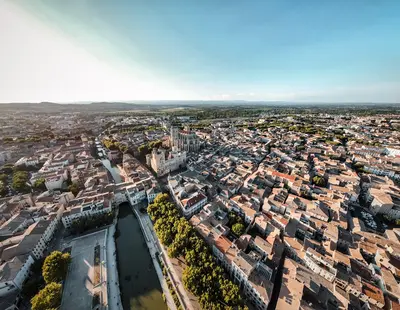
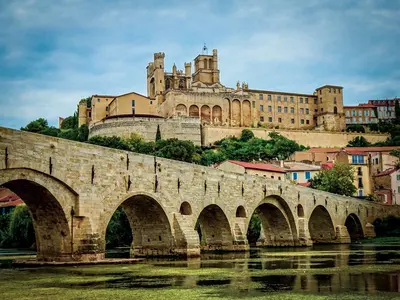
    Béziers is considered one of France's oldest cities. Its heritage spans from Roman roots to the Albigensian Crusade, which severely impacted the city in 1209. From Saint-Nazaire Cathedral on the hill, you look out over the Orb Valley and the Languedoc vineyards. On the city's edge, the Canal du Midi tackles a major elevation difference at the Fonserannes Locks. Additionally, there are plane tree avenues, a market hall, and a lively bar and festival culture.
    Agde

    Agde

    Agde is called the "black city" because of its dark basalt buildings. Its Old Town by the Hérault river dates back to a Greek foundation; a few kilometres further, the seaside resort Cap d'Agde offers sandy beaches and marinas. On the city's outskirts runs the Canal du Midi, a UNESCO World Heritage site, with the Agde Round Lock. Here, history and beach holidays combine.
    Narbonne

    Narbonne

    Narbonne combines Roman history with the everyday life of a southern French town. Running through the heart of the old town is the Canal de la Robine, a branch of the Canal du Midi and part of its UNESCO World Heritage site. Here you'll find an unfinished Gothic cathedral, the Archbishop's Palace, a lively market hall, and Narbo Via, a modern Roman museum. The city is also a great base for excursions to the coast and the Corbières.
    Gruissan

    Gruissan

    Gruissan is a former fishing village on the Mediterranean coast of Languedoc, a few kilometers southeast of Narbonne. The old village center is laid out in a circle around the ruins of the Tour Barberousse, surrounded by lagoons, salt marshes, and the La Clape limestone massif. On the beach of Gruissan-Plage stand the famous wooden chalets on stilts, and the frequent wind makes the place a destination for wind and kitesurfers.
    Sète

    Sète

    Sète is often called the "Venice of Languedoc": Canals, an active fishing port, and Mont Saint-Clair shape this port city between the Mediterranean and Étang de Thau. You'll come for its maritime history, the water jousting on the canals, and a cuisine starring fish, oysters, and mussels from the lagoon.

    Sources & method

    • Photos: Pexels. Each photo carries its credit.
    • The content is based on web research from public, traceable sources. How the content is made · The role of AI