Fernweh: Home
    ExploreTravel GuidesPlan a tripMy tripLast visited
    de|en
    All Places & RegionsAll highlightsAbout FernwehFAQPrivacy PolicyImprint
    ExploreTravel GuidesPlan a tripMy tripLast visited
    • Neighborhoods & highlights
    • Walking tours
    • Eat & drink
    • Food culture
    • Culture
    • Getting around
    • Accommodation
    • Plan trip
    • Nearby
    Carcassonne

    France

    Carcassonne

    CityCulture

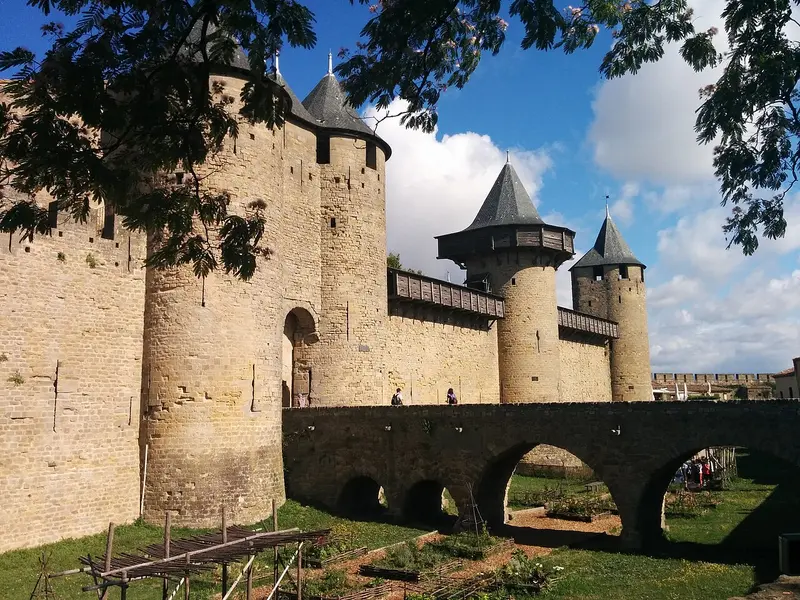
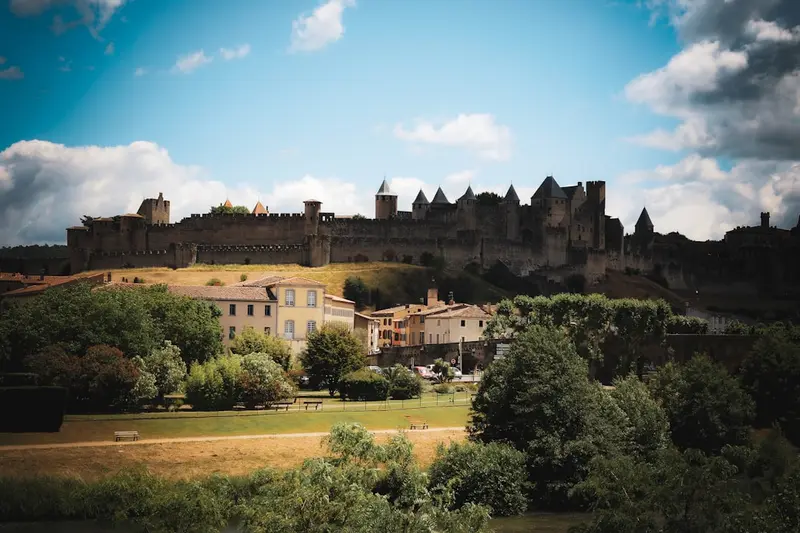
    Carcassonne is renowned for its Cité de Carcassonne, an impressive, double-walled fortress city and a UNESCO World Heritage site.

    by Felix Gillen

    1. Home
    2. Destinations
    3. France
    4. Occitania (Occitanie)
    5. Carcassonne
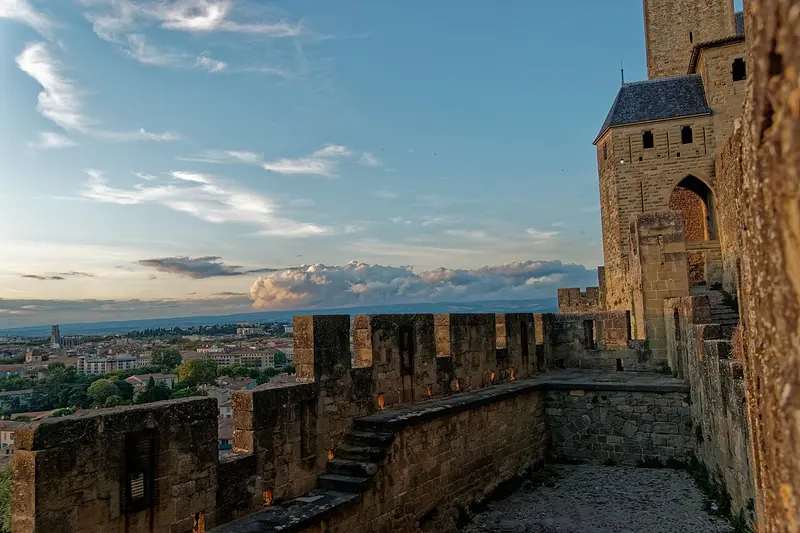
    Carcassonne is renowned for its Cité de Carcassonne, an impressive, double-walled fortress city and a UNESCO World Heritage site. You can explore the imposing defensive structures, whose origins date back to Roman times and which were extensively restored in the 19th century by Viollet-le-Duc. At the heart of the Cité are the Château Comtal and the Gothic Basilica Saint-Nazaire, reflecting the region's rich history, particularly during the Cathar Wars. Beyond the historic walls, the Ville Basse, the lower town, offers insights into modern French city life. For a more relaxed experience, visiting during the off-season is recommended to avoid the crowds. A practical tip is to ascend the walls in the late afternoon to witness the sunset over the landscape.

    Sights in Carcassonne

    Discover the most important sights and attractions

    1Camp Médiéval

    The Camp Médiéval in the Cité of Carcassonne is a small, free exhibition on daily life in the Middle Ages. Staged scenes show, for example, a monk copying manuscripts, a nobleman and a farmer with their tools; there are also armors, swords, and other weapons. The site is primarily aimed at families with children, and a play area is included. Our tip: Opening hours vary by season; outside of holidays, it's often only open on weekends.
    Open in Google Maps
    Cité von Carcassonne

    2Cité von Carcassonne

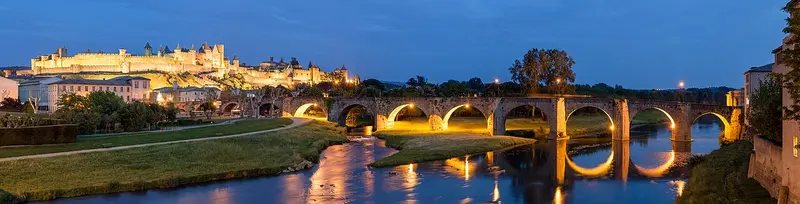
    The Cité of Carcassonne is one of Europe's most renowned medieval fortified cities and has been a UNESCO World Heritage site since 1997. Its history dates back to Roman times, but its current form is largely due to its expansion in the 13th century after the Albigensian Crusade, when it became a royal border fortress. The double ring wall is approximately three kilometres long and features 52 towers. Inside are the Château Comtal, the former count's castle, and the Basilica of Saint-Nazaire, with Romanesque and Gothic architectural elements. Its present appearance, such as the pointed slate roofs of the towers, largely stems from the 19th-century restoration by Eugène Viollet-le-Duc. Our Tip: The alleys are less crowded early in the morning or late in the afternoon. For the best view of the entire fortress, head to the Pont Vieux over the Aude.
    Open in Google Maps
    Château Comtal

    3Château Comtal

    The Château Comtal is the castle within the Cité of Carcassonne. The Trencavel family had it built in the 12th century; after its acquisition by the French Crown, it was heavily fortified in the 13th century to secure the border with the Kingdom of Aragon. The various construction phases are still clearly visible.During your visit, you'll gain access to the courtyards, parts of the ramparts, and several towers. An exhibition explains the history of the Cité and its restoration by Viollet-le-Duc in the 19th century; a 12th-century Romanesque wall painting is also on display. From the ramparts, you look out over the roofs of the Cité and the surrounding landscape. Your castle ticket also grants access to sections of the city walls that are otherwise not accessible.Our tip: Arrive right at opening time in the morning and buy your tickets online to save yourself the queue.
    Open in Google Maps
    Porte Narbonnaise

    4Porte Narbonnaise

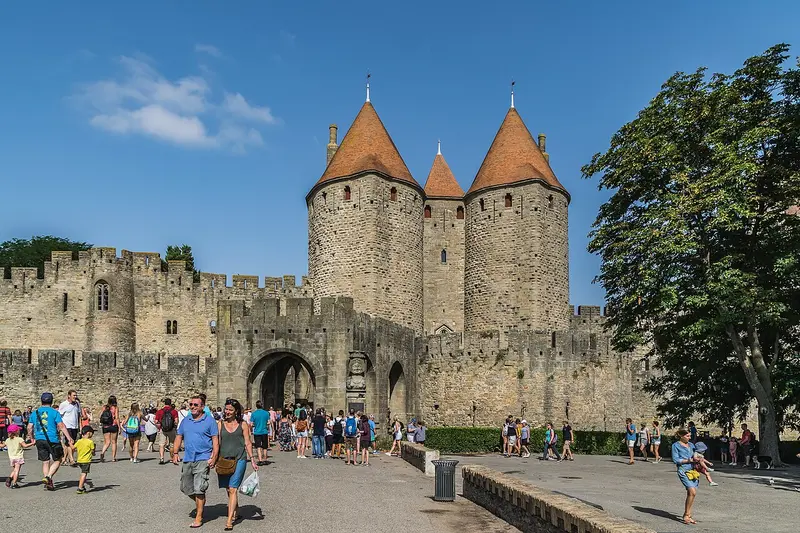
    The Porte Narbonnaise is the main gate of the Cité of Carcassonne and for most visitors, the entrance to the fortified city. The gate was built around 1280 under King Philip III, when the crown massively expanded the fortifications after the annexation to France. Two mighty towers flank the passage, which was once secured by a drawbridge, portcullis, and murder holes. It controlled the eastern access to the Cité, the road from Narbonne. In the 19th century, like the entire complex, it was restored by Viollet-le-Duc. Our Tip: Early in the morning or late in the afternoon, it is quieter here. You can take the best photo of the gate complex from the forecourt outside the walls.
    Open in Google Maps
    Porte d’Aude

    5Porte d’Aude

    Berühmtes Tor mit Flussblick und Teil der erhaltenen mittelalterlichen Stadtmauer.
    Open in Google Maps

    City walks in Carcassonne

    Curated walking tours through the city's highlights, handpicked by experienced travel journalists.

    Carcassonne: The Living Heart – From the Bastide to the Canal du Midi

    Discover Carcassonne's vibrant city life beyond the medieval walls. This walk takes you through the charming Bastide Saint-Louis, the busy center of the town, and along the idyllic Canal du Midi, a UNESCO World Heritage Site. Experience another facet of the town with its local culture, 13th- to 19th-century architecture and picturesque waterways.

    ~2 Std.
    Open in Google Maps
    Stops (7)

    Food and Drinks

    Restaurant La Marquière

    Restaurant in 13 Rue Saint-Jean.
    Show on Google Maps

    La Table de Franck Putelat - Carcassonne

    Stilvolle Zimmer und Suiten in einem High-End-Hotel mit modernem Restaurant.
    Show on Google Maps

    Barrière Truffes

    Bar in 16 Côte de la Cité.
    Show on Google Maps

    Café Saillan

    Bar in 31 Rue du Dr Albert Tomey.
    Show on Google Maps

    restaurant le chaudron

    Restaurant in 6 Rue Saint-Jean.
    Show on Google Maps

    Food & Drink

    Carcassonne boasts its own Cassoulet variant and lies between two wine regions. In the Cité, the cuisine is touristy; in the lower town, it's more authentic.

    Cassoulet de Carcassonne

    The local version traditionally features lamb, while Toulouse opts for sausage and Castelnaudary for duck confit. This dispute is part of the regional culture.

    Wines from the Minervois and the Corbières

    North and south of the city are two large appellations with robust red wines made from Syrah, Grenache, and Carignan.

    Blanquette de Limoux

    The sparkling wine from Limoux, some 25 kilometers south, has been produced since the 16th century and is one of France's oldest.

    Market in Lower Town

    Place Carnot hosts a market three mornings a week. Locals shop here, not in the Cité.

    Carcassonne: A journey through history

    Carcassonne is primarily known for its Cité Médiévale, an imposing fortified city whose origins date back to Roman times. However, it largely acquired its current form in the Middle Ages, particularly during the Crusades against the Cathars in the 13th century. At that time, the city played a key role in the conflict between the French monarchy and the lords of Southern France and was annexed by the French king in 1247, subsequently serving as an important border fortress.Architecturally, the Cité impresses with its double fortification wall featuring 52 towers, a masterpiece of medieval military architecture. Inside are the Château Comtal, the count's castle, and the Basilica of Saint-Nazaire and Saint-Celse, which combines elements of Romanesque and Gothic architecture and is known for its impressive stained-glass windows. In the 19th century, the heavily dilapidated fortress was extensively restored under the direction of architect Eugène Viollet-le-Duc, a measure that saved it from complete decay and shaped its iconic present-day silhouette.Although the Cité itself functions as a living museum of its past, local traditions of the Languedoc-Roussillon region, such as an awareness of Occitan language and culture, are also palpable. Historical events and legends, like that of Dame Carcas, shape the cultural memory and are often featured in local events and guided tours.

    Exploring locally

    You best explore the Cité and the Ville Basse on foot; from the train station in the lower town, it's about 30 minutes to the fortress, the last part is uphill. City buses also run between the station, lower town, and Cité, with additional shuttle buses in season. Taxis are also available. For excursions to the Cathar castles, Limoux, or the Corbières, you'll need a car. The Canal du Midi passes directly by the station.

    Accommodations in Carcassonne

    Find perfect stay in Carcassonne

    Booking.com* (Affiliate link)
    Search Hotels
    Agoda* (Affiliate link)
    Search Hotels
    Airbnb
    Vacation Rentals

    * Affiliate link: if you book through it, we earn a small commission. The price stays the same for you.

    Campgrounds in Carcassonne

    Find perfect campground in Carcassonne

    Search via Google Maps
    Campgrounds nearby (15km)
    Camping.info
    Find Campgrounds
    Park4Night
    RV Parks & Camping

    Plan your trip to Carcassonne

    Save places, build a route and plan your city trip, all in one place.

    1. 1
      Sunrise over alpine peaks and a sea of clouds
      1234

      Round trip

      12 days · 4 stops

      Saved

      Pick a route

      Pick a ready-made one or save places and plan your own.

      Open bookmarks
    2. 2

      Trip to Carcassonne

      Live
      • 1Camp Médiéval3 days
      • 2Cité von Carcassonne4 days
      • 3Château Comtal5 days
      Budget

      Plan your trip

      The planner sorts stops, days and budget. Plan together in real time.

      Start trip planning
    3. 3
      9:41 No signal
      Carcassonne
      Available offline

      Use it on the road

      Download the guide to your phone and use it on site, even offline.

    Nearby

    Narbonne

    Narbonne

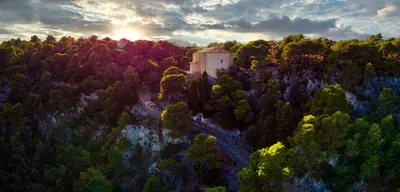
    Narbonne combines Roman history with the everyday life of a southern French town. Running through the heart of the old town is the Canal de la Robine, a branch of the Canal du Midi and part of its UNESCO World Heritage site. Here you'll find an unfinished Gothic cathedral, the Archbishop's Palace, a lively market hall, and Narbo Via, a modern Roman museum. The city is also a great base for excursions to the coast and the Corbières.
    Gruissan

    Gruissan

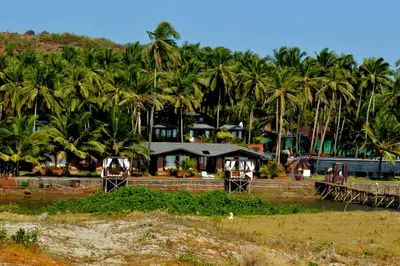
    Gruissan is a former fishing village on the Mediterranean coast of Languedoc, a few kilometers southeast of Narbonne. The old village center is laid out in a circle around the ruins of the Tour Barberousse, surrounded by lagoons, salt marshes, and the La Clape limestone massif. On the beach of Gruissan-Plage stand the famous wooden chalets on stilts, and the frequent wind makes the place a destination for wind and kitesurfers.
    Canal du Midi

    Canal du Midi

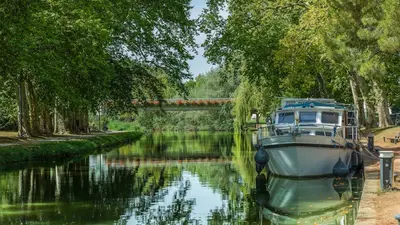
    The Canal du Midi is an approximately 240-kilometer-long 17th-century waterway between Toulouse and the Étang de Thau, and has been a UNESCO World Heritage site since 1996. Locks, bridges, and aqueducts line the way, which you can explore by houseboat or bicycle along its towpaths.
    Béziers

    Béziers

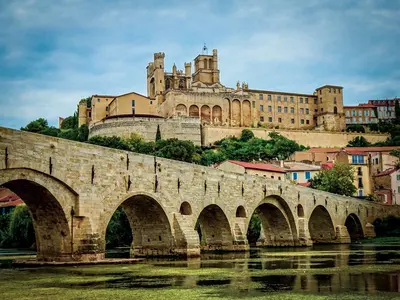
    Béziers is considered one of France's oldest cities. Its heritage spans from Roman roots to the Albigensian Crusade, which severely impacted the city in 1209. From Saint-Nazaire Cathedral on the hill, you look out over the Orb Valley and the Languedoc vineyards. On the city's edge, the Canal du Midi tackles a major elevation difference at the Fonserannes Locks. Additionally, there are plane tree avenues, a market hall, and a lively bar and festival culture.
    Albi

    Albi

    Albi in southwestern France lies on the Tarn and is known for its red brick buildings. The Episcopal City, the "Cité épiscopale", has been a UNESCO World Heritage Site since 2010. At its heart stands the Cathédrale Sainte-Cécile, a massive brick fortress on the outside, decorated inside with wall paintings and a stone rood screen. Right next to it is the Palais de la Berbie with the Musée Toulouse-Lautrec and a terraced garden above the river. Stroll through the lanes of the old town and across the Pont Vieux; the view of the river and the city is at its best in the late afternoon. Allow plenty of time for the museum on Henri de Toulouse-Lautrec, who was born in Albi.

    Sources & method

    • Photos: Wikimedia Commons, Unsplash. Each photo carries its credit.
    • The content is based on web research from public, traceable sources. How the content is made · The role of AI